Credit: © Lunghammer – TU Graz
Researchers at TU Graz have found a way to convert the aromatic substance vanillin into a redox-active electrolyte material for liquid batteries. The technology is an important step towards ecologically sustainable energy storage.
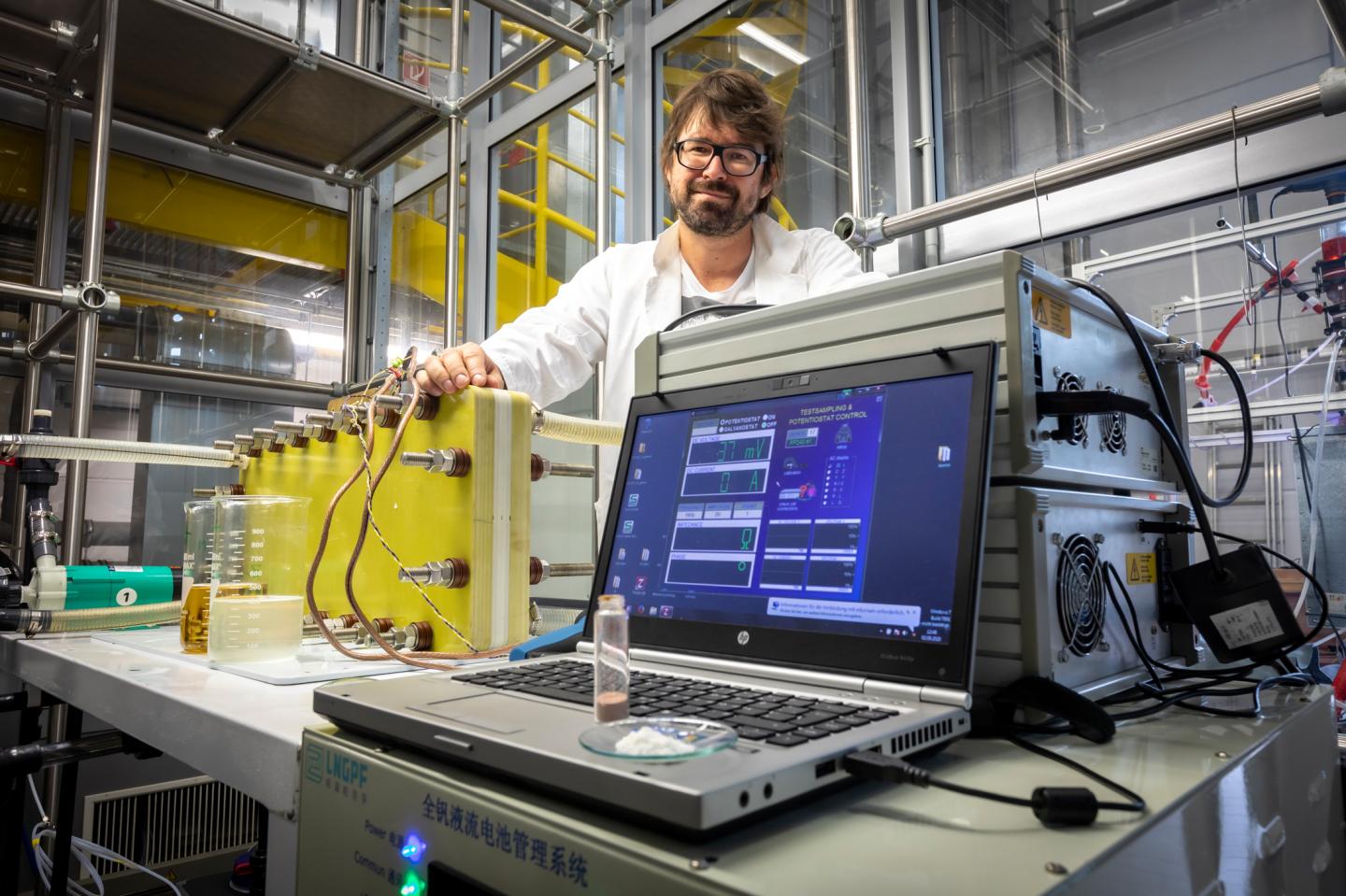
“It is ground-breaking in the field of sustainable energy storage technology,” says Stefan Spirk from the Institute of Bioproducts and Paper Technology at Graz University of Technology. He and his team have succeeded in making redox-flow batteries more environmentally friendly by replacing their core element, the liquid electrolyte, which are mostly made up of ecologically harmful heavy metals or rare earths – with vanillin, an important ingredient of Austrian vanilla croissants.
Sustainable energy storage
Vanillin, a commonly used flavour compound, is one of the few fine-chemicals produced from lignin. Spirk and his team refine lignin into vanillin into a redox-active material using mild and green chemistry without the use of toxic and expensive metal catalysts, so that it can be used in flow batteries. The process works at room temperature and can be implemented with common household chemicals. Vanillin is also present in large quantities. “If you want you can buy it even in the supermarket, but we can also use a simple reaction to separate it from lignin, which in turn is produced in large quantities as waste product in paper production.”
Patenting and commercialisation
The separation and refining process was patented and the successful test results were published in the journal “Angewandte Chemie“.
Now the researchers want to commercialise the technology, especially since the process is highly scalable and suitable for continuous production. Spirk explains: “The plan is to hook up our plant to a pulp mill and isolate the vanillin from the lignin that is left over as waste. Whatever is not needed can subsequently flow back into the regular cycle and be used energetically as usual. We are in concrete talks with Mondi AG, a leading global manufacturer of paper-based products, which is showing great interest in the technology.” For the final implementation, the technology has to be tested in real operation. The company is now looking for energy supply companies that can integrate the start-up’s redox flow technology into its infrastructure and thus relieve the burden on the grid. Spirk is convinced of its future success because: “We can keep the value chain ranging from the procurement of raw materials and components to the generation of electricity on a regional basis, enable storage capacities of up to hundreds of MWh, relieve the strain on the electricity grid and make an important contribution to the green energy storage.
Liquid battery as a piece of the jigsaw puzzle for the energy revolution
Redox flow technology is an important piece of the puzzle for the expansion of renewable energies such as wind and solar power, as it is characterized by the storage of large amounts of energy and can therefore cushion voltage peaks in the power grid. The batteries are also suitable as backup storage for stationary applications such as power plants, hospitals, mobile phone systems or e-fuelling stations. Redox flow batteries are more easily scalable, less toxic, more recyclable and more fireproof than lithium-ion batteries. Other major advantages are their high life expectancy and low self-discharge.
###
Original publication:
Angewandte Chemie International Edition
2?Methoxyhydroquinone from Vanillin for Aqueous Redox?Flow Batteries
Werner Schlemmer, Philipp Nothdurft, Alina Petzold, Philipp Frühwirt, Max Schmallegger, Gisbert Riess, Georg Gescheidt-Demner, Roland Fischer, Stefan A Freunberger, Wolfgang Kern, Stefan Spirk;
DOI: 10.1002/anie.202008253
This research work is anchored in the Fields of Expertise “Sustainable systems” and “Advanced materials science”, two of the five strategic research foci of Graz University of Technology. The work was part of the research project “Lignobatt – Lignin in Redox-Flow Batteries”, which was funded by the Climate and Energy Fund and carried out within the framework of the “Energy Research Programme 2016 – Emerging Technologies” of the Austrian Research Promotion Agency FFG. Project partners at Graz University of Technology were the Institute of Bioproducts and Paper Technology, the Institute of Chemistry and Technology of Materials, and the Institute of Physical and Theoretical Chemistry. The team received external support from the Chair of Chemistry of Plastics at the University of Leoben and from the Mondi companies.
Contact:
Stefan SPIRK
Assoc. Prof. Dr.
TU Graz | Institute of Bioproducts and Paper Technology
Phone +43 316 873 30763
Mobile: +43 664 859 23 73
[email protected]
http://www.
Media Contact
Stefan SPIRK
[email protected]
Original Source
https:/
Related Journal Article
http://dx.