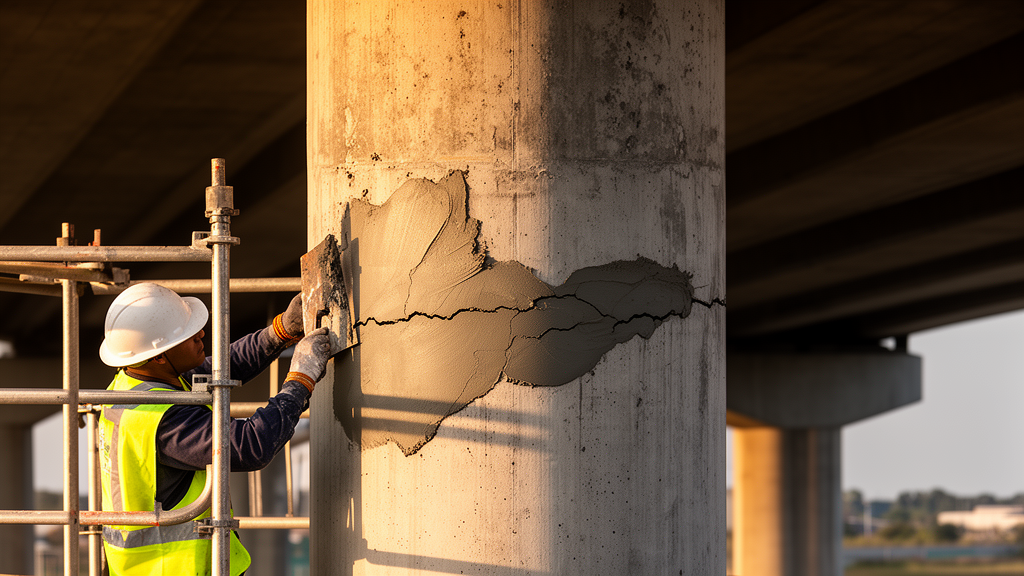
A bendable concrete that stretches more than a hundred times farther than ordinary concrete before cracking is moving from the laboratory into real bridges, according to a new review of two decades of field deployments and laboratory studies of Engineered Cementitious Composites, or ECC. The review, published in Advances in Bridge Engineering, surveys how this fiber-reinforced material has been used in link slabs, composite decks, pavement overlays, pier plastic hinges, shear keys and seismic dampers, and argues that its combination of ultrahigh tensile ductility and self-controlled crack width offers a route to longer-lasting, more resilient bridge infrastructure.
The material’s defining property is its tensile behavior. Typical ECC develops a tensile strain capacity of at least 3 percent, whereas traditional concrete fails in a brittle manner under tension at an ultimate tensile strain of only 0.01 to 0.02 percent, a difference of more than two orders of magnitude. Even cementitious composites incorporating steel fibers generally do not exceed 1 percent tensile strain. These attributes are achieved by tailoring the fiber, the matrix and the fiber-matrix interface within a micromechanical design framework, so that instead of one localizing fracture, the material forms many fine microcracks that carry load through fiber bridging.
Durability follows from the same mechanism. ECC’s cracks are typically held below 0.05 to 0.1 millimeters, in contrast to ordinary reinforced concrete, for which serviceability standards such as China’s GB/T 50010-2010 and Europe’s EN 1992-1-1:2023 generally specify crack widths of 0.2 to 0.4 millimeters. The tight cracks limit the ingress of corrosives, delay deterioration of the material and embedded steel, and promote self-healing. The review’s authors frame this against a sobering infrastructure backdrop: the American Society of Civil Engineers’ 2025 report card graded United States bridges a C and estimated rehabilitation needs at 191 billion dollars, while more than 75 percent of railway bridges in Europe are over 50 years old and approaching the end of their design lives.
Field use of ECC in bridges dates to 2002, beginning with pilot projects in the United States. The review catalogues six distinct functions ECC now serves in a bridge: link slab, composite deck system, plastic hinges and joints, patch repair, transverse shear key infill, and seismic damper. The most mature application is the link slab, a ductile slab that replaces mechanical expansion joints in jointless bridge designs. Expansion joints are persistent trouble spots, suffering concrete cracking in the anchorage zone, aging and detachment of sealing rubber, and fatigue fracture of toothed plates, while water infiltration carries chloride ions to beam ends and bearings, with deicing salts accelerating corrosion. The ECC link slab is deliberately debonded from the steel girder beneath it so its multiple fine cracking can accommodate joint deformation, with shear connectors at its ends providing pull-out resistance and longitudinal restraint.
Laboratory testing summarized in the review shows how design choices tune link slab performance. Under similar reinforcement ratios, hybrid-ECC link slabs containing both steel and polyethylene fibers have a lower ultimate deflection-to-span ratio than slabs with polyvinyl alcohol or polyethylene fibers alone, but the synergy of steel and PE fibers gives them higher flexural stiffness and a service fatigue life of up to 10 million cycles, well beyond the 2-million-cycle baseline in a recent Chinese association standard. Slabs with PVA or PE fibers achieve higher ductility while keeping crack width below 0.15 millimeters, consistent with limits prescribed for chloride-contaminated and corrosive environments. Glass and basalt fiber reinforced polymer rebars have also been proposed as corrosion-resistant alternatives to steel reinforcement, with GFRP-ECC slabs showing improved flexibility and reduced fatigue damage at an optimal reinforcement ratio lowered to 0.72 percent.
Long-term field evidence is a central strength of the survey. After 300 freeze-thaw cycles, ECC retained 76.3 percent of its relative dynamic elastic modulus, compared with 25.1 percent for ordinary concrete and 21.3 percent for hybrid fiber-reinforced concrete. Field studies in China found that after 15 years of service, ECC link slabs retained tensile strain capacities up to 6.29 times higher than requirements while meeting domestic compressive strength code requirements. Under coupled freeze-thaw and carbonation exposure in Qinghai, an eco-friendly ECC maintained sound tensile strength and ductility, held crack widths below 0.03 millimeters and showed evident self-healing potential. A superhydrophobic variant, developed by tailoring the pore network and PVA fiber bridging, has been demonstrated in a pilot-scale link slab on a roadway ramp leading to a parking structure.
Composite bridge decks are a newer frontier. On the Zhadian Bridge in Yunnan, China, an ECC-concrete-steel composite deck was demonstrated in which the 330-millimeter-thick slab comprised a 150-millimeter precast concrete layer, a 130-millimeter field-cast concrete layer and a 50-millimeter field-cast ECC layer confined to the negative moment region to control cost. A hybrid PVA and steel fiber system was formulated there for shrinkage control; it lowered the composite strain capacity to 0.5 percent but improved tensile strength and fatigue resistance. Laboratory work has explored ECC ductile strips within concrete slabs with slanted interfaces to reduce interfacial normal stress, ECC-steel composite girders connected by shear studs, and ECC layers atop orthotropic steel bridge decks to mitigate fatigue damage and reduce stress ranges at welded joints.
The review is candid about failures. On Mihara Bridge in Hokkaido, Japan, an ECC-topped orthotropic steel deck showed significant local damage and irregular flaky spalling in the ECC layer only a few years after entering normal service, with no reliable connection details at the exposed interface. Subsequent research attributed the cracking to a lack of effective interfacial bond and to water accumulating between the ECC and the steel. At Sangen Bridge, also in Hokkaido, water jetting occurred because the anti-corrosion coating on the steel plate compromised the bond, and water trapped by ECC’s tight crack width and low permeability could not escape; the fix was installing water outlets in the underside steel plate. The authors conclude that integrated structural-material design is essential when pairing ECC with steel.
In the substructure, ECC’s ductility is directed at seismic resistance. Post-tensioned piers with precast concrete and ECC segments place the material at the plastic hinge to promote hysteretic energy dissipation and delay damage localization, and a full-size shake table test confirmed enhanced earthquake resistance, with ECC mitigating concrete damage, buckling of longitudinal reinforcement and deformation of cross ties. ECC jacketing, mesh-reinforced composite jackets and sprayed ECC covers confined by FRP jackets extend these benefits to retrofitting, including corroded splash and tidal zones in marine environments. On the Seisho viaduct in Japan, reinforced ECC dampers limited beam-end displacement to prevent unseating during earthquakes while inhibiting chloride infiltration throughout the service life.
The environmental and economic case rests on lifecycle accounting rather than unit price. Although ECC’s production energy is 3.2 times that of ordinary concrete, its reflective-cracking resistance allows overlay thickness to drop from 175 to 65 millimeters, cutting energy consumption by 75 percent and global warming potential by 32 to 37 percent relative to concrete or hot mix asphalt overlays. Replacing steel expansion joints with ECC link slabs is estimated to lower total energy use by 40 percent and solid waste by 50 percent over a 60-year life cycle, and a 30-millimeter self-healing ECC repair layer can cut global warming potential by up to 70 percent versus an 80-millimeter concrete repair. In one 40-year case study, an ECC overlay cost 44.3 million dollars, 39.2 percent less than a concrete overlay and 55.7 percent less than an asphalt overlay, with user cost reduction accounting for 86 percent of the savings. The authors caution that wider deployment is still limited by the absence of design standards, incomplete quantification of long-term strain-hardening under coupled environmental actions, unresolved interface durability, and a shortage of large-scale field data.
Subject of Research: Applications of Engineered Cementitious Composites in durable and resilient bridge infrastructure
Article Title: Emerging deployment of Engineered Cementitious Composites (ECC) for durable and resilient bridge infrastructure
Article References: Hu, M., Liao, H., Cai, X., Li, Y., Li, V. C., & Zhang, D. (2026). Emerging deployment of Engineered Cementitious Composites (ECC) for durable and resilient bridge infrastructure. Advances in Bridge Engineering, 7(1), Article 38. https://doi.org/10.1186/s43251-026-00224-5
Image Credits: AI Generated
DOI: 10.1186/s43251-026-00224-5
Keywords: Engineered Cementitious Composites, ECC, bridge engineering, tensile ductility, crack control, link slabs, composite bridge decks, seismic resistance, durability, lifecycle cost, infrastructure, self-healing
News Source: Beatrice Stafford. (October 28, 2026). Ductile cement composite emerges as durable fix for aging bridges. Scienmag.