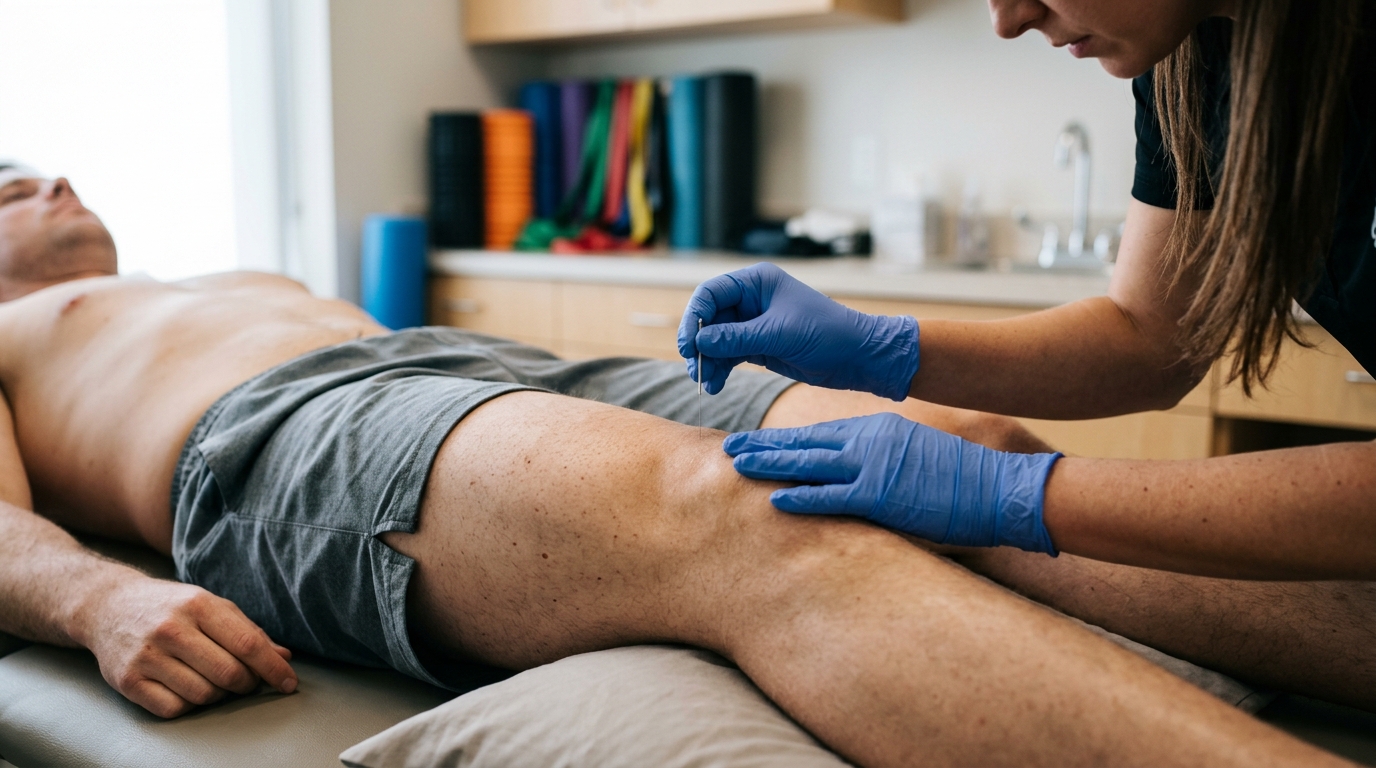
People with patellofemoral pain syndrome, one of the most common causes of knee pain, may gain lasting relief from a treatment that combines dry needling of myofascial trigger points with a simple home stretching routine. A randomised, single-blind, sham-controlled trial published in BMC Complementary Medicine and Therapies found that six weekly sessions of active dry needling targeting the quadriceps, hip adductors and tensor fasciae latae, delivered alongside stretching, outperformed sham needling plus the same stretching programme on both pain and knee function, with benefits that persisted for at least six months.
At week 8, the dry needling group showed a significantly greater reduction in pain than the control group, with a mean difference of −1.18 on the VAS (95% confidence interval −1.60 to −0.77, P < 0.001) and a large effect size corresponding to Cohen’s d of 1.23. Knee function also improved substantially more in the active treatment group, with a mean difference of 5.74 points on the Lysholm scale (95% CI 3.30 to 8.19, P < 0.001, Cohen’s d = 1.08).
Those gains were not fleeting. At the six-month follow-up, the between-group differences remained statistically significant and virtually unchanged: pain scores still favoured dry needling by a mean difference of −1.16 (95% CI −1.58 to −0.75, P < 0.001, Cohen’s d = 1.21), and function scores by 5.75 points (95% CI 3.31 to 8.20, P < 0.001, Cohen’s d = 1.08). The authors conclude that the benefits on pain and function persist for at least six months after the treatment course ends.
Beyond pain and function, the trial examined whether dry needling could correct a neuromuscular deficit often seen in this condition: an elevated hamstring-to-quadriceps peak torque ratio. The H/Q ratio reflects the balance of strength between the muscles at the back and front of the thigh, and an abnormally high value is considered a marker of quadriceps dysfunction. In the dry needling group, the ratio fell from 0.69 to 0.60 over the treatment period, a mean difference of −0.12 (95% CI −0.20 to −0.03, P = 0.009), moving it towards the normal reference range of 0.47 to 0.66. No significant change occurred in the control group.
The researchers note an important nuance here. The overall group-by-time interaction for the H/Q ratio was not statistically significant (P = 0.125), although the secondary week-8 between-group comparison was significant. In other words, the evidence for a needling effect on this strength balance measure is weaker than the evidence for pain and function, and the finding should be read as an association observed in a secondary comparison rather than a confirmed primary outcome.
Secondary outcomes told a consistent story. Active knee flexion range of motion, pressure pain threshold, and isokinetic quadriceps and hamstring peak torque all improved significantly more in the dry needling group than in the control group. Pressure pain threshold, a measure of local tenderness, rose in the actively treated participants, while strength measures in both muscle groups also shifted favourably. Both groups showed comparable adherence to the assigned interventions, and no serious adverse events were reported during the trial.
Patellofemoral pain syndrome is described in the study background as a prevalent knee disorder involving quadriceps dysfunction, deficits in proximal hip control, and myofascial trigger points—irritable, taut bands within muscle that are thought to contribute to pain and movement impairment. Although dry needling, in which a fine needle is inserted into these trigger points without injecting any substance, is increasingly used as an adjunct intervention, evidence on its efficacy for correcting neuromuscular deficits such as the H/Q ratio had remained limited.
The authors state that dry needling targeting quadriceps, hip adductor and tensor fasciae latae trigger points combined with home stretching is superior to sham needling plus stretching for reducing pain and improving function, and that it was also associated with a reduction in the elevated H/Q ratio seen in this patient group.
For clinicians and patients, the trial offers a signal that a short, structured course of trigger-point dry needling may add meaningful and durable benefit to conservative care for patellofemoral pain syndrome, with large effect sizes on pain and function that endure for half a year. The findings come from a single randomised trial of 66 participants, and the strength-balance result rests on a secondary comparison, so independent replication will be needed before the neuromuscular claims can be considered firmly established.
Subject of Research: Dry needling combined with stretching for pain, function and hamstring-to-quadriceps strength balance in patellofemoral pain syndrome
Article Title: Dry needling with stretching improves pain and function in patellofemoral pain syndrome: a randomised sham-controlled trial
Article References: Ma, Y.-T., Liu, Q.-G., Zheng, B.-F., Liu, L., Huang, Q.-M., Zhao, J.-M., & Zheng, Y.-J. (2026). Dry needling with stretching improves pain and function in patellofemoral pain syndrome: a randomised sham-controlled trial. BMC Complementary Medicine and Therapies. https://doi.org/10.1186/s12906-026-05660-4
Image Credits: AI Generated
DOI: 10.1186/s12906-026-05660-4
Keywords: dry needling, patellofemoral pain syndrome, myofascial trigger points, randomised controlled trial, knee pain, stretching, hamstring-to-quadriceps ratio, Lysholm score, visual analogue scale, rehabilitation, complementary medicine, needling
News Source: Ophelia Keating. (November 6, 2026). Dry needling plus stretching eases knee pain and improves function in patellofemoral pain syndrome. Scienmag.