


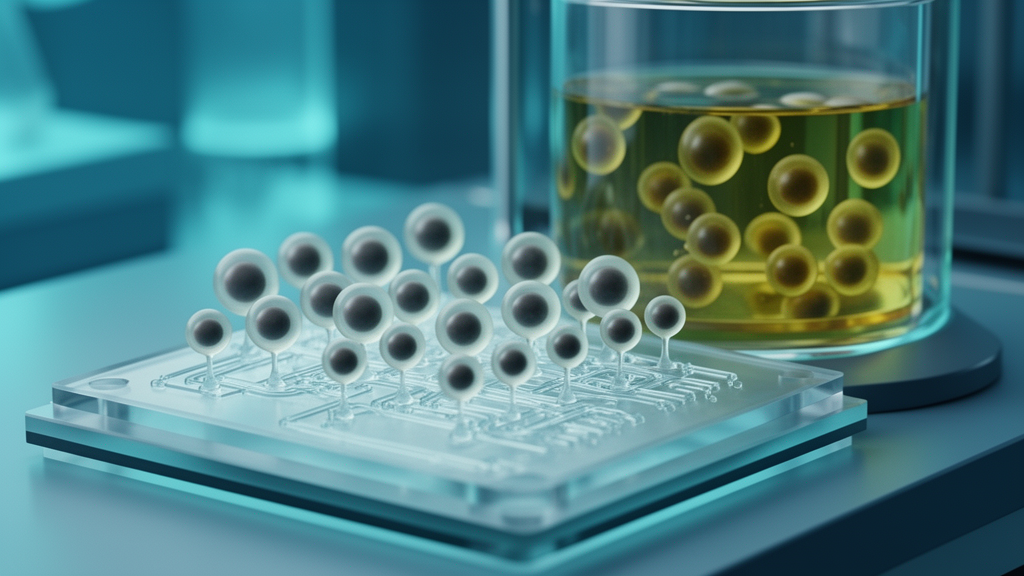
Researchers report a droplet microfluidic platform that produces tumor-laden core-shell hydrogel microspheres at high throughput, offering a new route to three-dimensional in vitro models of non-small cell lung cancer (NSCLC). The work, published in BMC Biotechnology as an open-access research article, addresses a persistent bottleneck in tumor modeling: fabricating large numbers of uniform 3D constructs that reliably recapitulate key structural features of solid tumors, something conventional two-dimensional culture systems cannot do.
The platform is built around a three-channel microfluidic device in which Matrigel serves as the core phase and HAMA, a methacrylated hyaluronic acid, forms the shell. Through coaxial flow combined with shearing by the oil phase, the device generates core-shell droplets that are then stabilized by blue-light photocrosslinking of the HAMA shell. Because the geometry of each droplet is set by fluid dynamics rather than by manual handling, the process lends itself to continuous, scalable production of tumor-bearing microspheres.
A central advantage of the approach is tunability. By adjusting the flow rates of the core, shell, and oil phases, the team obtained core-shell microspheres with controllable size and good uniformity. Under optimized conditions — core and shell flow rates of 10:10 µL/min, an oil flow rate of 200 µL/min, and a HAMA concentration of 4% — the platform generated microspheres approximately 450 μm in diameter. These standardized constructs were then used to build an in vitro NSCLC microsphere model.
The authors performed an initial characterization of the resulting constructs, examining morphology, cell viability, and the response to a model anticancer drug. Compared with a conventional 3D culture approach, the core-shell microspheres showed improved structural integrity and supported cell survival over the tested culture period. The researchers emphasize that these findings demonstrate the feasibility of the microfluidic fabrication strategy for producing tumor-laden core-shell microspheres and suggest its potential as a basis for future in vitro tumor modeling and drug-response studies. As an early-access, peer-reviewed accepted article, the version is subject to further edits before the final Version of Record appears.
Subject of Research: High-throughput droplet microfluidic fabrication of HAMA/Matrigel core-shell hydrogel microspheres for three-dimensional in vitro NSCLC tumor models
Article Title: High-throughput fabrication of HAMA/matrigel core-shell hydrogel microspheres by droplet microfluidics for in vitro NSCLC model
Article References: Wu, Q., Tang, R., Luo, T., Wang, Z., Wang, Y., Zhou, S., Yan, F., Deng, L., & He, L. (2026). High-throughput fabrication of HAMA/matrigel core-shell hydrogel microspheres by droplet microfluidics for in vitro NSCLC model. BMC Biotechnology. https://doi.org/10.1186/s12896-026-01228-9
Image Credits: AI Generated
DOI: 10.1186/s12896-026-01228-9
Keywords: droplet microfluidics, core-shell microspheres, HAMA, Matrigel, hydrogel, 3D tumor model, NSCLC, photocrosslinking, cell viability, drug response, in vitro culture, BMC Biotechnology
News Source: Gregory Coleman. (October 29, 2026). Droplet Microfluidics Yields Uniform Core-Shell Microspheres for 3D NSCLC Models. Scienmag.



