Among the neurotransmitters in the brain, dopamine has gained an almost mythical status. Decades of research have established its contribution to several seemingly unrelated brain functions including learning, motivation, and movement, raising the question of how a single neurotransmitter can play so many different roles.
Credit: Laboratory of Neurophysiology and Behavior at The Rockefeller University
Among the neurotransmitters in the brain, dopamine has gained an almost mythical status. Decades of research have established its contribution to several seemingly unrelated brain functions including learning, motivation, and movement, raising the question of how a single neurotransmitter can play so many different roles.
Untangling dopamine’s diverse functions has been challenging, in part because the advanced brain of humans and other mammals contain different kinds of dopamine neurons, all embedded in highly complex circuits. In a new study, Rockefeller’s Vanessa Ruta and her team dive deep into the question by looking instead at the much simpler brain of the fruit fly, whose neurons and their connections have been mapped in detail.
As in humans, a fly’s dopamine neurons provide a signal for learning, helping them to link a particular odor to a particular outcome. Learning that, for example, apple cider vinegar contains sugar serves to shape the animals’ future behavior on their next encounter with that odor. But Ruta’s team discovered that the same dopamine neurons also correlate strongly with the animal’s ongoing behavior. The activity of these dopamine neurons does not simply encode the mechanics of movement, but rather appears to reflect the motivation or goal underlying the fly’s actions in real time. In other words, the same dopamine neurons that teach animals long-term lessons also provide moment-to-moment reinforcement, encouraging the flies to continue with a beneficial action.
“There seems to be an intimate connection between learning and motivation, two different facets of what dopamine does,” says Ruta, who published the findings in Nature Neuroscience.
Continuous learning
Smells are important to flies. A brain center for olfactory learning, called the mushroom body, is responsible for teaching them which smells signify tasty sugar. There, three types of neurons come together: Kenyon cells that respond to odors, the output neurons that send signals to the rest of the brain, and the dopamine-producing neurons. When the fly encounters an odor and then gets a sugar reward, a quick release of dopamine alters the strength of connections between neurons of the mushroom body, essentially helping the fly to make new associations and change its future response to that odor.
But Ruta and her colleagues have noticed ongoing dopamine signaling even in the absence of rewards. The same neurons that helped the flies learn associations also fired frequently as the animal moved. “That raised the question, are these neurons representing specific aspects of the movement, like how the animal is moving its legs, or are they related to something else, like the goal of the animal?” Ruta says.
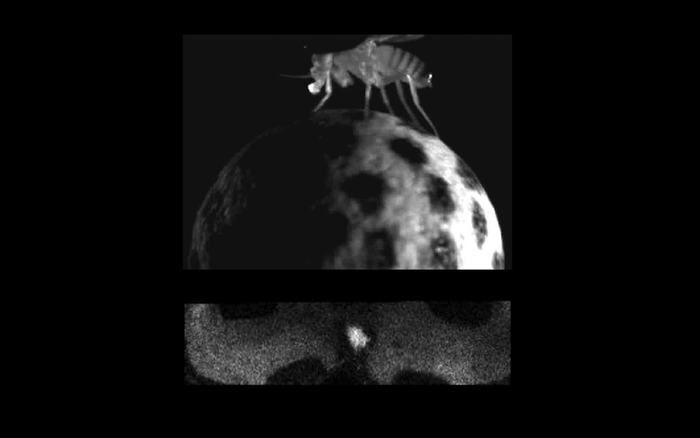
To find out, the team developed a virtual-reality system in which fruit flies can navigate an olfactory environment, walking on a treadmill-like ball while their brain activity is monitored by a microscope over their head. A stream of air delivers odors through a small tube. When the fly gets a whiff of an attractive odor, like apple cider vinegar, it reorients and starts to move upwind, towards the source.
Using this system, the researchers were able to examine the fly’s brain activity under different conditions. They found that the activity of dopamine neurons closely reflects movements as they were happening, but only when the flies engage in purposeful tracking, and not when they are just wandering about.
When the researchers suppressed the activity of the dopamine neurons, the animals diminished their tracking of the odor, even when they were starving and therefore had a heightened interest in food-related smells. In contrast, activating the neurons in food-indifferent, fully fed flies, propelled them into active pursuit of the odor.
Together, the findings reveal how one dopamine pathway can perform two functions: conveying motivational signals to rapidly shape ongoing behaviors while also providing instructive signals to guide future behavior through learning. “It gives us a deeper understanding of how a single pathway can generate different forms of flexible behavior,” Ruta says.
The next step is to understand how the other neurons know what a burst of dopamine means at any given time. One possibility, Ruta says, is that learning is a more continuous, dynamic process than often thought: On short timescales, animals continuously evaluate their behavior at every step, learning not just the final associations, but also the actions that lead them there.
Journal
Nature Neuroscience
DOI
10.1038/s41593-021-00929-y