• HOME
  • NEWS
  • EXPLORE
    • CAREER
      • Companies
      • Jobs
    • EVENTS
    • iGEM
      • News
      • Team
    • PHOTOS
    • VIDEO
    • WIKI
  • BLOG
  • COMMUNITY
    • FACEBOOK
    • INSTAGRAM
    • TWITTER
Saturday, June 27, 2026
BIOENGINEER.ORG
No Result
View All Result
  • Login
  • HOME
  • NEWS
  • EXPLORE
    • CAREER
      • Companies
      • Jobs
        • Lecturer
        • PhD Studentship
        • Postdoc
        • Research Assistant
    • EVENTS
    • iGEM
      • News
      • Team
    • PHOTOS
    • VIDEO
    • WIKI
  • BLOG
  • COMMUNITY
    • FACEBOOK
    • INSTAGRAM
    • TWITTER
  • HOME
  • NEWS
  • EXPLORE
    • CAREER
      • Companies
      • Jobs
        • Lecturer
        • PhD Studentship
        • Postdoc
        • Research Assistant
    • EVENTS
    • iGEM
      • News
      • Team
    • PHOTOS
    • VIDEO
    • WIKI
  • BLOG
  • COMMUNITY
    • FACEBOOK
    • INSTAGRAM
    • TWITTER
No Result
View All Result
Bioengineer.org
No Result
View All Result
Home NEWS Science News Cancer

DNA 'webs' aid ovarian cancer metastasis, study reveals

Bioengineer by Bioengineer
December 19, 2018
in Cancer
Reading Time: 3 mins read
0
IMAGE
Share on FacebookShare on TwitterShare on LinkedinShare on RedditShare on Telegram

IMAGE

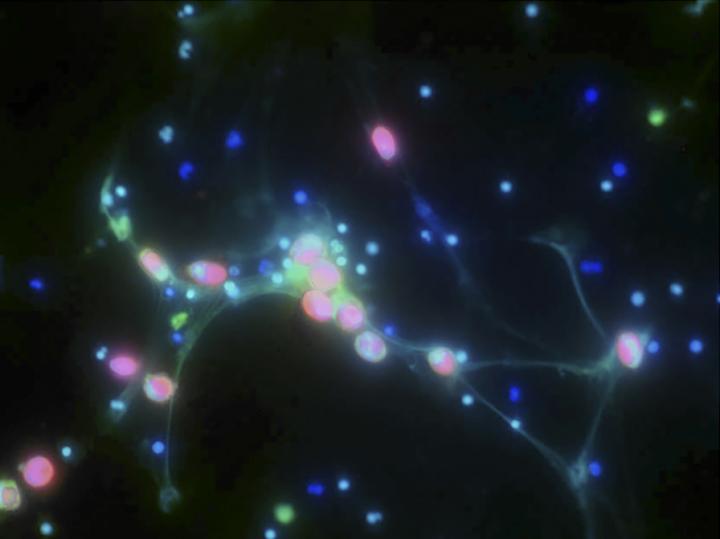
Credit: Lee et al., 2018


Researchers from the University of Texas MD Anderson Cancer Center have discovered that ovarian cancer cells spread, or metastasize, to new tissue after being caught in DNA “webs” extruded by immune cells. The study, which will be published December 19 in the Journal of Experimental Medicine, reveals that preventing immune cells from forming these webs reduces metastasis in mice, suggesting that similar treatments could be used to limit the spread of ovarian cancer in humans.

Ovarian cancer is the fifth leading cause of cancer death in women. Advanced stages of the disease are typically characterized by the spread of cancer cells to the omentum, a fatty tissue that drapes from the stomach and is informally described as the “policeman of the abdomen” due to its role in housing immune cells that can fight off infections in the abdominal cavity. How and why ovarian cancer cells preferentially spread to this tissue is unclear.

A team of researchers led by Dr. Honami Naora at the University of Texas MD Anderson Cancer Center found that, at early stages of ovarian cancer, immune cells called neutrophils accumulate in the omentum and begin to unwind and extrude their DNA in the form of sticky webs. These webs, known as neutrophil extracellular traps (NETs), are normally used to entrap invading microbes. But Naora and colleagues found that NETs can also entrap circulating ovarian cancer cells, allowing them to colonize the omentum.

Naora’s team determined that ovarian cancer cells release proinflammatory molecules that cause neutrophils to accumulate in the omentum and deploy their NETs. But when the researchers prevented NET extrusion by inhibiting a key enzyme required for the process, they reduced the ability of ovarian cancer cells to spread to the omentum in mice.

Currently, the omentum is often surgically removed from patients with early-stage ovarian cancer in an attempt to limit the spread of the disease. But Naora and colleagues suggest that inhibiting NET formation could prevent ovarian cancer metastasis while maintaining the omentum’s protective function within the abdomen. “Our study demonstrates that inhibiting NET formation decreases omental metastasis,” Naora says. “Further studies of this intriguing host defense mechanism could yield new insights into improving ovarian cancer treatment.”

###

Lee et al., 2018. J. Exp. Med. http://jem.rupress.org/cgi/doi/10.1084/jem.20181170?PR

About the Journal of Experimental Medicine

The Journal of Experimental Medicine (JEM) features peer-reviewed research on immunology, cancer biology, stem cell biology, microbial pathogenesis, vascular biology, and neurobiology. All editorial decisions are made by research-active scientists in conjunction with in-house scientific editors. JEM makes all of its content free online no later than six months after publication. Established in 1896, JEM is published by Rockefeller University Press. For more information, visit http://jem.rupress.org/>jem.org.

Visit our http://rupress.org/newsroom>Newsroom, and sign up for a weekly preview of articles to be published. Embargoed media alerts are for journalists only.

Follow JEM on Twitter at @JExpMed and @RockUPress.

Media Contact
Ben Short
[email protected]

Related Journal Article

http://dx.doi.org/10.1084/jem.20181170

Tags: cancerCell BiologyGynecologyImmunology/Allergies/AsthmaMedicine/Health
Share12Tweet8Share2ShareShareShare2

Related Posts

Cracking the Code: How Cancer Evades Antibody-Drug Conjugates and New Strategies to Overcome Resistance

June 25, 2026

MSU Scientists Reveal Mechanism Behind Ovarian Cancer’s Chemotherapy Resistance and Strategies to Overcome It

June 25, 2026

Rare Mixed Liver Cancer Underscores Diagnostic and Therapeutic Challenges

June 25, 2026

How Socioeconomic Factors Shape Lung Cancer Screening Experiences

June 25, 2026
Please login to join discussion

POPULAR NEWS

  • Saying Goodbye to PGY-6: Pediatric Fellowship Realities

    103 shares
    Share 41 Tweet 26
  • Multi-Hospital Study Reveals Long Covid Burden Is Twice as High as Current Estimates

    92 shares
    Share 36 Tweet 23
  • Detection of EDCs in Breast Milk and Infant Urine Up to Six Months Highlights Early Exposure Risks

    77 shares
    Share 31 Tweet 19
  • New Drug Candidate Developed at McMaster Shows Potential for Treating Brain Cancer

    58 shares
    Share 23 Tweet 15

About

We bring you the latest biotechnology news from best research centers and universities around the world. Check our website.

Follow us

Recent News

Tracking Lanthanide-Labeled Microplastics in Plants

POSTECH Researchers Slash Cost of Reconstituted Cell-Free Systems by 95%

AI and Physics Collaborate to Design Advanced Hydrogen Storage Materials

Subscribe to Blog via Email

Success! An email was just sent to confirm your subscription. Please find the email now and click 'Confirm' to start subscribing.

Join 82 other subscribers
  • Contact Us

Bioengineer.org © Copyright 2023 All Rights Reserved.

Welcome Back!

Login to your account below

Forgotten Password?

Retrieve your password

Please enter your username or email address to reset your password.

Log In
No Result
View All Result
  • Homepages
    • Home Page 1
    • Home Page 2
  • News
  • National
  • Business
  • Health
  • Lifestyle
  • Science

Bioengineer.org © Copyright 2023 All Rights Reserved.