In a groundbreaking advance poised to reshape the future of molecular computing, researchers at the Korea Advanced Institute of Science and Technology (KAIST) have engineered an innovative DNA-based molecular computer operating at a scale far beyond conventional semiconductor devices. This new technology merges the computational and memory capabilities within a single molecular system, overcoming a long-standing limitation that has constrained DNA circuits to one-time-use functions. By achieving both information processing and storage at the nanoscale, this breakthrough opens vast potential for bio-computing applications, particularly in fields such as medical diagnostics and biological information technologies.
Historically, DNA circuits have been limited to relatively simple, repetitive tasks—primarily sensing cancer biomarkers or detecting specific molecules—with operation constrained by irreversible chemical reactions. Once the reaction initiated, these systems lost functionality, preventing reuse or sustained computation. Stepping beyond this barrier, the research team led by Professor Yeongjae Choi has demonstrated an intricate DNA-based “bio-transistor,” a molecular equivalent of semiconductor transistors that revolutionizes how bio-circuits can be designed. This molecular bio-transistor serves as a fundamental logic gate that not only processes signals but also simultaneously records outcomes, functioning as a non-volatile memory.
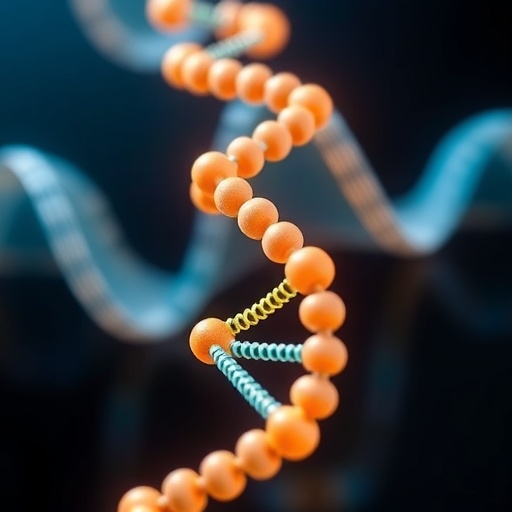
The significance of this development is magnified when one considers the physical limitations currently facing traditional silicon-based semiconductor technologies. As the semiconductor industry approaches the 2-nanometer manufacturing node—a theoretical boundary for miniaturization due to quantum and thermal constraints—the urgent need for alternative paradigms has intensified. DNA molecules, with their nanometric spacing of approximately 0.34 nanometers between adjacent nucleotide bases, present a highly scalable, programmable substrate for ultra-dense information processing. Their inherent base-pairing specificity enables precise reaction control that can be engineered for complex logic operations.
Despite these promising properties, DNA computational circuits have historically grappled with the challenge of volatility and lack of data retention. The conventional systems effectively “burn out” after processing, similar to write-once-read-many memory, which hampers complex, sequential computing. The KAIST team’s innovative approach sidesteps this by designing DNA strands capable of switching between distinct binding configurations in response to specific molecular inputs. These configurations remain stable over time, effectively encoding memory at the molecular level. By stabilizing these states, the DNA circuit operates without an external reset mechanism, facilitating real-time processing and persistent information storage.
This reset-free design is a paradigm shift, enabling continuous, dynamic input processing without initialization delays. The molecular states serve as both a computational record and an active participant in downstream logic, much like how transistors modulate electrical signals while retaining charge states in modern computers. This capability allows for unprecedented complexity and reusability in molecular circuits, advancing molecular logic to realms previously accessible only by electronic devices.
The implications for biotechnology and medicine are profound. Such DNA-based molecular systems could be embedded within living cells for diagnostic purposes, performing real-time logic on biochemical signals to detect and respond to disease markers with high specificity and minimal power consumption. Their nanoscale size and biocompatibility position them as ideal agents for smart therapeutics, enabling autonomous decision-making within biological environments.
This research directly challenges the assumption that molecules are only suitable for simplistic chemical sensors by demonstrating transistor-like behavior—a fundamental electronic device hallmark—within DNA molecules. It extends the frontier of molecular engineering into programmable, multifunctional molecular machines that bridge the gap between chemistry and information technology.
The team, which included KAIST researchers Taehoon Kim, Sangeun Jeong, and Sion Kim, as well as GIST students Woojin Kim and Junho Sim, published their findings in the journal Science Advances. The work was supported by the Future Promising Convergence Technology Pioneer Program, the Ministry of Science and ICT, and the KAIST Quantum+X Convergence R&D Project. The study showcases the synergy between molecular biology and electronic engineering, promising a future where computing extends beyond silicon and into the dynamic, programmable world of DNA.
Professor Yeongjae Choi emphasized the transformative potential of this work by stating, “This research advances the feasibility of implementing molecular computers using DNA. It opens exhilarating new directions for bio-computing and medical technologies by pushing the boundaries of how computation and memory can be realized at the molecular scale.”
As semiconductor scaling hits fundamental physical limits, DNA-based bio-transistors and logic circuits provide a promising avenue for low-power, high-density computation that could redefine computing architecture. Their ability to integrate processing and memory within a single molecular framework offers efficiencies and capabilities unattainable in traditional hardware.
Fundamentally, this study marks a major step toward realizing practical molecular computers capable of interacting seamlessly with biological systems. By developing reset-free DNA logic circuits that can perform real-time input processing and store computation outputs persistently, the researchers have paved the way for future intelligent molecular devices capable of complex functions inside living organisms.
This pioneering work exemplifies how interdisciplinary collaboration—uniting molecular biology, engineering, and computer science—can forge innovations that transcend conventional technological boundaries. As the quest to miniaturize and enhance computing power continues, DNA molecular circuits stand at the forefront, embodying the next generation of nanoscale computational devices.
Subject of Research: Not applicable
Article Title: Reset-free DNA logic circuits for real-time input processing and memory
News Publication Date: Not available (publication date of the article is April 1, 2026)
Web References: http://dx.doi.org/10.1126/sciadv.aeb1699
References: Not provided
Image Credits: KAIST
Keywords: Technology, Molecular Computing, DNA Circuits, Bio-transistor, Nanoscale Memory, Semiconductor Alternatives, Real-time Processing, Reset-Free Logic, Bio-computing, Medical Diagnostics
Tags: advanced DNA computing for biosensingbio-computing in medical diagnosticsDNA bio-circuits for biological informationDNA molecular computer under 2nmDNA-based molecular bio-transistorKAIST DNA computing breakthroughmolecular computing memory integrationmolecular logic gates in bioelectronicsnanoscale bio-computing technologynon-volatile DNA logic gatesovercoming semiconductor scale limitsreusable DNA circuits for computation