Distribution and origin of highly radioactive microparticles in Fukushima revealed
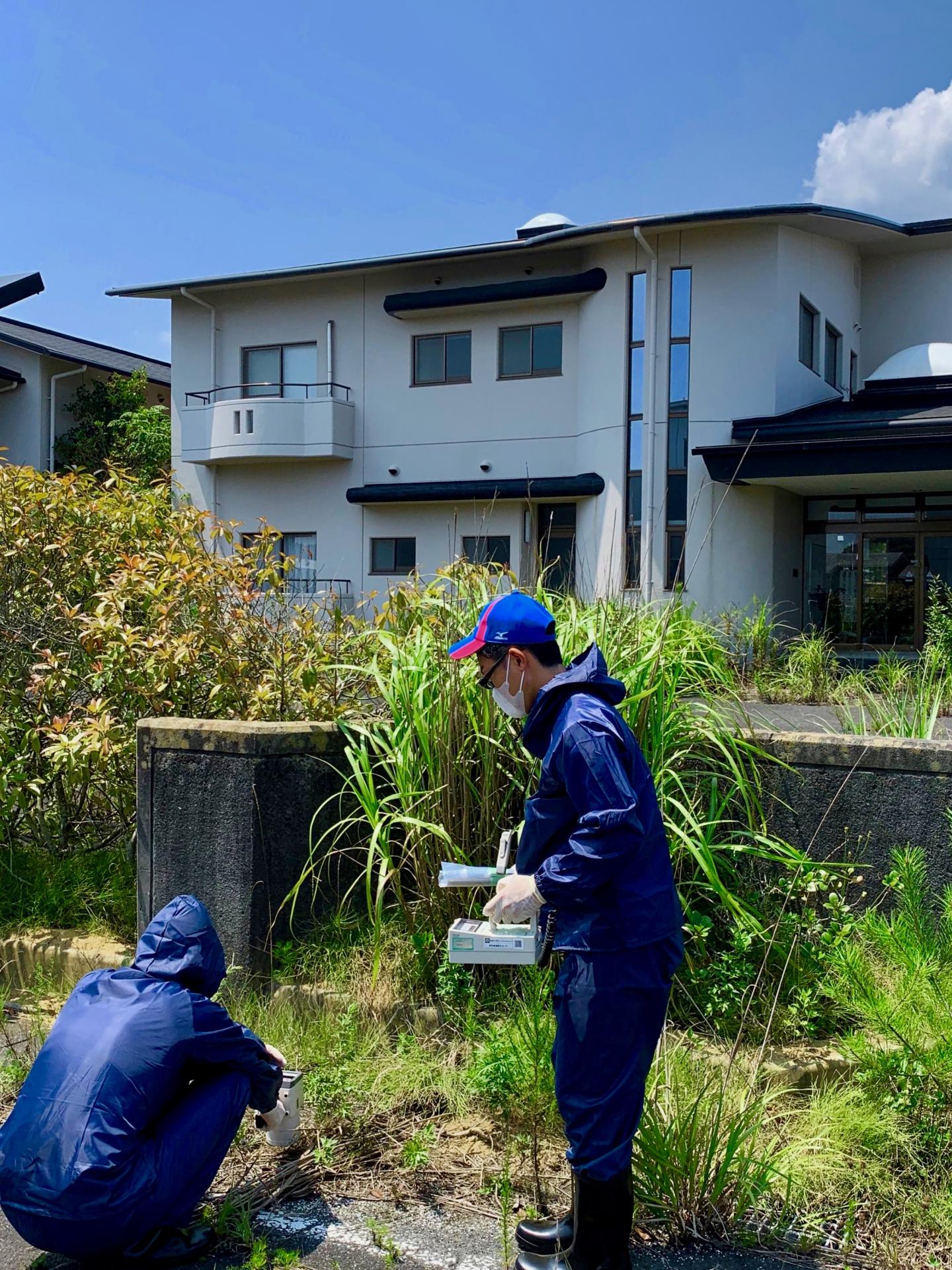
Credit: Satoshi Utsunomiya
New method allows scientists to create a quantitative map of radioactive cesium-rich microparticle distribution in soils collected around the damaged Fukushima Daiichi Nuclear Power Plant Nuclear Power Plant. This could help inform clean-up efforts in Fuksuhima region.
Distribution, number, source, and movement of the microparticles in the environment has remained poorly understood
A large quantity of radioactivity was released into the environment during the 2011 Fukushima Daiichi Nuclear Power Plant accident. The released radioactivity included small, poorly soluble, cesium-rich microparticles. The microparticles have a very high radioactivity per unit mass (~1011 Bq/g), but their distribution, number, source, and movement in the environment has remained poorly understood. This lack of information has made it hard to predict the potential impact of the radioactive microparticles.
However, a study just published in the scientific journal Chemosphere, involving scientists from Japan, Finland, France, and the USA, addresses these issues. The team, led by Dr. Satoshi Utsunomiya, Ryohei Ikehara, and Kazuya Morooka (Kyushu University), developed a method in 2018 that allows scientists to quantify the amount of cesium-rich microparticles in soil and sediment samples.
They have now applied the method to a wide range of soil samples taken from within, and outside, the Fukushima Daiichi nuclear exclusion zone, and this has allowed them to publish the first quantitative map of cesium-rich microparticle distribution in parts of Fukushima region.
Three regions of interest within 60 km from the Fukushima Daiichi site
Dr Utsunomiya states: “Using our method, we have determined the number and amount of cesium-rich microparticles in surface soils from a wide range of locations up to 60 km from the Fukushima Daiichi site. Our work reveals three regions of particular interest. In two regions to the northwest of the damaged nuclear reactors, the number of cesium-rich microparticles per gram of soil ranged between 22 and 101, and the amount of total soil cesium radioactivity associated with the microparticles ranged from 15-37%. In another region to the southwest of the nuclear reactors, 1-8 cesium-rich microparticles were found per gram of soil, and these microparticles accounted for 27-80% of the total soil cesium radioactivity.”
Prof. Gareth Law (University of Helsinki), a co-author of the study, stated that the paper “reports regions where the cesium-rich microparticles are surprisingly abundant and account for a large amount of soil radioactivity. This data, and application of our technique to a wider range of samples could help inform clean-up efforts”. Utsunomiya also added that the work “provides important understanding on cesium-rich microparticle dispersion dynamics, which can be used to assess risks and environmental impacts in inhabited regions.”
The authors found that the cesium-rich microparticle distribution was consistent with the trajectories of the major radioactivity plumes released from the Fukushima Daiichi site during the late afternoon of March 14, 2011, to the late afternoon of March 15, 2011. This may indicate that microparticles only formed during this short period. Utsunomiya adds: “based on the distribution and known sequence of events during the accident, our data suggests that reactor unit 3 was the most plausible source of the cesium-rich microparticles at the beginning of the release period”.
###
Reference:
Abundance and distribution of radioactive cesium-rich microparticles released from the Fukushima Daiichi Nuclear Power Plant into the environment, Ryohei Ikehara, Kazuya Morooka, Mizuki Suetake, Tatsuki Komiya, Eitaro Kurihara, Masato Takehara, Ryu Takami, Chiaki Kino, Kenji Horie, Mami Takehara, Shinya Yamasaki, Toshihiko Ohnuki, Gareth Law, William Bower, Bernd Grambow, Rodney Ewing, Satoshi Utsunomiya. 2019. Chemosphere, Volume 241, February 2020, 125019
https:/
https:/
More Information:
Dr Satoshi Utsunomiya. Dept. of Chemistry, Kyushu University. Email: [email protected]. Web: http://www.
Professor of Radiochemistry, Gareth Law, Radiochemistry Unit, Dept. of Chemistry, The University of Helsinki. Email: [email protected]. Web: http://www.
Media Contact
Riitta-Leena Inki
[email protected]
358-504-485-770
Original Source
https:/
Related Journal Article
http://dx.