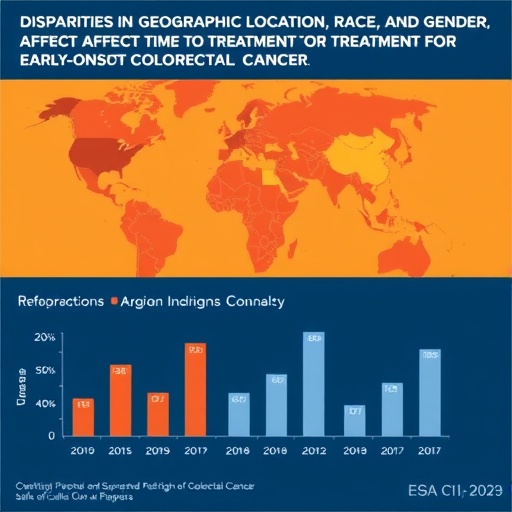
A recent cross-sectional study published in JAMA Network Open sheds new light on the complexities surrounding treatment initiation for early-onset colorectal cancer (CRC) in diverse urban populations. Contrary to prevailing assumptions that urban residency ensures timely access to healthcare services, this investigation reveals pervasive delays in starting treatment, frequently exceeding the critical 90-day threshold. These delays appear not randomly distributed but instead disproportionately impact particular sociodemographic groups, notably young males, and individuals identifying as Asian or Pacific Islander, Black, or Hispanic.
Early-onset colorectal cancer, defined as CRC diagnosed in individuals younger than 50 years, has garnered increasing attention due to its rising incidence globally. Understanding the timelines from diagnosis to treatment initiation is paramount because delays can significantly influence prognostic outcomes. By employing a cross-sectional analytical design, the study scrutinized patterns of treatment commencement across multiple urban settings, focusing explicitly on well-established delay benchmarks at 30, 60, and 90 days. The selection of these thresholds aligns with recent meta-analytic evidence that links such delays to worsened clinical outcomes in colorectal malignancies.
The study’s key finding challenges the widely held assumption that urban environments, often characterized by denser healthcare infrastructures and specialist availability, uniformly translate to expedited treatment pathways. Instead, the analysis elucidates that even within metropolitan areas, systemic impediments lead to clinically meaningful waiting periods for many patients. These delays underscore the multifaceted nature of healthcare access, extending beyond mere physical proximity to factors such as health literacy, insurance barriers, socioeconomic status, and potential implicit biases within clinical workflows.
Of particular concern is the heterogeneity in treatment delay distribution across racial and ethnic lines. The disproportionately affected subgroups—young males and those of Asian or Pacific Islander, Black, or Hispanic descent—may encounter compounding social determinants of health that amplify barriers to timely care. These findings dovetail with broader public health concerns regarding health disparities and systemic inequities that affect cancer prognosis and survival outcomes in minority populations.
Furthermore, the modest absolute differences reported in average treatment initiation times mask the clinical significance embedded within crossing critical delay thresholds. While a few days’ difference in average wait times might seem negligible statistically, surpassing the 90-day delay marker is strongly associated with adverse tumor progression and overall survival. This nuanced understanding is crucial for clinicians and policymakers designing interventions aimed at optimizing cancer care timelines.
Technically, the methodology integrated rigorous statistical modeling to adjust for confounding variables, allowing for a refined analysis of delay patterns across urban populations. By stratifying results according to sociodemographic factors and applying robust meta-analytic benchmarks, the study validates the clinical relevance of its findings. This methodological rigor strengthens the credibility of the insights offered and sets a precedent for future research on healthcare delivery timeliness.
The study also opens avenues for deeper exploration into the systemic factors driving these disparities. Potential contributors include delays in diagnosis, referral processes, insurance authorization, and patient navigation challenges in complex healthcare systems. The persistence of these barriers in urban centers demands a reevaluation of current healthcare delivery models and the integration of culturally competent, equity-focused strategies.
In the context of oncology, the findings underscore the urgent need for targeted interventions that address both access and timeliness of care for early-onset colorectal cancer patients. Multidisciplinary approaches involving community outreach, enhanced patient education, and streamlined clinical pathways may mitigate delays. Additionally, improved data surveillance systems that monitor treatment intervals could facilitate real-time identification of high-risk cohorts and prompt remedial action.
Importantly, these insights emphasize the interconnectedness of social determinants, healthcare infrastructure, and clinical outcomes. Urban areas, despite their resources, are not monolithic entities immune to the challenges of equitable care delivery. Recognizing and addressing the nuanced barriers within these settings remains critical for improving survival rates and quality of life among young colorectal cancer patients.
This study’s revelations also resonate with broader discussions in public health and medical sociology about the persistence of inequities within ostensibly resource-rich environments. As researchers and clinicians grapple with the rising tide of early-onset colorectal cancer, a holistic approach that encompasses medical, social, and systemic dimensions is imperative.
Ultimately, the cross-sectional analysis published in JAMA Network Open serves as a clarion call for stakeholders across the healthcare spectrum. Timely initiation of treatment for early-onset colorectal cancer is not merely a clinical urgency but a marker of systemic equity and justice. Addressing the entrenched disparities identified in this study is a vital step towards ensuring that urban healthcare systems fulfill their promise of timely, effective, and equitable cancer care for all populations.
Subject of Research: Early-onset colorectal cancer treatment delays in urban populations and sociodemographic disparities.
Article Title: [Not provided]
News Publication Date: [Not provided]
Web References: [Not provided]
References: doi:10.1001/jamanetworkopen.2026.1980
Image Credits: [Not provided]
Keywords: Colorectal cancer, racial differences, medical treatments, geographic regions, sex ratios, oncology, meta-analysis, urban populations, young people
Tags: colorectal cancer prognosis and treatment timingcross-sectional studies on cancer treatment disparitiesearly-onset colorectal cancer epidemiologyearly-onset colorectal cancer treatment delaysgender differences in cancer treatment initiationgeographic disparities in cancer carehealthcare inequalities in urban cancer patientsimpact of sociodemographic factors on cancer careracial disparities in colorectal cancer treatmenttime to treatment benchmarks colorectal cancertreatment initiation thresholds in oncologyurban healthcare access challenges