• HOME
  • NEWS
  • EXPLORE
    • CAREER
      • Companies
      • Jobs
    • EVENTS
    • iGEM
      • News
      • Team
    • PHOTOS
    • VIDEO
    • WIKI
  • BLOG
  • COMMUNITY
    • FACEBOOK
    • INSTAGRAM
    • TWITTER
Friday, May 15, 2026
BIOENGINEER.ORG
No Result
View All Result
  • Login
  • HOME
  • NEWS
  • EXPLORE
    • CAREER
      • Companies
      • Jobs
        • Lecturer
        • PhD Studentship
        • Postdoc
        • Research Assistant
    • EVENTS
    • iGEM
      • News
      • Team
    • PHOTOS
    • VIDEO
    • WIKI
  • BLOG
  • COMMUNITY
    • FACEBOOK
    • INSTAGRAM
    • TWITTER
  • HOME
  • NEWS
  • EXPLORE
    • CAREER
      • Companies
      • Jobs
        • Lecturer
        • PhD Studentship
        • Postdoc
        • Research Assistant
    • EVENTS
    • iGEM
      • News
      • Team
    • PHOTOS
    • VIDEO
    • WIKI
  • BLOG
  • COMMUNITY
    • FACEBOOK
    • INSTAGRAM
    • TWITTER
No Result
View All Result
Bioengineer.org
No Result
View All Result
Home NEWS Science News Biology

Discriminating diets of meat-eating dinosaurs

Bioengineer by Bioengineer
November 4, 2019
in Biology
Reading Time: 3 mins read
0
IMAGE
Share on FacebookShare on TwitterShare on LinkedinShare on RedditShare on Telegram

IMAGE

Credit: Joep Schaeffer


A big problem with dinosaurs is that there seem to be too many meat-eaters. From studies of modern animals, there is a feeding pyramid, with plants at the bottom, then plant-eaters, and then meat-eaters at the top.

A new study by scientists at the University of Bristol’s School of Earth Sciences, published in the journal Palaeontology, shows that dinosaurian meat-eaters, the theropod dinosaurs, specialised a great deal, and so broadened their food base.

The big ones, such as Allosaurus and Tyrannosaurs Rex, fed on other dinosaurs. But there were also lots of small meat-eaters that probably fed on other animals such as lizards and mammals. And some of the theropods even became plant-eaters.

Joep Schaeffer carried out the study as part of his studies for the MSc in Palaeobiology at Bristol. He said: “I was always mad about tyrannosaurs and other meat-eating dinosaurs, but this study tested my computing ability.

“I measured everything I could from the jaws and teeth of 83 theropod dinosaurs, including the giants, but also small ones the size of a turkey.”

Professor Emily Rayfield, who co-led the research, added: “Our idea was to describe every possible jaw shape and tooth shape in terms of about 80 measurements.

“Were all these meat-eaters feeding in the same way on the same things? If so, that would mean a lot of competition.”

Professor Mike Benton, who also co-led the research, said: “We also had problems in deciding which computational method to use.

“We could simply treat all the separate measurements as part of the mix, or we could measure so-called landmarks, where we make an outline of the jaw and tooth shape by marking dots round the edge.

So, in the end, Joep ran his analyses using each possible measurement method, and we compared the results.”

Dr Tom Stubbs, who also worked on the study, added: “These kinds of studies are very informative. We have a huge amount of data from many excellent specimens, but there are many different ways of analyzing the data.

“We were able to show that it didn’t matter which was used to do the calculations, we found the same results – tyrannosaurs were different from all the other theropods, and there were big differences between the theropods.”

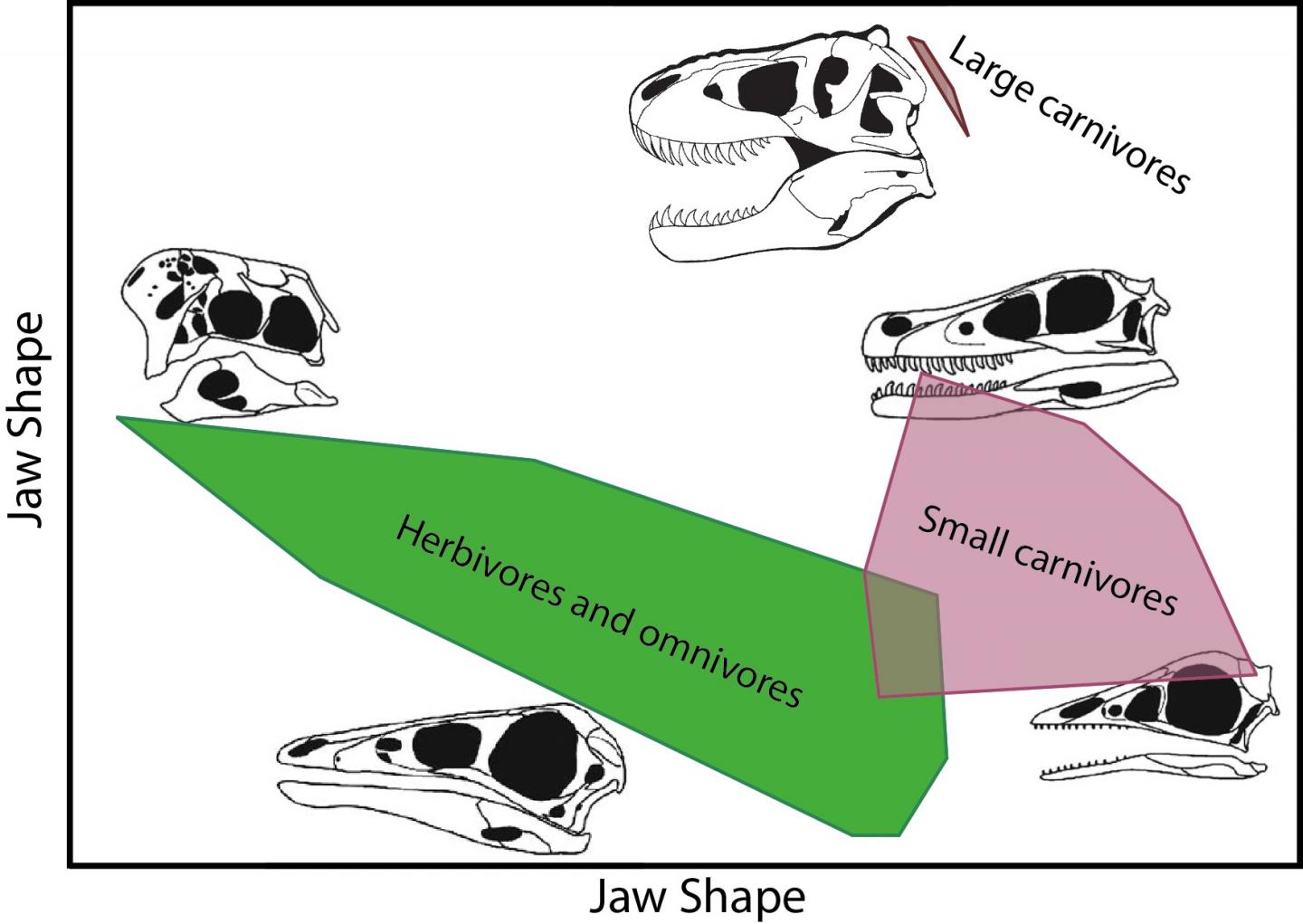
The analyses separated out three groups – the large dinosaur-eaters, the small carnivores and the herbivores. In particular, the tyrannosaurs such as T. rex were quite distinct – they had deeper jaws and more powerful teeth than any of the other theropods, and so had evidently evolved particular ways of dealing with large prey.

The other key finding is that the maniraptoriform theropods – those most closely related to birds – show the greatest amount of variation in jaw shapes. This suggests, but does not prove, that they had the greatest range of functions.

Joep Schaffer added: “Tyrannosaurs were good at subduing large prey with their massive jaws. So, they all had the same kinds of jaws and teeth. But the maniraptoriforms were experimenting with a wide range of smaller prey, maybe from small dinosaurs to early mammals and lizards… even some large, juicy insects.

“This meant they had evolved a much wider array of kinds of jaws and teeth, and while many probably continued to hunt prey on the ground, others might have become specialized to hunting in the trees and pursuing fast-moving prey.”

###

Media Contact
Mike Benton
[email protected]

Tags: Earth ScienceEvolutionPaleontology
Share18Tweet11Share3ShareShareShare2

Related Posts

Excessive Neuronal Activity Initiates Severe Autoimmune Brain Disorder — Biology

Excessive Neuronal Activity Initiates Severe Autoimmune Brain Disorder

May 15, 2026
Precision Anti-Aging Strategies Focus on Eliminating Harmful Senescent Cells While Preserving Beneficial Ones — Biology

Precision Anti-Aging Strategies Focus on Eliminating Harmful Senescent Cells While Preserving Beneficial Ones

May 15, 2026

Root-Knot Nematodes Hijack Plant Signaling Peptides

May 15, 2026

61 Newly Discovered Beetle Species Highlight How Much We Still Have to Learn About Biodiversity

May 15, 2026
Please login to join discussion

POPULAR NEWS

  • Research Indicates Potential Connection Between Prenatal Medication Exposure and Elevated Autism Risk

    843 shares
    Share 337 Tweet 211
  • New Study Reveals Plants Can Detect the Sound of Rain

    729 shares
    Share 291 Tweet 182
  • Salmonella Haem Blocks Macrophages, Boosts Infection

    62 shares
    Share 25 Tweet 16
  • Breastmilk Balances E. coli and Beneficial Bacteria in Infant Gut Microbiomes

    58 shares
    Share 23 Tweet 15

About

BIOENGINEER.ORG

We bring you the latest biotechnology news from best research centers and universities around the world. Check our website.

Follow us

Recent News

High-Dimensional Study Reveals Immune Drivers of Severe Pediatric ARDS

New Study Reveals Key Differences Between Healthy and Unhealthy Ultra-Processed Foods

Bacteria Could Unlock New Clues for Cancer Treatment

Subscribe to Blog via Email

Enter your email address to subscribe to this blog and receive notifications of new posts by email.

Join 82 other subscribers
  • Contact Us

Bioengineer.org © Copyright 2023 All Rights Reserved.

Welcome Back!

Login to your account below

Forgotten Password?

Retrieve your password

Please enter your username or email address to reset your password.

Log In
No Result
View All Result
  • Homepages
    • Home Page 1
    • Home Page 2
  • News
  • National
  • Business
  • Health
  • Lifestyle
  • Science

Bioengineer.org © Copyright 2023 All Rights Reserved.