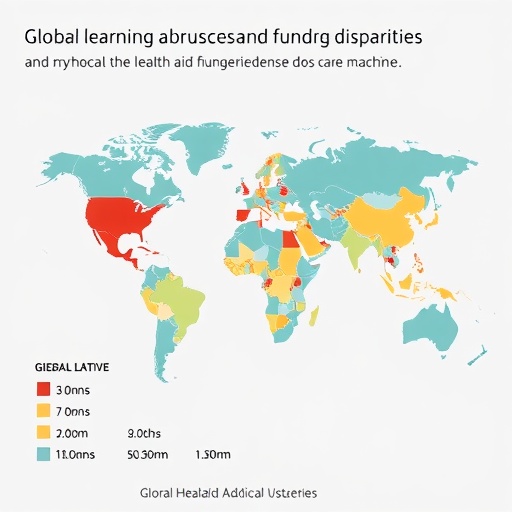
Global health aid is often presented as a force directed toward the places with the greatest medical need. Yet the money that supports hospitals, vaccination programs, disease surveillance and health workers does not always follow the global map of illness. A new study published in Nature Communications examines that tension with a machine-learning approach designed to track how funding disparities emerge across countries, health priorities and donor systems. The research, led by Florian Stürenburg, Katharina Forster and Nadine Banholzer, places the rapidly expanding field of artificial intelligence at the center of one of global health’s most politically sensitive questions: who receives international health assistance, for what purpose and in proportion to which needs?
Global health aid is an extraordinarily complex system. Governments, development banks, philanthropic foundations, United Nations agencies and nongovernmental organizations all finance projects, often through several layers of intermediaries. A single program may be recorded under different names, divided into multiple grants or reported across several years. The same country can receive money for infectious diseases, maternal health, health-system reform and emergency response from entirely different sources. These fragmented records make it difficult to compare funding fairly, especially when researchers want to determine whether financial support reflects population size, disease burden, economic hardship or the political priorities of donors.
Machine learning offers a way to analyze this complexity at a scale that conventional spreadsheets and manually coded databases struggle to reach. In this context, algorithms can be trained to recognize relationships among large numbers of variables, including donor identity, recipient country, sector, grant size, time period and stated project objectives. Natural-language processing can help interpret descriptions written in different styles, identifying whether a project concerns malaria prevention, pandemic preparedness, reproductive health or broader health-system capacity. Classification models can then organize thousands of projects into comparable categories, while statistical techniques can reveal patterns that remain hidden when funding is examined one grant at a time.
The study’s importance lies not simply in applying artificial intelligence to development data, but in using it to question the assumption that aid is distributed according to need. Funding decisions are influenced by humanitarian crises, diplomatic relationships, donor expertise, historical commitments and the visibility of particular diseases. Some conditions attract extensive international attention because they have dedicated advocacy networks or measurable intervention targets. Other health problems, despite affecting millions of people, may receive less support because they are chronic, politically sensitive or difficult to address through short-term projects. A data-driven comparison can expose these imbalances and make them more difficult to dismiss as isolated examples.
A central technical challenge is turning inconsistent records into a dataset that can be compared across time and geography. Aid databases often contain missing values, shifting definitions and duplicate entries. Currency differences must be adjusted, and nominal funding must be distinguished from real purchasing power. A grant announced in one year may be spent over several years, while emergency allocations can produce temporary spikes that do not represent sustained investment. Machine-learning pipelines are therefore only as reliable as the preparation of the data beneath them. Cleaning, linking and standardizing records are not routine administrative steps; they determine which disparities become visible and which remain buried in the structure of the dataset.
The researchers’ approach also highlights a broader issue in the use of artificial intelligence for public policy: algorithms can detect patterns, but they do not automatically explain why those patterns exist. A model may show that certain countries or health topics receive disproportionately high or low levels of aid after accounting for available indicators. That result can guide investigation, but it cannot by itself determine whether the difference reflects political influence, logistical constraints, underreported need or a legitimate emergency response. For that reason, interpretable models and transparent variables are especially important. Policymakers need to know not only what the algorithm predicts, but also which factors are associated with its conclusions and how sensitive those conclusions are to missing or uncertain information.
The findings carry practical implications for organizations that plan and evaluate global health programs. If funding gaps can be measured more consistently, donors may be able to identify neglected diseases, overlooked populations and countries whose health needs are poorly represented in international portfolios. Governments and civil-society groups could use comparable evidence when negotiating grants or arguing for resources. Better tracking could also reveal whether money announced during a global emergency is reaching frontline services, or whether it is concentrated in administrative, research or infrastructure categories. Such distinctions matter because a large headline figure can conceal limited support for the health workers and communities expected to deliver care.
At the same time, the study does not suggest that a single algorithm can produce a definitive ranking of fairness. Equity itself can be defined in several ways. One approach may prioritize funding according to disease burden; another may emphasize poverty, preventable mortality or the ability of local systems to absorb additional resources. Equal funding per person is not necessarily equitable funding, because the cost of delivering care varies widely between countries and regions. A remote population may require more investment than an urban population to achieve the same level of access. Machine learning can help compare these scenarios, but the choice of objective remains a social and political decision rather than a purely technical one.
The research arrives as international health financing faces pressure from overlapping crises, including pandemics, conflict, climate-related disasters and rising debt burdens. In such an environment, governments and institutions are being asked to do more with limited resources while demonstrating that their decisions are evidence-based. By linking large-scale funding records with computational analysis, the study provides a framework for examining whether global health aid is aligned with the needs it claims to address. Its broader message is both promising and cautionary: artificial intelligence can make hidden patterns in aid allocation visible, but meaningful change will depend on institutions willing to confront those patterns, improve transparency and redirect resources toward populations that have historically received too little attention.
Subject of Research: Global health aid funding disparities and the use of machine learning to track funding allocation.
Article Title: Tracking funding disparities in global health aid with machine learning
Article References: Stürenburg, F., Forster, K., Banholzer, N. et al. Tracking funding disparities in global health aid with machine learning. Nature Communications 17, 8569 (2026). https://doi.org/10.1038/s41467-026-76542-z
Image Credits: AI Generated
DOI: https://doi.org/10.1038/s41467-026-76542-z
Keywords: Global health aid, funding disparities, machine learning, health equity, development assistance, public health, aid allocation, data science, health financing
Tags: AI applications in global health policyAI-driven analysis of global health financecomplex global health funding systemsdisparities in health aid distributionGlobal health aid disparitiesglobal health funding inequitieshealth aid and disease burden mappinghealth aid data fragmentation challengeshealth funding transparency and accountabilityinternational health funding allocationmachine learning in health funding analysistracking health aid through machine learning