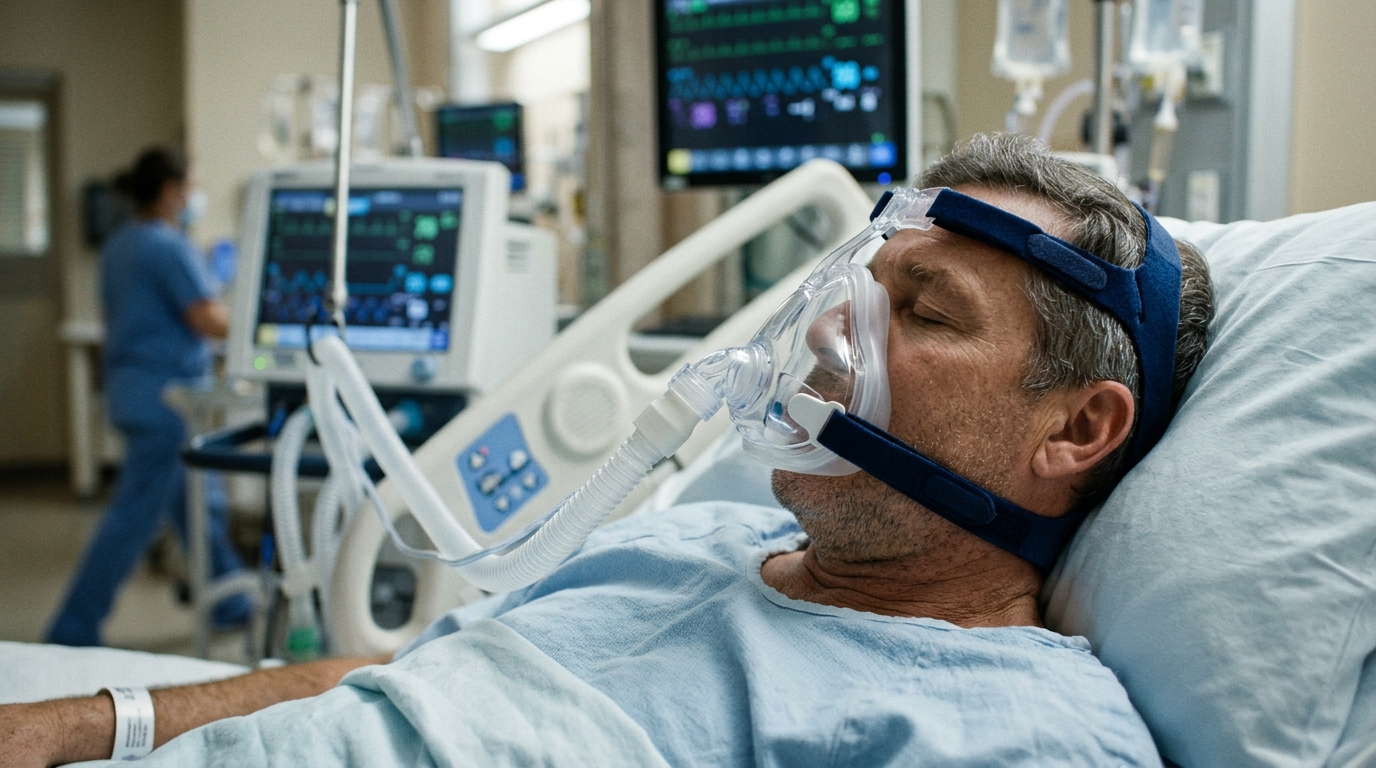
Immunocompromised patients who land in the intensive care unit with acute respiratory failure face some of the grimmest odds in critical care, and a new analysis of a large French and Italian trial suggests that the factors driving their risk of death inside the ICU are strikingly different from those shaping their fate in the months after discharge. The study, published in Annals of Intensive Care, found that a simple bedside measure of patient discomfort one hour after starting noninvasive respiratory support was independently linked to dying in the ICU, while the strength of a patient before admission, their performance status, dominated the picture for longer-term outcomes.
The researchers, led by Mélanie Métais and Rémi Coudroy of the CHU de Poitiers together with colleagues from the FLORALI-IM study group and the REVA Research Network, set out to test a hypothesis that has rarely been examined directly: that the predictors of death within the ICU would not be the same as the predictors of death or disability after patients leave it. Most previous studies of long-term mortality in this population, the authors note, simply borrowed the risk factors established for ICU mortality, such as the severity of organ failure, without asking whether those factors still mattered once patients survived their stay.
To qualify for the seminal trial, patients had to be at least 18 years old and immunocompromised, defined by criteria including an active or recently remitting hematological malignancy, an allogeneic stem cell transplant within the previous five years, active or relapsing solid cancer, chemotherapy-induced leucopenia or neutropenia, solid organ transplantation, AIDS, systemic steroids at prednisone-equivalent doses of at least 0.5 milligrams per kilogram per day for at least three weeks, or immunosuppressive or immunomodulatory drugs. Their respiratory failure had to be acute and hypoxemic, with a respiratory rate of at least 25 breaths per minute and a ratio of arterial oxygen partial pressure to inspired oxygen fraction of 300 millimeters of mercury or lower while breathing spontaneously with standard oxygen, high-flow nasal oxygen or noninvasive ventilation. Patients with hypercapnia, acute-on-chronic respiratory failure, cardiogenic pulmonary edema, recent surgery, shock, impaired consciousness, an urgent need for intubation or a do-not-intubate order were excluded, as were those who could strongly benefit from noninvasive ventilation.
The analysis focused on 299 patients. Malignancy, either hematological or solid, was the cause of immunosuppression in 74 percent of them, or 222 patients. Their average performance status before ICU admission, measured on the Eastern Cooperative Oncology Group scale, was 1 on a scale where 0 is fully functional and higher numbers indicate greater limitation, and 16 percent, 49 of the 299, already had a poor score of 3 or 4 before they became critically ill. At admission, their Simplified Acute Physiology Score II averaged 45 and their Sequential Organ Failure Assessment score averaged 6. At inclusion, the respiratory rate averaged 31 breaths per minute, the PaO2/FiO2 ratio averaged 147 millimeters of mercury, and 74 percent of patients, 223 of 299, had bilateral infiltrates visible on chest X-ray.
The headline numbers are sobering. Mortality inside the ICU was 31 percent, 94 of the 299 patients. By six months, 49 percent, 146 patients, had died. Among the 205 ICU survivors, three were excluded because their six-month performance status was missing, leaving 202 patients whose functional trajectory could be assessed. Of those, 31 percent, 62 patients, had a poor outcome at six months, a composite defined as death after ICU discharge or survival with an ECOG performance status of 3 or 4. Fifty-two patients, 26 percent of the survivors, died in the months after leaving the ICU, and 10, 5 percent, were alive but severely limited in their daily functioning.
To disentangle which early factors truly predicted ICU death, the researchers built a multivariable logistic regression model using only variables that could be assessed within the first six hours after admission. Intubation within the first 24 hours and the SAPS II score were deliberately left out, despite their strong association with mortality, because both require at least 24 hours of hindsight and therefore offer little help to a clinician deciding on admission or early treatment. Four factors emerged as independently associated with in-ICU mortality. Solid cancer carried an adjusted odds ratio of 2.92, with a 95 percent confidence interval of 1.22 to 7.28. The severity SOFA score at admission carried an adjusted odds ratio of 1.29, from 1.14 to 1.48, meaning each additional point of organ failure raised the odds of dying. The number of quadrants with pulmonary infiltrates on chest X-ray, a measure of radiographic extent, carried an adjusted odds ratio of 1.57, from 1.17 to 2.15. And an increase in the discomfort score one hour after the initiation of noninvasive respiratory support carried an adjusted odds ratio of 2.08, from 1.12 to 3.85. That discomfort was measured with a 100-millimeter visual analogue scale ranging from no discomfort to maximal imaginable discomfort, a tool the authors describe as simple to use at the bedside.
The model for longer-term outcomes told a different story. Among the 202 ICU survivors with reported six-month performance status, only two patient-level factors were independently associated with a poor outcome at six months: solid cancer, with an adjusted odds ratio of 3.03 and a confidence interval of 1.33 to 9.09, and a poor ECOG performance status of 3 or 4 before ICU admission, with an adjusted odds ratio of 2.43 and a confidence interval of 1.03 to 5.88. Both associations held independently of the decision to forgo life-sustaining therapies during the ICU stay, which itself carried an adjusted odds ratio of 5.88, from 2.17 to 20.00, for poor outcome among survivors. Notably, the severity scores recorded at ICU admission and organ failure during the stay, including the need for intubation, were not independently linked to poor outcomes at six months among survivors.
The authors interpret this divergence as a fundamental split in what matters when. In-ICU mortality, they write, was mainly driven by severity, captured by the SOFA score, the extent of lung infiltrates and the patient’s response to the first hour of breathing support. Poor outcomes at six months, by contrast, were mainly driven by performance status before ICU admission. Solid cancer stood out as the only factor independently associated with both poor short-term and longer-term outcomes. The discomfort finding, the researchers suggest, may partly reflect dyspnea, which is a known independent risk factor for failure of noninvasive respiratory support in de novo respiratory failure and is associated with increased respiratory drive in mechanically ventilated patients, itself linked to poor outcomes. Whether tailoring noninvasive support to a patient’s dyspnea or comfort can actually change outcomes remains untested.
The study has limitations the authors acknowledge. The randomized design of the seminal trial, with strict inclusion and exclusion criteria, and the unplanned nature of this post-hoc analysis could have introduced selection bias and may limit generalizability, although the baseline characteristics and outcomes resemble those of the largest international observational study of immunocompromised ICU patients, which reported a 32 percent in-ICU mortality rate among 1,611 patients. Variables were restricted to those collected in the original trial, so data such as performance status at ICU or hospital discharge, the timing of decisions to forgo life-sustaining therapies, and the resumption of cancer treatment after discharge were not available. The choice of variables for the regression models is debatable, and data were collected at inclusion rather than at ICU admission, though the median interval between the two was less than 15 minutes. The authors also lacked the statistical power to compare outcomes across different types of solid cancer, a major determinant of short-term prognosis. Still, the six-month mortality of 49 percent sits close to figures reported elsewhere, including 47 percent in a retrospective study of 366 patients with hematological malignancy and 55 percent in a multicenter observational study of 449 patients with lung cancer, reinforcing the external validity of the findings.
The practical upshot, the authors argue, is that decisions about ICU readmission for immunocompromised patients should lean more heavily on the functional status the patient had before the index ICU admission than on the intensity of organ failure during that stay. Poor performance status before admission is a well-established risk factor for long-term mortality in ICU survivors with solid cancer, likely because such patients are less able to resume cancer treatments afterward. The finding, they write, reinforces the importance of interventions before ICU admission to improve cancer patients’ general condition. For clinicians weighing whether an immunocompromised patient with failing lungs should be admitted, readmitted or offered continued life support, the message is that the answer may lie less in the severity scores of the acute illness and more in how the patient was living before the crisis began, and, in the first hour on the ventilator mask, in how comfortable that patient actually is.
Subject of Research: Risk factors for ICU mortality and six-month functional outcomes in immunocompromised patients with acute respiratory failure
Article Title: Factors associated with ICU mortality and long-term outcomes in immunocompromised patients admitted to the intensive care unit for acute respiratory failure
Article References: Métais, M., Frat, J.-P., Ehrmann, S., Pène, F., Decavèle, M., Terzi, N., Prat, G., Martin, M., Contou, D., Gacouin, A., Bourenne, J., Girault, C., Vinsonneau, C., Dellamonica, J., Labro, G., Jochmans, S., Herbland, A., Quenot, J.-P., Devaquet, J., … Kouatchet, A. (2025). Factors associated with ICU mortality and long-term outcomes in immunocompromised patients admitted to the intensive care unit for acute respiratory failure. Annals of Intensive Care, 15(1), Article 175. https://doi.org/10.1186/s13613-025-01578-1
Image Credits: AI Generated
DOI: 10.1186/s13613-025-01578-1
Keywords: ICU mortality, immunocompromised patients, acute respiratory failure, noninvasive ventilation, solid cancer, performance status, SOFA score, life-sustaining therapies, post-hoc analysis, Annals of Intensive Care, Factors, associated
News Source: Ophelia Keating. (November 5, 2026). Discomfort on breathing support flags ICU death risk in immunocompromised patients. Scienmag.