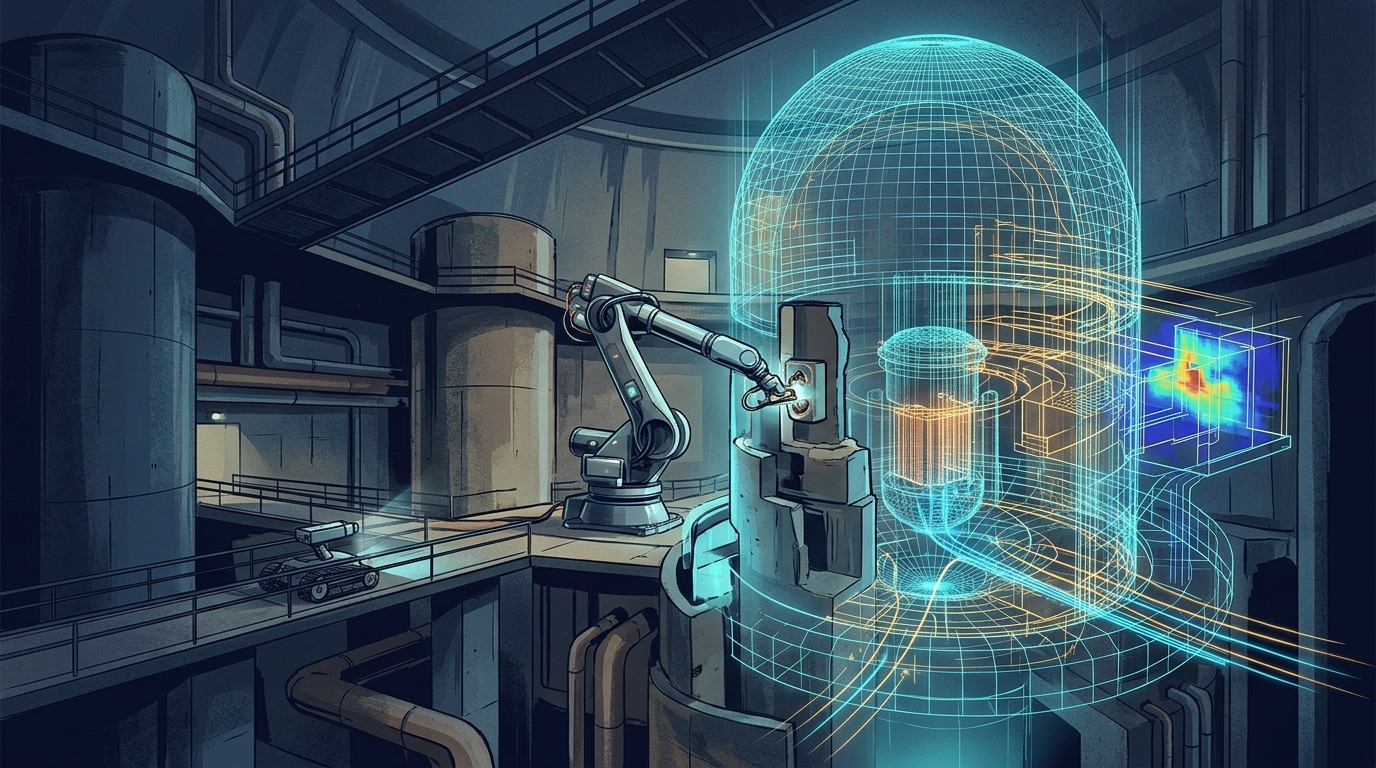
Nuclear decommissioning is one of the most punishing environments in engineering. Facilities reaching end of life were rarely designed to be taken apart, their documentation may be decades old and inconsistent with the as-built plant, and every hour a human spends in a contaminated area must be justified against the dose incurred under the ALARA principle. A new review in Frontiers in Nuclear Engineering argues that the decisive challenge in pairing robots with digital twins in this setting is not the performance of individual sensors or algorithms, but the disciplined, uncertainty-aware conversion of information between geometric, semantic, radiological, and operational representations.
The review, led by Omar Zahra of the Institute for Energy Technology in Norway with collaborators from Germany, Finland, Belgium, and Slovakia, is a structured narrative review built from a search of Scopus, Web of Science, IEEE Xplore, and Google Scholar covering January 2010 to July 2026, complemented by IAEA, OECD/NEA, ISO, and CORDIS repositories. Its reference base comprises 107 sources, 73 percent published in 2016 or later. Rather than cataloguing robot mechanics, the authors organise their synthesis around the information loop between a robotic fleet and a digital twin: the twin supplies prior knowledge, constraints, and mission objectives, while robots return observations that update and refine the model.
The authors adopt established maturity distinctions, citing a framework that separates digital models with no automated data exchange, digital shadows in which data flow automatically from the physical object to the digital one, and true digital twins in which data flow automatically in both directions. On a capability scale from standalone through descriptive, diagnostic, predictive, and prescriptive to autonomous, they conclude that most decommissioning applications sit between the descriptive and predictive levels: diagnostic functions such as change detection and predictive dose analysis are available, but loop closure is mediated by human operators. Most current systems, in their words, operate at the level of digital shadows rather than fully bidirectional twins.
On the sensing side, the review compares geometric capture modalities. Terrestrial laser scanning provides dense, metrically reliable point clouds at millimetre accuracy for baseline surveys, at the cost of operator time at each station. Robot-mounted LiDAR with inertial support enables continuous, illumination-independent acquisition during motion, supporting SLAM, navigation, and repeated surveys, though its data are trajectory-dependent and subject to drift. RGB-D cameras add dense colourised depth at roughly 0.2 to 10 metres for close inspection, but reflective metals, transparent surfaces, dust, and ionising radiation degrade their output. Photogrammetry and neural scene representations such as NeRF and 3D Gaussian splatting offer photorealistic visualisation, yet the authors state they are not aware of published validation of these methods under representative radiological conditions and treat them as a visual layer anchored to LiDAR geometry rather than an authoritative record.
Radiological instruments receive parallel treatment. Dose-rate meters, scintillator and semiconductor spectrometers, coded-aperture and Compton gamma cameras, and alpha and beta contamination probes each return spatially referenced data that can be attached to facility components. The review highlights instruments such as a 268-gram coded-aperture camera that can pass through 8 to 10 centimetre hot-cell apertures and covers 60 kiloelectronvolts to 1.3 megaelectronvolts, and 3D position-sensitive CdZnTe Compton imagers with energy resolution near 1.1 percent at 662 kiloelectronvolts. The decisive integration step, the authors argue, is treating each instrument as a first-class sensor: outputs published into platform middleware, stamped on a common time base, and paired with the interpolated platform pose, so every sample enters the twin as a position-tagged, uncertainty-tagged measurement.
Individual readings become useful only when assembled into spatial representations. Measured dose-rate maps are honest about coverage but silent between samples; geostatistical interpolation, including kriging and Gaussian-process regression, can fill gaps and return a predictive variance that flags weakly constrained regions and drives information-gain exploration, in which the robot moves next to where the map is least certain. The authors stress that interpolated maps should be checked against held-out measurements before being used for planning, and that a dose-rate field and a surface contamination map are not interchangeable quantities and must not be conflated.
Interoperability emerges as a central barrier. A decommissioning twin combines BIM models, CAD geometry, point clouds, meshes, radiological data, and robotic maps, and the same wall may exist simultaneously as an IFC element, a simulation mesh, a scanned point set, and a shielding volume in a transport calculation. The review catalogues exchange formats from IFC and STEP through E57, LAS/LAZ, STL, URDF, SDF, and USD, noting that IFC defines no radiological property sets, so decommissioning-specific data must be carried through custom property sets. Non-geometric operational data such as task plans and provenance are covered by none of these schemas and travel instead as structured documents or ontology instances.
Uncertainty is the thread running through the entire chain. Counting statistics and calibration in sensing, extrinsic calibration and synchronisation errors in fusion, drift and degeneracy in localisation, registration error in change detection, and material assumptions in dose calculation are all coupled: a pose error displaces a dose-rate sample, which biases the interpolated field and the inferred source term, which in turn biases the predicted dose for a planned intervention. Yet in current practice each algorithm typically handles its own uncertainty and passes only a point estimate downstream. The authors call for a decision-grade twin that carries standard uncertainties, pose covariances, predictive variances, and registration quality with the data, with provenance links that allow downstream products to be recomputed when upstream estimates are revised.
The evidence base from real facilities remains uneven. Robots and gamma imagers have operated inside the Fukushima Daiichi reactor buildings; Gaussian-process radiation mapping has been demonstrated at a research reactor; an autonomous radiometric survey has run on the Sellafield site; and aerial dose-rate mapping has been flown in the Chornobyl Exclusion Zone. Integrated robot-to-twin workflows have been shown at a plant under dismantling and in data-driven form with data from three real sites. By contrast, model-based localisation, informative path planning, and automated change detection have been demonstrated mainly in non-nuclear buildings or with sealed sources. The review found no published study quantifying end-to-end performance of a robot–twin loop under representative radiological conditions, nor any quantified comparison of worker dose or schedule with and without such a loop, so claims of improved safety and efficiency should be read as expected benefits rather than demonstrated outcomes.
The EURATOM DORADO project, running from 2024 to 2027, is presented separately as a case study of how these requirements are being addressed in an ongoing engineering programme. It extends the earlier PLEIADES platform into a BIM and digital-twin architecture integrating sensor-data fusion, change detection, ALARA dose estimation, IFC-based data integration, mission control, and a shared ontology built on ifcOWL. Dose planning uses two established point-kernel tools, one sharing a single triangle mesh between fast estimates and a Geant4 Monte Carlo reference, the other importing pre-computed dose maps from a separately qualified code. The authors characterise the current architecture as a digital shadow with diagnostic and predictive functions, note that end-to-end uncertainty propagation is not yet implemented, that key tools have not been independently evaluated, and that the twin-to-robot direction remains operator-mediated. The main barriers, they conclude, are interoperability, end-to-end uncertainty management, validation under representative radiological conditions, and long-term data governance across decommissioning programmes that can span decades.
Subject of Research: A review of digital twins and robotics for nuclear decommissioning, examining information flow, sensing, radiological mapping, interoperability, and validation, with the EURATOM DORADO project as a case study.
Article Title: Digital twins for robot-assisted nuclear decommissioning: a review of perception, radiological mapping, and model interoperability, with the DORADO project as a case study
Article References: Zahra, O., Benkrid, A., Ridao, J., Edvardsen, D. F., Räty, A., Abdelrahman, M., Daniska, D., Bratteli, J., & Edvardsen, S. T. (2026). Digital twins for robot-assisted nuclear decommissioning: a review of perception, radiological mapping, and model interoperability, with the DORADO project as a case study. Frontiers in Nuclear Engineering, 5, Article 1954802. https://doi.org/10.3389/fnuen.2026.1954802
Image Credits: AI Generated
DOI: 10.3389/fnuen.2026.1954802
Keywords: digital twin, nuclear decommissioning, robotics, radiological mapping, BIM, SLAM, interoperability, uncertainty quantification, DORADO project, gamma imaging, mission planning, data governance
News Source: Denise Maddox. (November 4, 2026). Digital twins and robots could transform nuclear decommissioning, review finds. Scienmag.