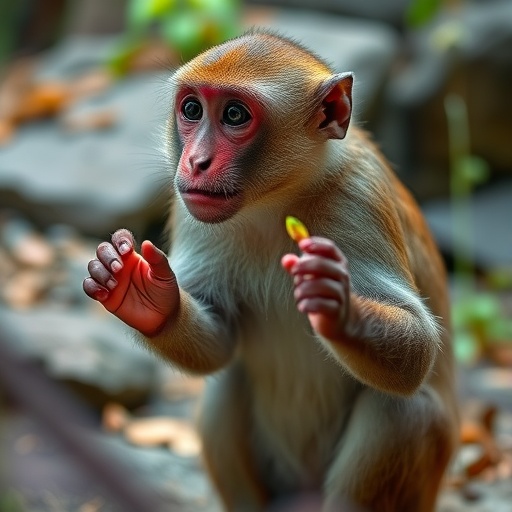
In a groundbreaking study set to reshape our understanding of primate cognition, researchers have unveiled compelling evidence that macaque monkeys exhibit curiosity-driven visual attention, using an innovative digit-tracking methodology. This pioneering approach allows scientists to dissect the intricate ways in which curiosity—long considered a uniquely human trait—might manifest itself in non-human primates, specifically through the lens of visual exploration and attentional dynamics. By deploying this cutting-edge technology, the team has ventured beyond traditional observation techniques, entering a realm where the minutiae of visual engagement can be quantified with unprecedented precision.
The research, led by Yang, Ameloot, Lio, and their colleagues, leverages digit-tracking to reveal how macaques prioritize certain visual stimuli over others based on intrinsic curiosity rather than external reward. This distinction is crucial; whereas previous studies often linked attention patterns directly to tangible rewards or learned behaviors, this new evidence suggests an inherent drive for knowledge acquisition and environment exploration. The digit-tracking method captures eye and finger movements, enabling a sophisticated analysis of where attention is allocated and how it evolves when monkeys interact with visual stimuli designed to evoke curiosity.
At the heart of the study is the methodology itself—a seamless integration of digit-tracking technology combined with meticulously curated experimental paradigms designed to isolate curiosity-driven behavior. Monkeys were presented with a variety of images and interactive displays that varied in novelty and complexity but were devoid of explicit rewards or training cues. This ensured that any attentional preference observed stemmed from the natural inclination to seek new information rather than conditioned responses, providing a robust framework to interpret the data.
The researchers employed computational algorithms to decode the patterns of digit movement alongside eye-tracking data. This dual modality approach offered a window into the temporal and spatial dynamics of attention, revealing subtle shifts in focal engagement that purely observational methods might have missed. The data showed distinct patterns correlating with increasing curiosity levels, such as longer fixation durations on novel stimuli, more frequent digit interactions with unexplored image areas, and strategic scanning behaviors suggestive of active information gathering.
One of the most fascinating findings from the study is how macaques appear to balance exploratory drive with attentional resources, mirroring theories hypothesized in human cognitive psychology. The monkeys did not willy-nilly inspect every new stimulus; rather, their visual attention was strategically modulated, showing bursts of focused engagement followed by exploratory shifts, a behavior pattern indicative of sophisticated information-seeking processes. This suggests that visual curiosity is not merely a passive response but an active cognitive mechanism with deep evolutionary roots.
Furthermore, the implications of this research extend beyond basic science. Understanding curiosity-driven attention in macaques offers potential insights into the neural circuits underpinning motivation and learning. It paves the way for future neurophysiological studies examining how specific brain regions orchestrate exploratory behaviors and attention allocation. These findings could inform models of cognitive disorders in humans where curiosity and attentional processes are disrupted, such as autism spectrum disorder or attention deficit hyperactivity disorder.
The digit-tracking system itself represents a monumental advancement in behavioral neuroscience tools. Unlike traditional eye trackers that function solely through passive gaze detection, this technology captures deliberate digit movements on touch-sensitive screens, inferring intent and cognitive engagement. This multi-dimensional capture of attentional metrics has unlocked new possibilities for behavioral quantification in animal models, promising richer datasets and more nuanced interpretations of cognitive phenomena.
Remarkably, the monkeys’ engagement was spontaneous and untrained, underscoring the naturalistic validity of the findings. This spontaneous interaction challenges entrenched notions that such complex attentional behaviors require human-like reasoning or extensive conditioning. Instead, it positions curiosity as a fundamental cognitive driver, deeply wired into primates’ motivational circuits, enabling them to navigate and understand dynamic environments more effectively.
From an evolutionary perspective, these findings reaffirm the adaptive value of curiosity. Visual attention driven by an innate desire for knowledge acquisition likely conferred survival advantages, enabling macaques to detect predators, locate food sources, and learn social cues more efficiently. By quantifying this process, the study offers a window into how cognitive traits that have evolved over millions of years continue to shape behavior, cognition, and perhaps culture in primate lineages.
The study also touches upon the challenges of interpreting attention metrics in animal cognition research. Traditional paradigms often fall short in accounting for the complex interplay between curiosity, motivation, and environmental stimuli. By harnessing digit-tracking, the researchers circumvented these limitations, introducing a scalable, objective technology capable of discerning subtle attentional shifts without relying on intrusive experimental manipulation.
As the researchers outline in their paper, the potential applications of their approach could extend into comparative cognition, enabling cross-species analyses of curiosity-driven attention. This could not only illuminate shared cognitive architectures but also highlight evolutionary divergences, enriching our understanding of brain-behavior relationships across taxa.
In sum, Yang, Ameloot, Lio, and their team’s study heralds a new era in primate cognition research, where curiosity is not just observed but carefully measured and analyzed through sophisticated behavioral tools. Their findings underscore a shared cognitive lineage between humans and macaques, positioning curiosity as a fundamental cognitive process with broad implications for neuroscience, psychology, and evolutionary biology.
Future research directions opened by this work might explore how curiosity-driven attention interacts with memory formation and decision-making processes in primates, potentially unveiling the cognitive scaffolding on which complex learning is built. Additionally, integrating neural imaging techniques could shed light on the brain dynamics accompanying these curiosity-driven behaviors, bridging the gap between observable actions and underlying neural mechanisms.
As this technology becomes more accessible, it promises to democratize the study of animal cognition, allowing laboratories worldwide to implement nuanced behavioral assays without prohibitive costs or technical barriers. The digit-tracking paradigm, coupled with transparent data-sharing initiatives, could foster collaborative efforts to map the landscape of curiosity and attention across multiple species, ultimately enriching our understanding of cognition itself.
By illuminating the subconscious urges driving macaques’ engagement with their environment, the study also invites broader reflections on the nature of curiosity—not merely as an intellectual pursuit but as a primal urge deeply entwined with survival, learning, and adaptation. Such insights reshape how we conceptualize intelligence and motivation, blurring the lines between human uniqueness and the shared cognitive foundations we hold with other primates.
Through this meticulous and innovative work, the research community gains not only new empirical data but also a conceptual framework for interpreting curiosity as a dynamic, measurable phenomenon in animal minds. The implications resonate deeply, not only for science but for our understanding of what it means to explore, to learn, and to be motivated by the unknown.
Subject of Research: Curiosity-driven visual attention in macaque monkeys using digit-tracking technology.
Article Title: Digit-tracking reveals curiosity-driven visual attention in macaque monkeys.
Article References:
Yang, Y., Ameloot, A., Lio, G. et al. Digit-tracking reveals curiosity-driven visual attention in macaque monkeys. Sci Rep (2026). https://doi.org/10.1038/s41598-026-57654-4
Image Credits: AI Generated
Tags: advanced attention quantification techniquescognitive neuroscience of curiositycuriosity-driven visual explorationdigit-tracking methodology in primateseye and finger movement trackinginnovative primate research methodsintrinsic motivation in macaquesmacaque visual attentionnon-human primate cognitionprimate curiosity researchprimate knowledge acquisition behaviorvisual stimuli prioritization in monkeys