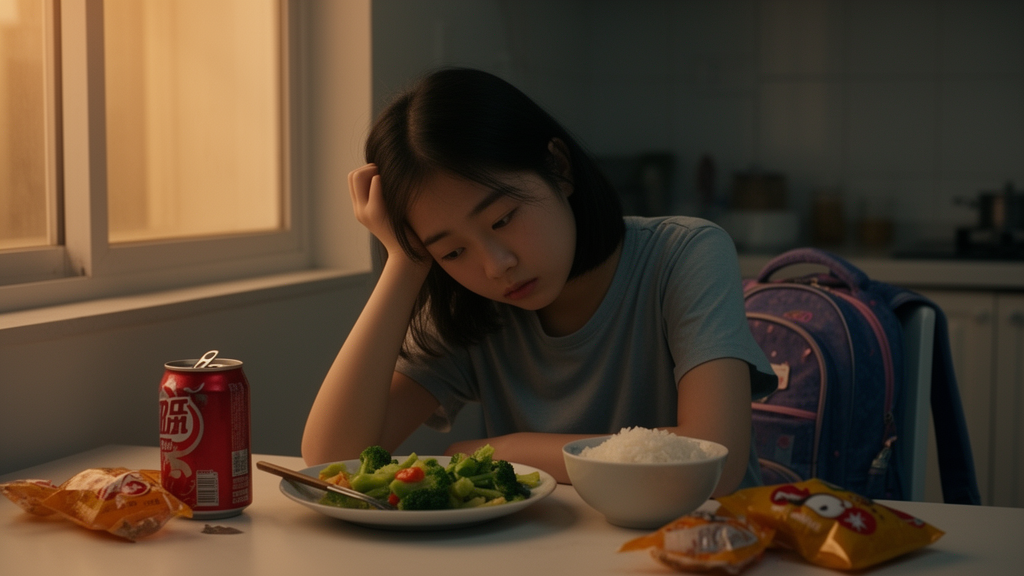
A large survey of more than 57,000 adolescents in Yunnan Province, Southwest China, has found that the co-occurrence of depressive and anxiety symptoms is common among teenagers, and that specific dietary behaviors and lifestyle patterns are associated with whether adolescents show both conditions at once. The cross-sectional study, conducted in 2023 and published in Frontiers in Public Health, screened adolescents aged 12 to 19 years across 129 counties.
The researchers used a complex, multi-stage stratified, probability sampling design to recruit 57,031 participants from 253 multi-center sites spanning 129 counties of Yunnan. Participants provided complete information on basic demographics, dietary behaviors, and lifestyle patterns including sleep duration, screen time, and exercise, and depressive and anxiety symptoms were assessed using standardized measures. To strengthen the comparison between groups, the team applied propensity score matching, which reduces imbalance in prespecified measured covariates, and then used multivariable logistic regression models to examine the associations.
Overall, the detection rate of comorbid depressive and anxiety symptoms among all participants was 12.72%. The rate differed markedly by sex: 15.51% of females showed comorbid symptoms, compared with 9.73% of males, a gap the authors describe as notable. Because the study is cross-sectional, it captures associations at a single point in time and cannot establish that any behavior causes or protects against the symptoms.
Among the behaviors positively associated with comorbid symptoms, sedative medication misuse showed the strongest association, with an odds ratio of 4.613 (95% CI 3.734–5.699). Always using electronic devices in dark environments at night was also strongly associated, with an odds ratio of 3.538 (95% CI 3.111–4.023). Other positive associations included computer use exceeding two hours daily (OR = 1.719, 95% CI 1.499–1.971), alcohol consumption (OR = 1.706, 95% CI 1.572–1.851), insufficient sleep (OR = 1.600, 95% CI 1.456–1.757), and smoking (OR = 1.469, 95% CI 1.339–1.612).
Several behaviors were negatively associated with comorbid symptoms. Consuming breakfast showed the strongest inverse association, with an odds ratio of 0.450 (95% CI 0.380–0.532), followed by watching television less than two hours daily (OR = 0.771, 95% CI 0.706–0.843), fruit consumption (OR = 0.705, 95% CI 0.618–0.805), vegetable consumption (OR = 0.712, 95% CI 0.587–0.864), and computer use of less than two hours daily (OR = 0.866, 95% CI 0.801–0.936). These odds ratios come from the multivariable logistic regression analyses after propensity score matching, meaning they account for the measured covariates the researchers prespecified.
The findings on screen-related behaviors are particularly detailed. Computer use showed a graded pattern in this analysis: exceeding two hours daily was positively associated with comorbid symptoms, while staying under two hours was negatively associated. Similarly, watching television for less than two hours was associated with lower odds of comorbid symptoms. The use of electronic devices in dark environments at night stood out as the strongest screen-related factor, with adolescents who always used devices in the dark at night showing markedly higher odds of comorbid symptoms than those who did not.
Dietary behaviors also emerged as a consistent theme. Regular consumption of breakfast, vegetables, and fruits was each associated with lower odds of comorbid depressive and anxiety symptoms, while insufficient sleep, smoking, and alcohol consumption were associated with higher odds. The study’s authors conclude that healthy dietary patterns, sleep patterns, and digital device usage should be carefully monitored as part of adolescent mental health interventions.
The scale of the survey is one of its distinguishing features. By sampling from 253 multi-center sites across 129 counties in a single province, the study captures a broad and geographically diverse adolescent population in Southwest China, and the use of propensity score matching adds a layer of control over measured confounding beyond standard multivariable regression alone. The standardized assessment of both depressive and anxiety symptoms allowed the researchers to focus specifically on adolescents experiencing both conditions together, rather than either condition in isolation.
At the same time, the authors are explicit about the limits of the design. As a cross-sectional screen, the survey documents associations between behaviors and comorbid symptoms at one point in time; it cannot show that changing a behavior would change symptom outcomes. The authors note that longitudinal, culturally responsive, and comprehensive interventions addressing individual behaviors, family dynamics, and community-level factors are urgently needed. The reported sex difference in detection rates, with females at 15.51% and males at 9.73%, underscores that adolescent mental health screening in the region may need to account for demographic differences alongside behavioral patterns.
Subject of Research: Associations between dietary behaviors, lifestyle patterns and comorbid depressive and anxiety symptoms among adolescents in Yunnan, China
Article Title: The association study between dietary behaviors, lifestyle patterns and comorbid depressive and anxiety symptoms in Yunnan adolescents aged 12–19, Southwest China: a largescale cross-section screen and a propensity score matching analysis
Article References: Yang, Y., Fang, H., Chen, W., Huang, S., & Yang, X. (2026). The association study between dietary behaviors, lifestyle patterns and comorbid depressive and anxiety symptoms in Yunnan adolescents aged 12–19, Southwest China: a largescale cross-section screen and a propensity score matching analysis. Frontiers in Public Health, 14, Article 1956492. https://doi.org/10.3389/fpubh.2026.1956492
Image Credits: AI Generated
DOI: 10.3389/fpubh.2026.1956492
Keywords: adolescent health, depression, anxiety, dietary behavior, sleep insufficiency, screen time, propensity score matching, cross-sectional study, China, public health, mental health, lifestyle patterns
News Source: Glenn Wilkins. (October 29, 2026). Diet and Lifestyle Habits Linked to Comorbid Depressive and Anxiety Symptoms in Chinese Adolescents. Scienmag.