Sepsis-associated acute kidney injury has no specific treatment, and researchers continue to search for approaches that might protect damaged kidney tubules beyond supportive care. One emerging hypothesis points to labile iron and iron-dependent lipid peroxidation, a cell death process known as ferroptosis, as contributors to tubular injury in experimental models. A new proof-of-concept pilot study, published in BMC Nephrology, tested whether iron could be pulled out of the blood through the dialysis circuit itself, using a chelating polymer called MEX-CD1 added to the dialysate.
MEX-CD1 is a high-molecular-weight chelating polymer designed to be dissolved in dialysis fluid rather than given to the patient. The idea is that as blood passes through the hemodialyzer, labile iron crosses into the dialysate, where the polymer binds it and carries it away. Because the chelator stays on the dialysate side of the membrane, the approach aims to extract iron extracorporeally while limiting direct exposure of the animal to the compound.
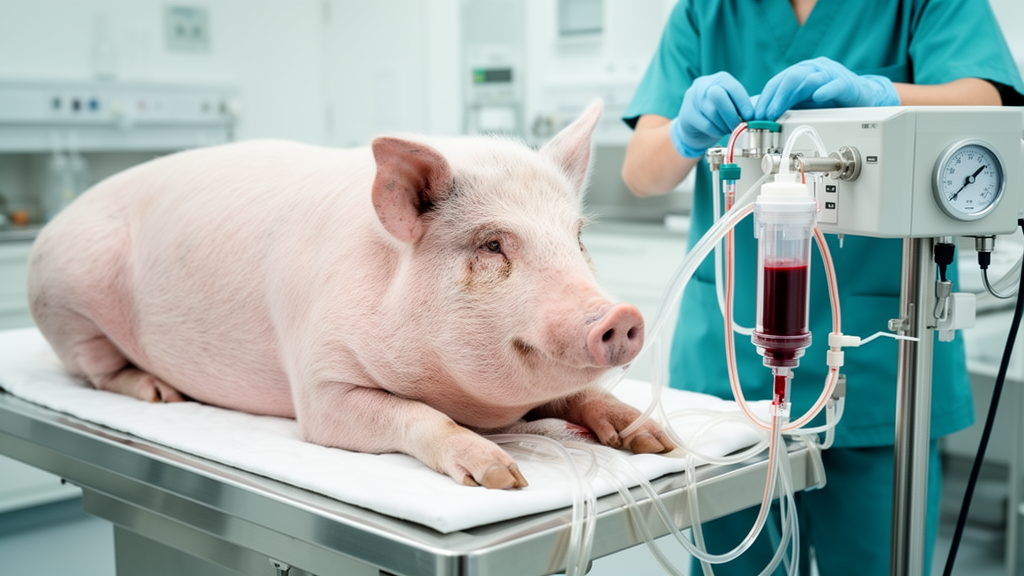
The study was deliberately small and descriptive. Three anesthetized pigs of both sexes, weighing 43 to 57 kilograms, received autologous fecal peritonitis to induce sepsis. After an observation period planned at 12 hours but shortened in two animals because of hemodynamic instability, resuscitation began with antibiotics, fluids and norepinephrine targeting a mean arterial pressure above 60 mmHg, together with a 24-hour continuous veno-venous hemodialysis session using MEX-CD1-containing dialysate. The effluent dose was set deliberately low, at roughly 4 mL/kg/h, to maximize contact time between blood and chelator.
All three animals developed vasopressor-dependent septic shock, transient oliguria beginning 4 to 7 hours after peritonitis induction, and KDIGO stage 1 to 2 acute kidney injury on the creatinine criterion at the start of resuscitation. Renal histology showed acute tubular necrosis, with Jablonski scores of 2 to 3, and all animals survived to the 48-hour time point. The planned 24-hour dialysis session was delivered in all animals, although circuit dysfunction occurred in the two pigs that received the lowest initial heparin doses, and heparin requirements far exceeded the planned regimen.
The key feasibility finding was that MEX-CD1 extracted measurable amounts of iron into the effluent: 158, 236 and 712 micrograms across the three animals, with effluent iron concentration remaining detectable throughout the 24-hour session. The polymer also removed other metals, but removal of copper, manganese and aluminum was small relative to daily intake, while zinc removal reached 4.6 milligrams. Iron parameters in the blood told a more complicated story: transferrin saturation was very low at baseline, below 12 percent, and followed no consistent pattern during the sessions, and hepcidin remained low, at or below 3.0 micrograms per liter.
Histological and staining analyses added context to the injury pattern. Tubular GPX4 immunoreactivity was diffuse overall, although focally reduced in injured regions, TUNEL staining was largely negative, and Perls’ staining was negative in the cortex with scattered medullary foci. The authors note that this pattern is compatible with a non-apoptotic form of tubular cell death but does not demonstrate ferroptosis, a distinction that matters for interpreting the biological rationale of iron removal in this setting.
The conclusions are carefully bounded. The study reports that extracorporeal iron removal with MEX-CD1 is feasible and was clinically tolerated in this porcine model of sepsis-associated acute kidney injury. Because no control group was included, no conclusion can be drawn on efficacy, and the results are presented as descriptive medians with ranges rather than comparisons. The authors state that these data support a controlled study comparing dialysis with and without MEX-CD1, which would be the necessary next step before any claims about therapeutic benefit could be made.
Several limitations deserve emphasis. With only three animals, and two observation periods shortened by hemodynamic instability, the study cannot characterize variability, dose-response or clinical outcomes. The anticoagulation problems, including circuit dysfunction and heparin requirements far above the planned regimen, indicate that the practical delivery of the intervention needs refinement. The iron amounts recovered, ranging from 158 to 712 micrograms over 24 hours, were modest, and the very low baseline transferrin saturation values raise questions about how much labile iron was available for removal in these animals. The findings should therefore be read as an early engineering and tolerability result in a large-animal model, not as evidence that dialysis-based iron chelation treats sepsis-associated kidney injury in humans. The proof of concept now rests on whether a properly controlled follow-up study can test whether the extracted iron corresponds to a biologically meaningful reduction in tubular injury.
Subject of Research: Feasibility of extracorporeal iron removal with the chelating polymer MEX-CD1 during hemodialysis in a porcine model of sepsis-associated acute kidney injury
Article Title: Extracorporeal iron removal with the chelating polymer MEX-CD1 during continuous hemodialysis in a porcine model of sepsis-associated acute kidney injury: a proof-of-concept pilot study
Article References: Couturier, A., Haenggi, M., Berger, D., Chadjichristos, C. E., Isnard, P., Barbar, S., Tillement, O., & Allaouchiche, B. (2026). Extracorporeal iron removal with the chelating polymer MEX-CD1 during continuous hemodialysis in a porcine model of sepsis-associated acute kidney injury: a proof-of-concept pilot study. BMC Nephrology. https://doi.org/10.1186/s12882-026-05467-y
Image Credits: AI Generated
DOI: 10.1186/s12882-026-05467-y
Keywords: sepsis-associated acute kidney injury, MEX-CD1, iron chelation, ferroptosis, continuous hemodialysis, porcine model, labile iron, acute tubular necrosis, pilot study, dialysate, hepcidin, transferrin saturation
News Source: Jerry Hayes. (October 28, 2026). Dialysis-Based Iron Removal Shows Feasibility in Pig Model of Sepsis-Linked Kidney Injury. Scienmag.