• HOME
  • NEWS
  • EXPLORE
    • CAREER
      • Companies
      • Jobs
    • EVENTS
    • iGEM
      • News
      • Team
    • PHOTOS
    • VIDEO
    • WIKI
  • BLOG
  • COMMUNITY
    • FACEBOOK
    • INSTAGRAM
    • TWITTER
Tuesday, July 7, 2026
BIOENGINEER.ORG
No Result
View All Result
  • Login
  • HOME
  • NEWS
  • EXPLORE
    • CAREER
      • Companies
      • Jobs
        • Lecturer
        • PhD Studentship
        • Postdoc
        • Research Assistant
    • EVENTS
    • iGEM
      • News
      • Team
    • PHOTOS
    • VIDEO
    • WIKI
  • BLOG
  • COMMUNITY
    • FACEBOOK
    • INSTAGRAM
    • TWITTER
  • HOME
  • NEWS
  • EXPLORE
    • CAREER
      • Companies
      • Jobs
        • Lecturer
        • PhD Studentship
        • Postdoc
        • Research Assistant
    • EVENTS
    • iGEM
      • News
      • Team
    • PHOTOS
    • VIDEO
    • WIKI
  • BLOG
  • COMMUNITY
    • FACEBOOK
    • INSTAGRAM
    • TWITTER
No Result
View All Result
Bioengineer.org
No Result
View All Result
Home NEWS Science News Health

Development of a novel approach ‘Tracing Retrogradely the Activated Cell Ensemble’

Bioengineer by Bioengineer
June 2, 2020
in Health
Reading Time: 2 mins read
0
IMAGE
Share on FacebookShare on TwitterShare on LinkedinShare on RedditShare on Telegram

IMAGE

Credit: Nathalie Krauth

A major interest in brain research is understanding behavioural experiences at the synaptic and circuit level. However, gaining insight into the neural circuits that underlie a specific behavioural experience is a challenge. The perplexity lies in defining which of the large number of neuronal inputs a specific region of the brain receives, expresses a defined behaviour, and yet there are no direct methods available to overcome this challenge. Today, a common mapping approach in neuroscience is to use retrograde tracing viruses and identify all neuronal inputs in a population of neurons in a specific region of the brain. But neuroscientists are still left to rely on their experience, knowledge and previous findings to exactify specific inputs that underlie a defined behaviour.

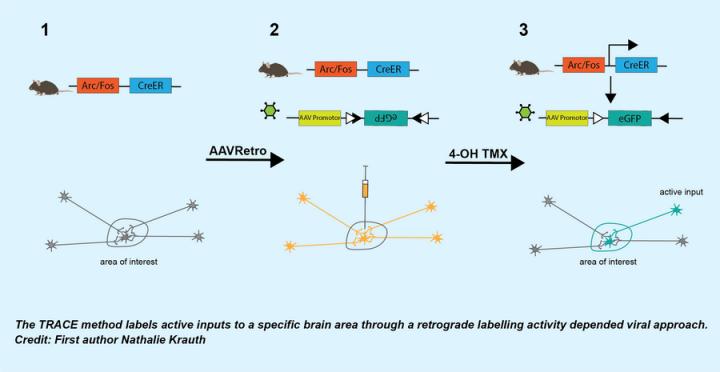
A collaborative study led by circuitry experts at the department of Molecular Biology and Genetics, department of Biomedicine and centre of Proteins in Memory unravel a new approach or so to say, an unbiased and accurate strategy, that selectively tags arriving inputs that are activated by a defined stimulus and projected to a particular brain region. The researchers’ new approach (TRACE) uses an approach where a retrograde virus is combined with a Cre-recombinase that is under the control of an activity dependent promoter to express a fluorescent marker in input neurons.

Using mouse models, the Nabavi and Capogna group have demonstrated the input specificity of their novel approach on four different brain circuits receiving defined sensory inputs. Researchers performed behavioural testing using optogenetic stimulation, odor driven innate fear detection and shock-induced circuit experiments. They also performed imaging of brain slices to investigate specific neural activity.

Their findings show that TRACE can identify active sensory neural inputs that underlie a defined behaviour. This new labelling system is an additional tool in the toolbox to gain access to neurons in the brain that are activated by a particular stimulation or experience.

###

The publication can be read in full at the Frontiers in Cellular Neuroscience website: https://www.frontiersin.org/articles/10.3389/fncel.2020.00114/full

Learn more about the Capogna group and their research within amygdala-hippocampal-cortical circuits in health and disease: https://dandrite.au.dk/people/affiliated-researchers/marco-capogna/

Visit the Nabavi group webpage to learn more their research within memory formation and consolidation at the synaptic and circuit level: https://dandrite.au.dk/people/group-leaders/nabavi-group/

Media Contact
Sadegh Nabavi
[email protected]

Original Source

https://projects.au.dk/nordic-embl-partnership/show-news/artikel/joint-efforts-between-nabavi-and-capogna-group-have-led-to-the-development-of-a-novel-approach-named/

Related Journal Article

http://dx.doi.org/10.3389/fncel.2020.00114

Tags: BiochemistryBiotechnologyCell BiologyGeneticsMedicine/HealthMicrobiologyMolecular Biologyneurobiology
Share12Tweet8Share2ShareShareShare2

Related Posts

Flame retardant BDE-209 targets molecularly linked to ulcerative colitis

July 6, 2026

Kidney transplant outcomes in older adults studied by German researchers

July 6, 2026

Salmonella protein SopB curbs early inflammation to slow disease progression

July 6, 2026

Multi-metal cooperation drives lung cancer chemoresistance, reversed by MiADMSA

July 6, 2026
Please login to join discussion

POPULAR NEWS

  • Detection of EDCs in Breast Milk and Infant Urine Up to Six Months Highlights Early Exposure Risks

    77 shares
    Share 31 Tweet 19
  • New Drug Candidate Developed at McMaster Shows Potential for Treating Brain Cancer

    58 shares
    Share 23 Tweet 15
  • Saying Goodbye to PGY-6: Pediatric Fellowship Realities

    103 shares
    Share 41 Tweet 26
  • KTU Researchers Explore Ultrasound’s Role in Enhancing Blood Flow Beyond Diagnostics

    53 shares
    Share 21 Tweet 13

About

We bring you the latest biotechnology news from best research centers and universities around the world. Check our website.

Follow us

Recent News

Flame retardant BDE-209 targets molecularly linked to ulcerative colitis

Ultra-high frequency particle impacts mimic rockbursts to shatter hard rock

Kidney transplant outcomes in older adults studied by German researchers

Subscribe to Blog via Email

Enter your email address to subscribe to this blog and receive notifications of new posts by email.

Join 83 other subscribers
  • Contact Us

Bioengineer.org © Copyright 2023 All Rights Reserved.

Welcome Back!

Login to your account below

Forgotten Password?

Retrieve your password

Please enter your username or email address to reset your password.

Log In
No Result
View All Result
  • Homepages
    • Home Page 1
    • Home Page 2
  • News
  • National
  • Business
  • Health
  • Lifestyle
  • Science

Bioengineer.org © Copyright 2023 All Rights Reserved.