• HOME
  • NEWS
  • EXPLORE
    • CAREER
      • Companies
      • Jobs
    • EVENTS
    • iGEM
      • News
      • Team
    • PHOTOS
    • VIDEO
    • WIKI
  • BLOG
  • COMMUNITY
    • FACEBOOK
    • INSTAGRAM
    • TWITTER
Thursday, May 21, 2026
BIOENGINEER.ORG
No Result
View All Result
  • Login
  • HOME
  • NEWS
  • EXPLORE
    • CAREER
      • Companies
      • Jobs
        • Lecturer
        • PhD Studentship
        • Postdoc
        • Research Assistant
    • EVENTS
    • iGEM
      • News
      • Team
    • PHOTOS
    • VIDEO
    • WIKI
  • BLOG
  • COMMUNITY
    • FACEBOOK
    • INSTAGRAM
    • TWITTER
  • HOME
  • NEWS
  • EXPLORE
    • CAREER
      • Companies
      • Jobs
        • Lecturer
        • PhD Studentship
        • Postdoc
        • Research Assistant
    • EVENTS
    • iGEM
      • News
      • Team
    • PHOTOS
    • VIDEO
    • WIKI
  • BLOG
  • COMMUNITY
    • FACEBOOK
    • INSTAGRAM
    • TWITTER
No Result
View All Result
Bioengineer.org
No Result
View All Result
Home NEWS Science News Chemistry

Developing electrically active materials to repair damaged hearts

Bioengineer by Bioengineer
October 8, 2019
in Chemistry
Reading Time: 3 mins read
0
IMAGE
Share on FacebookShare on TwitterShare on LinkedinShare on RedditShare on Telegram

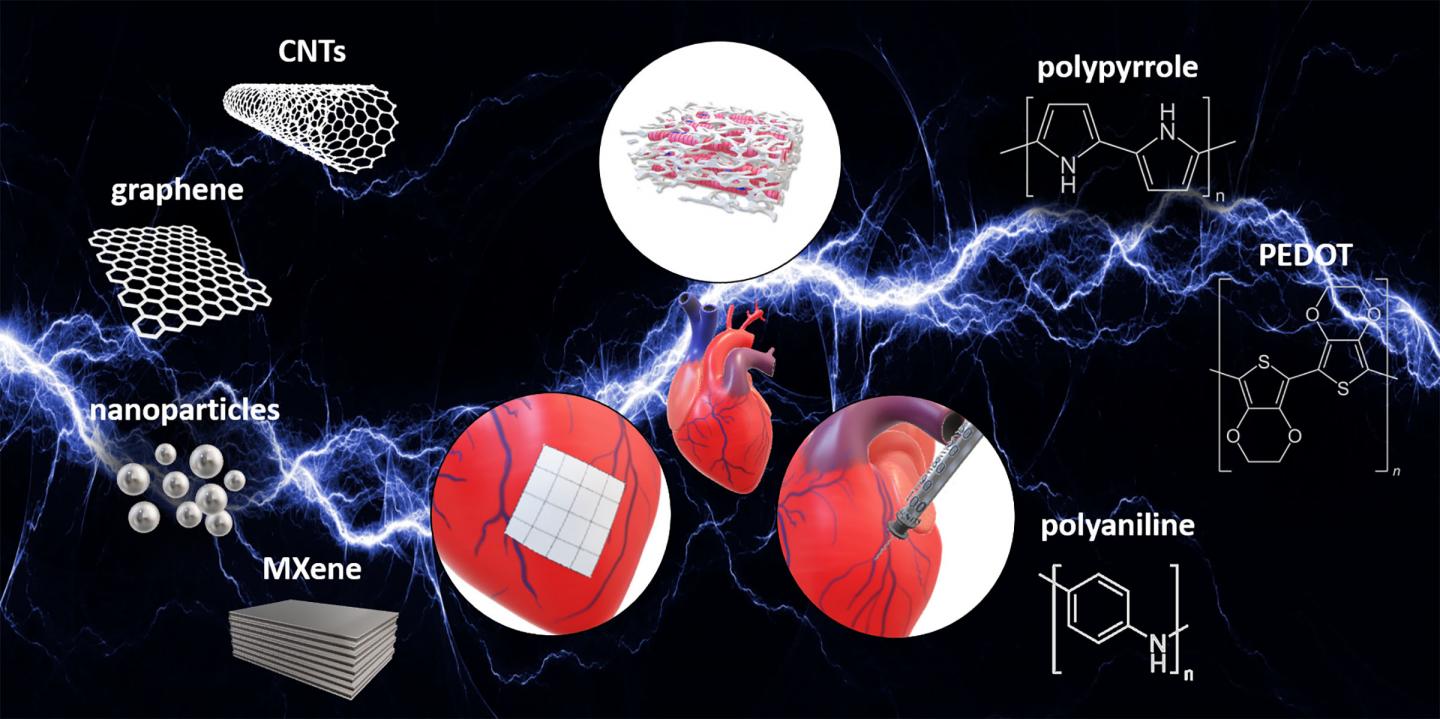
Scientists are developing new materials that can both conduct electricity and repair heart muscle damaged during a heart attack
IMAGE

Credit: Michael Monaghan, Trinity College Dublin


WASHINGTON, D.C., October 8, 2019 — When a heart attack occurs, muscle in the heart tissue can be scarred, interfering with electrical activity necessary for healthy heart function. Drug treatments are available that alleviate further damage, but these don’t lead to tissue regeneration. Using artificial materials to patch or rebuild damaged parts has been tried but only recently has work focused on the electrical properties needed for proper cardiac operation.

In this week’s APL Bioengineering, from AIP Publishing, investigators review the use of electrically conductive biomaterials for heart repair and treatment. The investigators considered three ways these materials can be used: to create scaffolds upon which heart cells might regenerate, to make electrically conductive patches to repair damaged tissue, and to produce injectable hydrogels to carry drugs to specific cardiac regions.

A healthy heart beats when cells in the myocardium contract. The myocardium is composed of precisely oriented fibers, so the contraction occurs in a twisting fashion. The contractions are triggered by an electrical signal from specialized cells known as the sinoatrial node. This signal is propagated through the heart muscle to the myocardium, unless it encounters scar tissue. The scar, which acts as an electrical insulator, may stop this signal, interfering with contraction.

Investigators are now developing electrically conductive materials to overcome this problem with scar tissue by matching the electrical conductance properties of native myocardium. The types of materials reviewed in this paper include small tubes or sheets of carbon; tiny metallic nanoparticles, usually of silver or gold; metal carbides, including the widely used titanium carbide; and polymers (plastics) doped with special substances that allow them to conduct electricity.

Any foreign material introduced into the body must be biocompatible to avoid both short- and long-term toxicity. Some toxicity issues are subtle. Silver nanoparticles, for example, have a size-dependent toxicity when delivered to the lungs. For many of these materials, toxicity, particularly long-term, has not yet been evaluated. However, some of these substances may impart beneficial effects. For example, certain metal carbides known as MXene may be anti-inflammatory.

Co-author Michael Monaghan suggests “a polymer known as PEDOT may be the most suitable for electrically conductive grafts or scaffolds, since it can be manufactured into 3D structures without different supporting materials.” The investigators also suggest some of PEDOT’s toxic properties might be prevented by more fully purifying the material when it is prepared. Further study is needed.

###

The article, “The rationale and emergence of electroconductive biomaterial scaffolds in cardiac tissue engineering,” is authored by Matteo Solazzo, Fergal J. O’Brien, Valeria Nicolosi and Michael G. Monaghan. The article will appear in the journal APL Bioengineering on Oct. 15, 2019 (DOI: 10.1063/1.5116579). After that date, it can be accessed at https://aip.scitation.org/doi/10.1063/1.5116579.

ABOUT THE JOURNAL

APL Bioengineering is an open access journal publishing significant discoveries specific to the understanding and advancement of physics and engineering of biological systems. See http://aip.scitation.org/journal/apb.

Media Contact
Larry Frum
[email protected]
301-209-3090

Related Journal Article

http://dx.doi.org/10.1063/1.5116579

Tags: BiologyBiomechanics/BiophysicsCardiologyChemistry/Physics/Materials SciencesMedicine/Health
Share12Tweet8Share2ShareShareShare2

Related Posts

Scientists Achieve Breakthrough in Molecular ‘Sandwich’ Assembly — Chemistry

Scientists Achieve Breakthrough in Molecular ‘Sandwich’ Assembly

May 21, 2026
Advancing In Vivo and In Situ Monitoring: Science Bulletin Highlights Host-Based Antifouling Gold Nanotube Sensor for Selective Detection of Mechanically Sensitive Serotonin Release in Intestinal Mucosa — Chemistry

Advancing In Vivo and In Situ Monitoring: Science Bulletin Highlights Host-Based Antifouling Gold Nanotube Sensor for Selective Detection of Mechanically Sensitive Serotonin Release in Intestinal Mucosa

May 20, 2026

How Magnetic Orientation Could Influence the Building Blocks of Life

May 20, 2026

Breaking a 200-Year-Old Belief: Novel Surface Design Achieves Two Distinct Wetting States on One Substrate

May 20, 2026
Please login to join discussion

POPULAR NEWS

  • blank

    New Study Reveals Plants Can Detect the Sound of Rain

    733 shares
    Share 292 Tweet 183
  • ESMO 2025: mRNA COVID Vaccines Enhance Efficacy of Cancer Immunotherapy

    304 shares
    Share 122 Tweet 76
  • Research Indicates Potential Connection Between Prenatal Medication Exposure and Elevated Autism Risk

    846 shares
    Share 338 Tweet 212
  • Breastmilk Balances E. coli and Beneficial Bacteria in Infant Gut Microbiomes

    58 shares
    Share 23 Tweet 15

About

We bring you the latest biotechnology news from best research centers and universities around the world. Check our website.

Follow us

Recent News

Innovative Reusable Brick Walls Revolutionize Construction Industry

Nonlinear Atomic Tunneling Enhanced by Bright Squeezed Vacuum

Label-Free Super-Resolution Imaging of Live Cells

Subscribe to Blog via Email

Enter your email address to subscribe to this blog and receive notifications of new posts by email.

Join 82 other subscribers
  • Contact Us

Bioengineer.org © Copyright 2023 All Rights Reserved.

Welcome Back!

Login to your account below

Forgotten Password?

Retrieve your password

Please enter your username or email address to reset your password.

Log In
No Result
View All Result
  • Homepages
    • Home Page 1
    • Home Page 2
  • News
  • National
  • Business
  • Health
  • Lifestyle
  • Science

Bioengineer.org © Copyright 2023 All Rights Reserved.