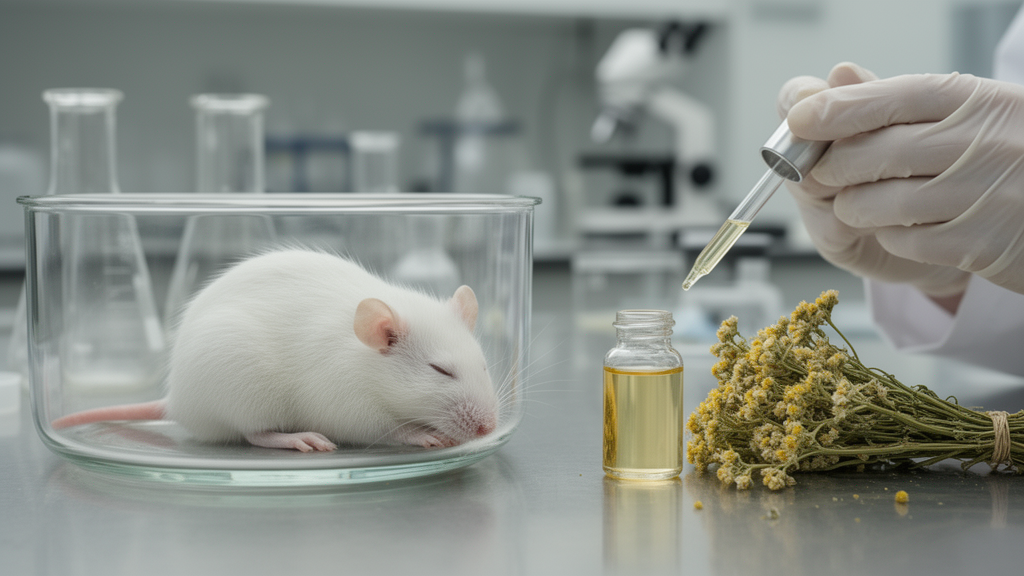
An aromatic desert shrub long used in Middle Eastern folk medicine has now been put through a systematic laboratory workout, and the results point to genuine sedative-like effects in rats, alongside cautionary signals at high doses.
The behavioral battery was unambiguous. In the open-field test, rats on the high dose showed a roughly 71 percent drop in line crossings and a 64 percent drop in rearing compared with controls, while immobility time rose nearly fivefold. The low dose produced smaller but still significant reductions in movement and exploration. In the hole-cross test, crossings through a wall opening fell by about 59 percent at the high dose and 52 percent at the low dose. On the rotarod, the time before falling off the rotating rod shortened by 51 percent in the high-dose group and 34 percent in the low-dose group, and in the wire wrist-grip test, hanging time fell by 66 percent and 31 percent respectively. Diazepam, the reference sedative, produced still larger effects on most measures.
One of the most striking results came from the negative geotaxis test, in which a rat placed head-down on an inclined plane must turn to face uphill. Extract-treated rats took substantially longer to complete the turn, with increases of 263 percent at the high dose and 174 percent at the low dose relative to controls, though both extract groups turned faster than the diazepam group. Together, the pattern of reduced locomotion, impaired grip and slowed righting suggests a depressant action on the central nervous system rather than a stimulant one.
Brain chemistry offered a plausible mechanism. Gamma-aminobutyric acid, the brain’s principal inhibitory neurotransmitter, rose by about 110 percent at the high dose and 72 percent at the low dose. The mRNA of GABARAP, a protein linked to GABA-A receptor trafficking, was upregulated roughly 184 percent at the high dose, though the low-dose increase did not reach statistical significance. Monoamine oxidase A, the enzyme that degrades dopamine and norepinephrine, was downregulated by about 60 percent at the high dose. The authors also report large increases in dopamine measured by ELISA, but they flag these numbers explicitly: the magnitudes exceed commonly reported values and may reflect antibody cross-reactivity or matrix interference, so confirmation by chromatographic methods such as LC–MS/MS is needed before any conclusion about the dopaminergic pathway.
The extract also shifted the brain’s oxidative balance. Total antioxidant capacity increased by 97 percent at the high dose and 67 percent at the low dose, while malondialdehyde, a lipid peroxidation marker, fell by roughly 57 and 52 percent. Protein carbonyl and 8-hydroxy-2-deoxyguanosine, markers of protein and DNA oxidation respectively, were also significantly reduced. Expression of the neuroplasticity genes BDNF and ARC rose significantly at the high dose, consistent with a coordinated neuroadaptive response involving inhibitory signaling and synaptic remodeling, although the authors caution that direct receptor activation was not tested and that the RT-PCR analysis used only three animals per group, limiting statistical power.
HPLC profiling identified eighteen phenolic and flavonoid compounds, dominated by naringenin at over 22,000 micrograms per gram, catechin, chlorogenic acid, diadzein and syringic acid. Many of these flavonoids are known from prior literature to interact with GABA-A receptors or benzodiazepine sites, and the authors suggest that compounds such as kaempferol and chlorogenic acid could partly underlie the observed anxiolytic-like and sedative profile. The quantification, however, was semi-quantitative, based on retention-time matching and relative peak areas without full method validation.
Safety data were mixed. In an acute toxicity screen following OECD Guideline 423, no mortality or overt signs of intoxication appeared even at doses above 2,000 milligrams per kilogram. Yet after fourteen days of repeated dosing, microscopic examination of brain sections from the high-dose group revealed shrunken eosinophilic neurons, perineuronal vacuolation and vascular congestion. These changes were not statistically significant across groups, but the authors argue they should not be dismissed, noting that supra-therapeutic doses of plant extracts can disrupt neurotransmitter balance and impose metabolic stress on neurons even when behavioral effects look transiently beneficial.
The study has other limitations the authors themselves enumerate. There was no vehicle-control group to separate extract effects from those of the propylene glycol carrier, only male rats were used so sex-specific responses remain unknown, and the dopamine assay was not chromatographically validated.
Overall, the work is the first in vivo demonstration that A. fragrantissima extract produces CNS-depressant, GABAergic and antioxidant effects in an animal model, lending tentative mechanistic support to its traditional use for nervous complaints. The authors conclude that the 800 milligram per kilogram dose cannot be assumed safe for repeated exposure and that well-defined dose–response studies, receptor-binding experiments, inclusion of both sexes and long-term toxicology will be required before any therapeutic claims can be considered.
Subject of Research: Neurobehavioral and neurochemical effects of Achillea fragrantissima ethanolic extract in male rats
Article Title: Neurobehavioral outcomes of Achillea fragrantissima ethanolic extract in male rats: modulation of GABAergic signaling, monoaminergic expression, neuroplasticity markers (BDNF, ARC), and oxidative stress
Article References: Eleiwa, N. Z., Khairy, M. H., Ahmed, A. M., Metwally, M. M. M., Abd El Aty, A. I., & Abu-Zeid, E. H. (2026). Neurobehavioral outcomes of Achillea fragrantissima ethanolic extract in male rats: modulation of GABAergic signaling, monoaminergic expression, neuroplasticity markers (BDNF, ARC), and oxidative stress. Future Journal of Pharmaceutical Sciences, 12(1), Article 96. https://doi.org/10.1186/s43094-026-01007-5
Image Credits: AI Generated
DOI: 10.1186/s43094-026-01007-5
Keywords: Achillea fragrantissima, ethanolic extract, CNS depression, GABA, BDNF, oxidative stress, diazepam, rats, behavioral tests, phytochemistry, neuroplasticity, MAOA
News Source: Ophelia Keating. (October 28, 2026). Desert Yarrow Extract Shows Sedative Effects in Rats, But High Doses Raise Safety Flags. Scienmag.