• HOME
  • NEWS
  • EXPLORE
    • CAREER
      • Companies
      • Jobs
    • EVENTS
    • iGEM
      • News
      • Team
    • PHOTOS
    • VIDEO
    • WIKI
  • BLOG
  • COMMUNITY
    • FACEBOOK
    • INSTAGRAM
    • TWITTER
Wednesday, May 13, 2026
BIOENGINEER.ORG
No Result
View All Result
  • Login
  • HOME
  • NEWS
  • EXPLORE
    • CAREER
      • Companies
      • Jobs
        • Lecturer
        • PhD Studentship
        • Postdoc
        • Research Assistant
    • EVENTS
    • iGEM
      • News
      • Team
    • PHOTOS
    • VIDEO
    • WIKI
  • BLOG
  • COMMUNITY
    • FACEBOOK
    • INSTAGRAM
    • TWITTER
  • HOME
  • NEWS
  • EXPLORE
    • CAREER
      • Companies
      • Jobs
        • Lecturer
        • PhD Studentship
        • Postdoc
        • Research Assistant
    • EVENTS
    • iGEM
      • News
      • Team
    • PHOTOS
    • VIDEO
    • WIKI
  • BLOG
  • COMMUNITY
    • FACEBOOK
    • INSTAGRAM
    • TWITTER
No Result
View All Result
Bioengineer.org
No Result
View All Result
Home NEWS Science News Biology

Dental microwear provides clues to dietary habits of lepidosauria

Bioengineer by Bioengineer
June 21, 2019
in Biology
Reading Time: 3 mins read
0
IMAGE
Share on FacebookShare on TwitterShare on LinkedinShare on RedditShare on Telegram

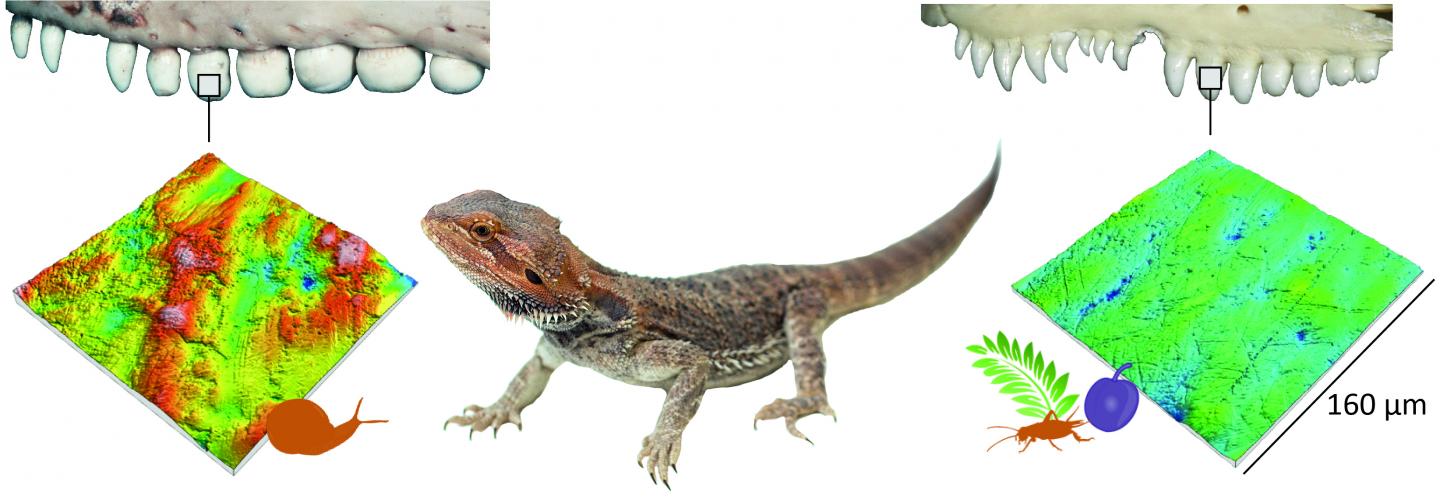
Microscopic images allow to differentiate between carnivores and herbivores and might support the discovery of the first herbivorous terrestrial vertebrates
IMAGE

Credit: Ill./©: Daniela E. Winkler, Michelle Aimée Oesch

High-resolution microscopic images of the surface of dental enamel of lepidosauria, which is a subclass of reptiles including monitor lizards, iguanas, lizards, and tuatara, allow scientists to determine their dietary habits. The enamel wear patterns reveal significant differences between carnivores and herbivores, but also allow finer distinctions, such as between algae-, fruit-, and mollusk-eating species. These findings are the result of research by a team led by scientists at Johannes Gutenberg University Mainz (JGU). They point out that so far it has always been difficult to make such fine distinctions between dietary behavior on the basis of dental or skeletal remains alone, particularly in the case of extinct species, because in many reptiles the teeth are of similar shape.

As the researchers report in Proceedings of the Royal Society B, they examined the upper teeth of 77 curated reptile specimens found in the wild and belonging to 23 extant species; the specimens were part of the collections of various natural history museums. For some of the samples, the researchers analyzed pieces of jaw containing teeth directly under a confocal microscope, while in other cases they made silicone impressions of the teeth which they then imaged. They created 3D surface models of the teeth and evaluated them with regard to 46 different characteristics, such as the number of furrows in the enamel and their mean depth. As a result, they found out that the animals could be grouped into different dietary categories based on their dental microwear textures. For example, the tooth enamel of carnivores exhibits only a few shallow furrows whereas the enamel of frugivores is very deeply furrowed. “This method was developed based on mammals. We applied it for the first time to reptiles and were able to show that it also works for lepidosauria,” stated Dr. Daniela Winkler of the Institute of Geosciences at JGU, lead author of the research paper. This was not necessarily what they had expected: “Reptiles hardly ever chew their food. Most of the time they simply bite off pieces of food and swallow them whole. Thus there was no guarantee that we would find informative traces of wear.”

The researchers now hope to be able to use the method to analyze teeth from dinosaurs and synapsids, which are very similar to those of lepidosauria, as well and finally identify the first herbivores among the terrestrial vertebrates. Synapsids are mammal-like reptiles, which inhabited the Earth around 310 million years ago, pre-dating dinosaurs by 70 million years. Some of them evolved from carnivores into herbivores. “This was a key event in evolution,” emphasized Winkler. “Our long-term goal is to find out when exactly this happened and in which species.”

###

Scientists from JGU, the Max Planck Institute for Evolutionary Anthropology in Leipzig, and the Center of Natural History at Universität Hamburg all contributed to the study. It is part of the Vertebrate Herbivory project led by Professor Thomas Tütken at the JGU Institute of Geosciences, funded by a Consolidator Grant from the European Research Council (ERC).

Media Contact
Dr. Daniela E. Winkler
[email protected]

Original Source

http://www.uni-mainz.de/presse/aktuell/8849_ENG_HTML.php

Related Journal Article

http://dx.doi.org/10.1098/rspb.2019.0544

Tags: BiodiversityBiologyEarth ScienceEvolutionPaleontology
Share12Tweet8Share2ShareShareShare2

Related Posts

Cutting-Edge Genomic Techniques Reveal Unexpected Cellular Changes in the Aging Brain — Biology

Cutting-Edge Genomic Techniques Reveal Unexpected Cellular Changes in the Aging Brain

May 12, 2026
USC Researchers Initiate Study on the Most Advanced Lab-Grown Kidney Structures — Biology

USC Researchers Initiate Study on the Most Advanced Lab-Grown Kidney Structures

May 12, 2026

Childbirth in Humans Is Not Uniquely Challenging Among Mammals, New Research Shows

May 12, 2026

From Complexity to Clarity: Unraveling the “Topological Laws” Governing Cell Death

May 11, 2026
Please login to join discussion

POPULAR NEWS

  • Research Indicates Potential Connection Between Prenatal Medication Exposure and Elevated Autism Risk

    842 shares
    Share 337 Tweet 211
  • New Study Reveals Plants Can Detect the Sound of Rain

    728 shares
    Share 290 Tweet 182
  • Salmonella Haem Blocks Macrophages, Boosts Infection

    62 shares
    Share 25 Tweet 16
  • Breastmilk Balances E. coli and Beneficial Bacteria in Infant Gut Microbiomes

    57 shares
    Share 23 Tweet 14

About

We bring you the latest biotechnology news from best research centers and universities around the world. Check our website.

Follow us

Recent News

Enhancing Carbon Capture Efficiency Using Laser-Engineered MOFs!

E-cadherin Loss Drives Tumor Environment in Lobular Cancer

Endothelial SPARC Drives Astrocyte Damage in NMOSD

Subscribe to Blog via Email

Enter your email address to subscribe to this blog and receive notifications of new posts by email.

Join 82 other subscribers
  • Contact Us

Bioengineer.org © Copyright 2023 All Rights Reserved.

Welcome Back!

Login to your account below

Forgotten Password?

Retrieve your password

Please enter your username or email address to reset your password.

Log In
No Result
View All Result
  • Homepages
    • Home Page 1
    • Home Page 2
  • News
  • National
  • Business
  • Health
  • Lifestyle
  • Science

Bioengineer.org © Copyright 2023 All Rights Reserved.