• HOME
  • NEWS
  • EXPLORE
    • CAREER
      • Companies
      • Jobs
    • EVENTS
    • iGEM
      • News
      • Team
    • PHOTOS
    • VIDEO
    • WIKI
  • BLOG
  • COMMUNITY
    • FACEBOOK
    • INSTAGRAM
    • TWITTER
Saturday, May 23, 2026
BIOENGINEER.ORG
No Result
View All Result
  • Login
  • HOME
  • NEWS
  • EXPLORE
    • CAREER
      • Companies
      • Jobs
        • Lecturer
        • PhD Studentship
        • Postdoc
        • Research Assistant
    • EVENTS
    • iGEM
      • News
      • Team
    • PHOTOS
    • VIDEO
    • WIKI
  • BLOG
  • COMMUNITY
    • FACEBOOK
    • INSTAGRAM
    • TWITTER
  • HOME
  • NEWS
  • EXPLORE
    • CAREER
      • Companies
      • Jobs
        • Lecturer
        • PhD Studentship
        • Postdoc
        • Research Assistant
    • EVENTS
    • iGEM
      • News
      • Team
    • PHOTOS
    • VIDEO
    • WIKI
  • BLOG
  • COMMUNITY
    • FACEBOOK
    • INSTAGRAM
    • TWITTER
No Result
View All Result
Bioengineer.org
No Result
View All Result
Home NEWS Science News Chemistry

Dendrimers finally have what it takes to break into the laser scene

Bioengineer by Bioengineer
May 8, 2020
in Chemistry
Reading Time: 2 mins read
0
IMAGE
Share on FacebookShare on TwitterShare on LinkedinShare on RedditShare on Telegram

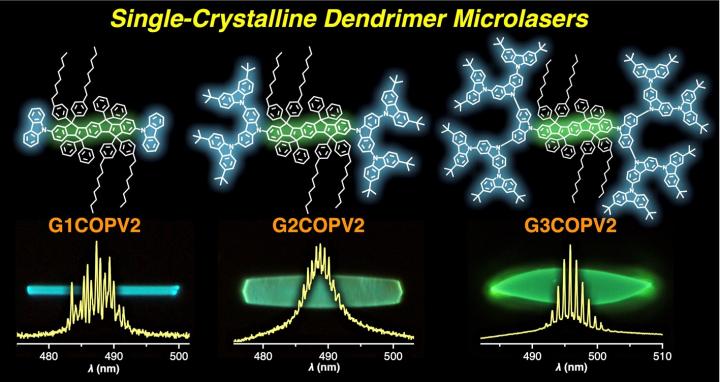
A team including researchers from the University of Tsukuba have synthesized branched polymer crystals that are tough enough to be used as tiny laser sources
IMAGE

Credit: University of Tsukuba

Tsukuba, Japan – The advances in optical devices that we expect as consumers must be supported by the development of new materials. Microcrystallites of luminescent organic compounds can act as tiny laser sources for such devices, for example for use in displays and other components. Dendrimers offer numerous advantages as luminescent materials, however so far they have not been used as microcrystallites owing to their fragility and poor crystallinity. Now a team of researchers has produced dendrimers that form robust crystals with lasing properties. Their findings are published in Angewandte Chemie.

Dendrimers are polymers that grow out from a core through the addition of small molecules to form extended branches–which explains their name, derived from the Greek word for tree. Dendrimers have many advantages that make them interesting luminescent materials. They are highly soluble, which makes them easy to incorporate into systems; they have high quantum yields, meaning you get a lot of the light you put in back again; they are good at harvesting light; and they tend to show relatively low luminescence loss when condensed into a solid.

The researchers made a family of dendrimers–getting larger in size as the generation number increased–made up of carbazole units forming the branches around a highly fluorescent core. The dendrimers formed stable single crystals even when the solvent was removed, and could be analyzed by single crystal X-ray analysis. In fact, the third generation dendrimer, which has a molecular weight of 4,600 Da, is the largest organic dendrimer ever to have been analyzed in this way.

“Our dendrimers have two key parts,” study corresponding author Professor Yohei Yamamoto explains. “The branches are made up of aromatic molecules that act as light harvesting antennas, collecting light made up of waves in many different planes, which is known as non-polarized light. This light is then transferred to the fluorescent core, whose structure leads to polarized light–light with waves in a single plane–being generated.”

When the dendrimer crystals were subjected to strong optical pumping–the process used to amplify the signal in laser materials–they produced amplified spontaneous emission and lasing with little damage to the structure of the material or the optical properties.

“The family of dendrimers we produced remedies a number of issues that have prevented the properties of these materials being exploited. We therefore expect them to make a significant contribution to the development of organic materials for laser optics,” says Professor Yamamoto. “The robust properties and laser emission of the crystals will be useful for components such as full-color optical displays and micro-optical circuits.”

###

Media Contact
Naoko Yamashina
[email protected]

Related Journal Article

http://dx.doi.org/10.1002/anie.202000712

Tags: Chemistry/Physics/Materials SciencesMaterialsOpticsPolymer Chemistry
Share12Tweet8Share2ShareShareShare2

Related Posts

Study Reveals How Valproate Affects Early Brain Development: Insights into the Antiepileptic Drug’s Impact — Chemistry

Study Reveals How Valproate Affects Early Brain Development: Insights into the Antiepileptic Drug’s Impact

May 22, 2026
Sustainable Chemistry: Iron Replaces Noble Metals in Catalytic Reactions — Chemistry

Sustainable Chemistry: Iron Replaces Noble Metals in Catalytic Reactions

May 22, 2026

Advancing Thin-Film Device Manufacturing with Imaging Ellipsometry for Enhanced Process Control

May 22, 2026

Simple Adjustment in 3D Printing Enhances Fit of Dental Crowns

May 22, 2026
Please login to join discussion

POPULAR NEWS

  • blank

    New Study Reveals Plants Can Detect the Sound of Rain

    734 shares
    Share 293 Tweet 183
  • ESMO 2025: mRNA COVID Vaccines Enhance Efficacy of Cancer Immunotherapy

    312 shares
    Share 125 Tweet 78
  • Research Indicates Potential Connection Between Prenatal Medication Exposure and Elevated Autism Risk

    847 shares
    Share 339 Tweet 212
  • Common Food Preservatives Associated with Elevated Blood Pressure and Increased Heart Disease Risk

    55 shares
    Share 22 Tweet 14

About

We bring you the latest biotechnology news from best research centers and universities around the world. Check our website.

Follow us

Recent News

Chewing, Nutrition, and Frailty in Elderly Patients

Fractional SIR Model Explores Vaccination Impact on Childhood Diseases

Fish Consumption and Mercury Exposure in Chicago Asians

Subscribe to Blog via Email

Enter your email address to subscribe to this blog and receive notifications of new posts by email.

Join 83 other subscribers
  • Contact Us

Bioengineer.org © Copyright 2023 All Rights Reserved.

Welcome Back!

Login to your account below

Forgotten Password?

Retrieve your password

Please enter your username or email address to reset your password.

Log In
No Result
View All Result
  • Homepages
    • Home Page 1
    • Home Page 2
  • News
  • National
  • Business
  • Health
  • Lifestyle
  • Science

Bioengineer.org © Copyright 2023 All Rights Reserved.