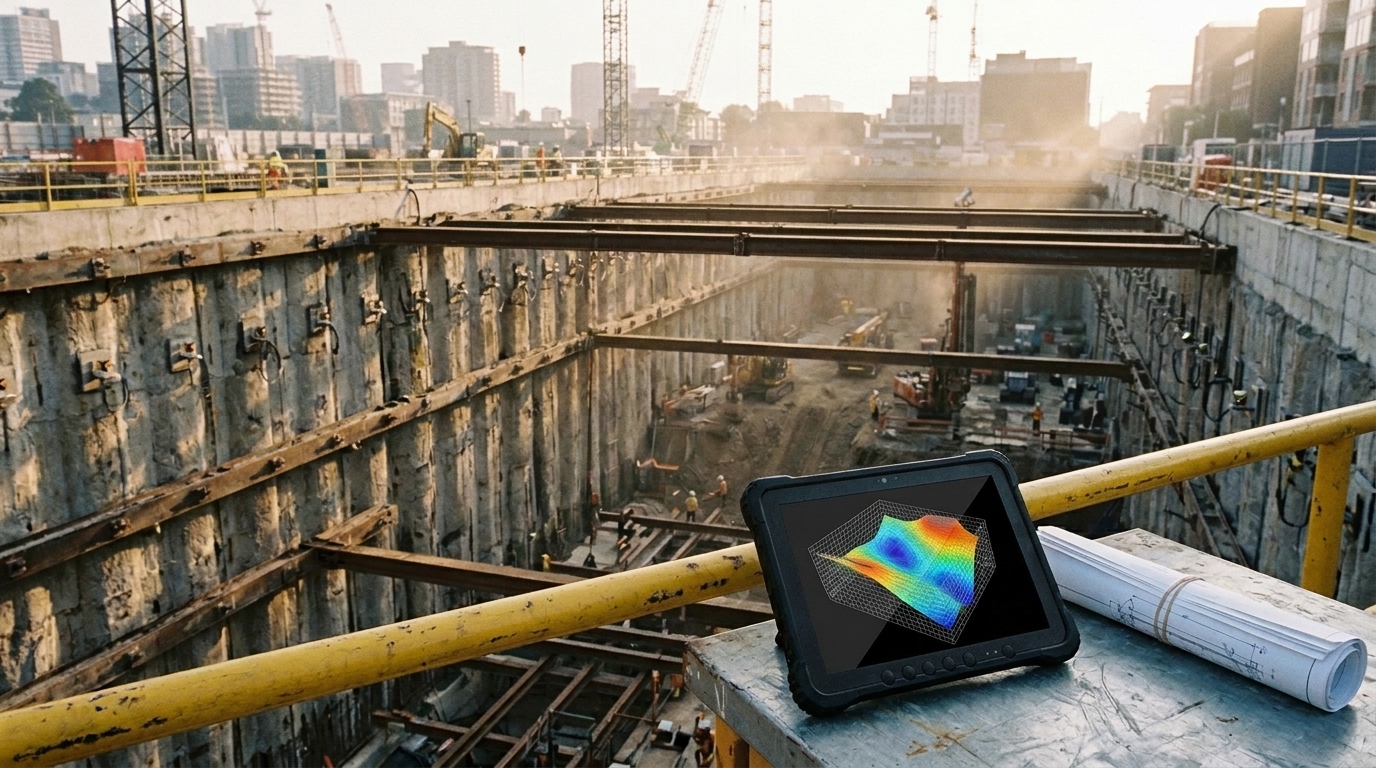
Engineers bracing deep excavations for metro stations now have a new tool for one of construction’s most stubborn forecasting problems: predicting how the concrete walls holding back the earth will bend weeks into the future. A research team working on Nanjing Metro Line 11 has developed a deep learning framework that fuses historical wall-deflection measurements with the planned sequence of excavation steps and strut installations, allowing it to forecast diaphragm wall deflections over long horizons with far less error accumulation than conventional autoregressive models. The study, published in AI in Civil Engineering, was validated on two foundation pit projects along the same metro line.
Diaphragm walls are the reinforced concrete barriers installed around the perimeter of a foundation pit before excavation begins. As soil is removed from inside the pit, the walls bow inward under changing earth pressures, and their lateral deflection is a critical indicator of whether the excavation system and nearby infrastructure remain safe. Real-time monitoring with inclinometers is standard practice, but monitoring only reports what has already happened. Predicting the full deflection profile days or weeks ahead would let engineers adjust excavation and support strategies before deformation becomes dangerous.
Machine learning-based autoregressive models have become popular for this task because they recursively use prior outputs as inputs for subsequent predictions, capturing the temporal evolution of deformation. Yet the authors of the new study identify two persistent weaknesses. First, these models generally perform well in short-term forecasting but degrade noticeably over longer horizons, because deformation evolves under the coupled influence of static ground conditions and dynamic construction activities such as strut installation, excavation pauses, and over-excavation. Most existing models rely solely on historical monitoring data and never see the construction schedule, so they struggle to infer deformation trends for subsequent excavation stages. Second, many models use fully connected layers as their output module, which flatten multi-dimensional feature maps and discard the spatial information embedded in them, undermining the reconstruction of the continuous deflection profile along the wall’s depth.
The proposed framework addresses both problems at once. Construction information and wall-deflection sequences are independently encoded by two LSTM-based encoders, which capture temporal dependencies in each data source. The encoded features are then concatenated along the channel dimension and processed by a convolutional encoder that extracts spatial deformation patterns from the fused representation. A 1D U-Net decoder, adapted from the image segmentation architecture introduced by Ronneberger and colleagues in 2015, reconstructs the spatially resolved deflection profile through multi-scale feature extraction, skip connections, and transposed convolution, avoiding flattening operations entirely. For multi-step prediction, the model first estimates deflection one time step ahead, feeds that prediction back as input, and iterates until the desired horizon is reached, enabling dynamic rolling prediction.
The construction-information input is deliberately lean. Wall deformation is strongly influenced by variables such as excavation depth, strut installation, strut axial force, and groundwater level, but in multi-step forecasting the future values of axial force and groundwater cannot be reliably predicted without additional models. Excavation depth and strut installation, by contrast, are predetermined by the construction scheme and can be updated at each prediction step. The feature vector therefore contains four components: excavation depth, strut type encoded as zero for concrete and one for steel, strut location measured as distance from the strut center to the ground, and strut axial stiffness. Zero padding aligns variable-length features so that uninstalled struts contribute consistent data dimensions.
A further refinement targets where accuracy matters most. Field experience shows that the maximum lateral deformation of a diaphragm wall typically occurs near the excavation face, in the upper portion of the wall. The researchers introduced a depth-weighted loss coefficient that divides the wall into an upper group and a lower group of measurement points and assigns them different weights in the mean squared error, with the shallow region receiving four times more gradient contribution than the deep region. Validation on inclinometer WD18 showed the weighted model consistently outperformed the standard-MSE version across all prediction steps, keeping peak errors within 2 mm at every horizon, while the unweighted model’s peak error climbed to 5.78 mm at 20 steps ahead.
The framework was tested on two braced excavation projects in the flat Yangtze River floodplain, both using bottom-up construction with similar stratigraphy of fill, mucky silty clay, silt, silty sand, and fine sand. Case 1 is a two-story underground island station roughly 177.4 m long with a pit depth of 17.55 m, supported by 53.1-m-long diaphragm walls and four strut levels. Case 2 is a 225-m-long station with an average excavation depth near 17 m, supported by 800-mm-thick walls embedded 45 m. From 23 inclinometers in Case 1 and 28 in Case 2, four representative positions were selected, each providing deflection profiles at 0.5 m sampling intervals down to 48 m and 44 m depth respectively. A separate model was trained for each monitoring section using only that section’s historical measurements, with the LSTM hidden state carried across consecutive sub-sequences during training.
Performance results support the design choices. For WD07 in Case 1, the 1-step-ahead prediction nearly coincided with measurements, with maximum deflection errors of only 0.06 mm and 0.26 mm for the two tested models. Even at 20 steps ahead, the in-band ratio, the share of points within a 15% error band around the maximum deflection, stayed above 75%. Adding ten more days of training data cut the peak error for a March 27 prediction from 1.63 mm to 0.50 mm and the mean absolute percentage error from 11.94% to 5.68%. In Case 2, long-term predictions stayed within the 15% band with in-band ratios never below 70%, although localized bulging treatment, over-excavation, water leakage, and struts installed without intended prestress introduced uncertainty the model inputs did not capture.
Comparative benchmarks sharpened the picture. Against four baselines trained identically on the first 70 days of WD18 data, the proposed model achieved peak errors of 0.16, 0.92, 3.54, 1.82, and 1.76 mm for 1-, 5-, 10-, 15-, and 20-step predictions, with in-band ratios never falling below 57.5%. A Transformer variant deteriorated fastest, reaching 17.93 mm peak error at 20 steps, while a temporal convolutional network variant exceeded 20% MAPE even at one step. The authors attribute this to the relatively short monitoring sequences and limited dataset size, which favor simpler, more robust LSTM encoders over data-intensive architectures. Removing the construction branch raised the 20-step peak error to 10.55 mm, confirming that dynamic prior constraints from the excavation plan are what suppress error accumulation.
The team also extended the framework to ground settlement prediction at three points adjacent to WD18, replacing the U-Net decoder with a fully connected layer suited to the smaller input dimension. Trained on 60 days of data, the fusion model achieved mean absolute errors between 0.37 and 0.52 mm and MAPEs between 3.04% and 6.67%, substantially better than a traditional single-source LSTM baseline. The authors note that disturbance factors such as ground overload, groundwater fluctuations, and leakage remain outside current inputs and may increase prediction uncertainty, and they plan to incorporate such features along with real-time alarm information in future work. For now, the results position the method as a practical candidate for deformation forecasting and construction risk management in foundation pit engineering.
Subject of Research: A multi-source deep learning framework for long-term prediction of diaphragm wall deflections in braced excavations
Article Title: A deep learning-based method for enhanced prediction of long-term diaphragm wall deflections using multi-source data
Article References: Liu, W., Xiao, Y., Tong, L., Li, H., Qiu, T., & Wu, H. (2026). A deep learning-based method for enhanced prediction of long-term diaphragm wall deflections using multi-source data. AI in Civil Engineering, 5(1), Article 28. https://doi.org/10.1007/s43503-026-00113-w
Image Credits: AI Generated
DOI: 10.1007/s43503-026-00113-w
Keywords: deep learning, diaphragm wall, braced excavation, LSTM, U-Net, deformation prediction, Nanjing Metro, foundation pit, autoregressive model, construction monitoring, settlement prediction, geotechnical engineering
News Source: Blake Davidson. (November 5, 2026). Deep learning model fuses construction plans with monitoring data to forecast diaphragm wall deflections. Scienmag.