


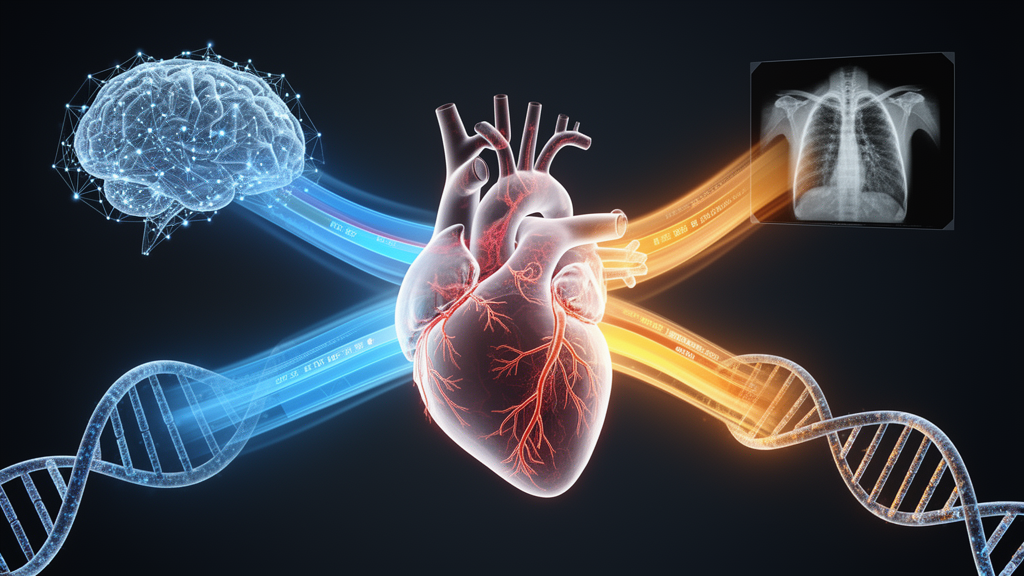
A new artificial intelligence framework called CardioHolisticAI, built around a predictive engine named MultiRiskNet, has been presented as a proof-of-concept method for sorting people into low, medium and high risk categories for coronary artery disease. The framework, described in a study published in Discover Computing, combines three very different kinds of information: structured clinical variables, imaging-derived radiomic descriptors and genomic pathway data. In repeated stratified five-fold cross-validation on a constructed benchmark of 140 composite multimodal instances, the model achieved an accuracy of 98.50 ± 0.16 percent, a Macro-F1 score of 0.985 ± 0.0015 and a one-vs-rest ROC-AUC of 0.992 ± 0.0009, outperforming all evaluated unimodal and conventional fusion baselines in that experimental setting.
The researchers, T. Aswani, Jose Moses Gummadi and G. Sharada, emphasize that these numbers describe internal methodological performance, not clinically validated results. The three data sources came from independent public repositories with no universal patient identifier, so the team could not link clinical records, images and gene expression profiles to the same individuals. Instead, they introduced a strategy called Cross-Modality Harmonised Cohort Alignment, or CMHCA, which aligns samples across modalities using three criteria: consistency of CAD risk labels, matching demographic stratification by age and sex, and phenotype-level cardiovascular correspondence based on indicators such as cholesterol category and blood pressure status. The resulting 140 composite cases should therefore not be read as 140 patients in whom all three modalities were collected simultaneously.
The clinical stream of the model draws on the UCI Cleveland Heart Disease Dataset, which contains 303 patient records and 13 clinical and demographic attributes including age, sex, resting blood pressure, cholesterol level, chest pain type and exercise-induced angina. After preprocessing, 18 clinical features were retained. A multilayer perceptron processes these standardized tabular variables, using batch normalization and a dropout rate of 0.30 to limit overfitting. The radiomic stream is more unusual: the team extracted 107 general imaging descriptors from the TCIA DeepLesion dataset, a collection of annotated lesions from routine CT scans that is not cardiac-specific and not coronary CT angiography. The authors are explicit that these descriptors should not be interpreted as measurements of coronary plaque, stenosis, myocardial morphology or any other CAD-specific structural abnormality; they serve only to test whether a generic imaging-derived feature stream can be integrated into the pipeline.
The genomic stream uses the GEO GSE90074 dataset, which contains blood-acquired expression profiles from 143 samples, including non-coding RNAs and protein-coding genes associated with CAD. After log-transformation, variance filtering and dimensionality reduction, 1,200 gene-expression features were retained. A graph neural network models gene-gene interactions, with edges built from curated biological knowledge such as protein-protein interaction data from the STRING database, Reactome pathways and KEGG cardiovascular disease pathways covering atherosclerosis and inflammation mechanisms. Each of the three streams produces an embedding of the same dimension, and an Adaptive Evidence Weighting Fusion module learns to weight the clinical, radiomic and genomic contributions adaptively rather than treating all evidence as fixed.
On the benchmark, which contained 46 low-risk, 48 medium-risk and 46 high-risk composite instances, MultiRiskNet outperformed a clinical-only multilayer perceptron, a radiomic-only convolutional network, a genomic-only graph network, an early fusion model that concatenated features, and a late fusion ensemble that averaged predictions. The unimodal baselines reached accuracies of 89.30, 92.10 and 93.40 percent respectively, while early fusion achieved 95.60 percent and late fusion 96.80 percent, against 98.50 percent for the full model. Pairwise statistical comparisons using conservative two-sided Welch tests with Holm correction found the improvements statistically significant, with the strongest baseline, late fusion, trailing by 1.70 percentage points in accuracy. The authors caution that these statistics reflect relative performance within the harmonised experiment and do not indicate superiority in different clinical cohorts.
Ablation experiments quantified how much each component contributes. Removing the genomic stream dropped accuracy to 96.40 percent, removing the radiomic stream to 96.90 percent, removing the attention mechanism to 96.20 percent, and removing the fusion module entirely to 95.10 percent, the largest degradation. This pattern suggests the learned cross-modal interaction, rather than any single modality, drives much of the performance. A controlled feature-masking test masked 10, 20 and 30 percent of features in each stream during inference; accuracy stayed above 97 percent with 10 percent masking and remained competitive at higher levels, though the authors note this simulates partial feature loss, not complete absence of a modality or systematic clinical missingness.
Robustness was probed further through noise injection, adversarial perturbation and repeated initialisations. Adding zero-mean Gaussian noise of 1, 3 and 5 percent of the normalized clinical feature scale produced only slight declines in accuracy and Macro-F1. Applying FGSM adversarial perturbations with strengths of 0.01, 0.03 and 0.05 to the radiomic and genomic streams showed controlled degradation, with overall accuracy at 94.80 percent at the highest perturbation level. Training the model with five different random seeds, and later with ten initialisations yielding 98.43 ± 0.18 percent accuracy with a 95 percent confidence interval of 98.32 to 98.54 percent, indicated the results were not sensitive to a particular initialization. The authors stress these are internal robustness evaluations that do not establish generalization to independent clinical populations.
Explainability is a central design goal. The framework integrates SHAP-based global importance, Integrated Gradients-based local attribution, radiomic feature ranking and pathway-level genomic analysis. The SHAP analysis highlighted classical CAD risk factors including age, cholesterol, resting blood pressure and ST-depression, and Integrated Gradients profiles for representative cases showed strong contributions from ischemia-related markers in a high-risk instance. Genomic contributions were aggregated into pathways related to inflammation, lipid metabolism, oxidative stress, platelet activation and endothelial dysfunction. The authors note, however, that similarity between model attributions and known clinical knowledge does not establish explanation faithfulness or clinical validity, and the quantitative agreement between SHAP and Integrated Gradients was not evaluated.
The framework also includes a treatment-recommendation module that maps predicted risk tiers to guideline-aligned action categories: low-risk predictions correspond to routine lifestyle advice and repeat assessment, medium-risk to physician assessment and risk-factor optimization, and high-risk to urgent cardiology referral and complete diagnostic workup. The authors describe these outputs as proof-of-concept decision support rather than clinically validated treatment recommendations. Calibration analysis produced a Brier score of 0.018 and a reliability diagram that stayed close to the ideal diagonal, suggesting the predicted probabilities were well calibrated within the evaluated conditions. Computationally, the model has 3.15 million trainable parameters, a 12.5 MB checkpoint, training time of 12.6 seconds per epoch, peak training memory of 3.5 GB and an average inference latency of 2.7 milliseconds per sample on an NVIDIA RTX 3090 GPU, though these measurements exclude data retrieval, image segmentation, radiomic extraction and genomic preprocessing.
The study’s limitations are substantial and acknowledged throughout. The imaging source is non-cardiac, the modalities are independently sourced and not clinically validated at the patient level, and the relatively small constructed benchmark may yield optimistic performance estimates despite leakage-controlled preprocessing, early stopping and repeated cross-validation. The robustness analyses did not test complete modality absence, non-random clinical missingness, genomic batch effects, sequencing platform differences, imaging protocol variation or institutional distribution shifts. The explainability outputs were not quantitatively assessed for faithfulness, attribution stability or agreement between methods, and no practising cardiologists evaluated them. Deployment evaluation was limited to model-level latency and memory measurements without integration with electronic health records, PACS, HL7 or FHIR systems. Before any clinical use, the authors call for external evaluation in a patient-linked multimodal cardiac cohort, quantitative explanation testing, cardiologist-in-the-loop assessment and prospective end-to-end workflow studies. Until then, CardioHolisticAI stands as a competitive proof-of-concept platform for multimodal CAD risk stratification rather than a validated clinical decision-support system.
Subject of Research: Multimodal deep learning framework for coronary artery disease risk stratification and personalized treatment recommendation
Article Title: CardioHolisticAI for multimodal deep learning based coronary artery disease risk stratification and personalized treatment recommendation
Article References: Aswani, T., Gummadi, J. M., & Sharada, G. (2026). CardioHolisticAI for multimodal deep learning based coronary artery disease risk stratification and personalized treatment recommendation. Discover Computing, 29(1), Article 818. https://doi.org/10.1007/s10791-026-10699-5
Image Credits: AI Generated
DOI: 10.1007/s10791-026-10699-5
Keywords: coronary artery disease, multimodal deep learning, risk stratification, radiomics, genomics, explainable AI, SHAP, Integrated Gradients, cardiovascular risk, treatment recommendation, graph neural network, clinical decision support
News Source: Blake Davidson. (October 30, 2026). Deep learning model fuses clinical, imaging and genomic data to stratify coronary artery disease risk. Scienmag.



