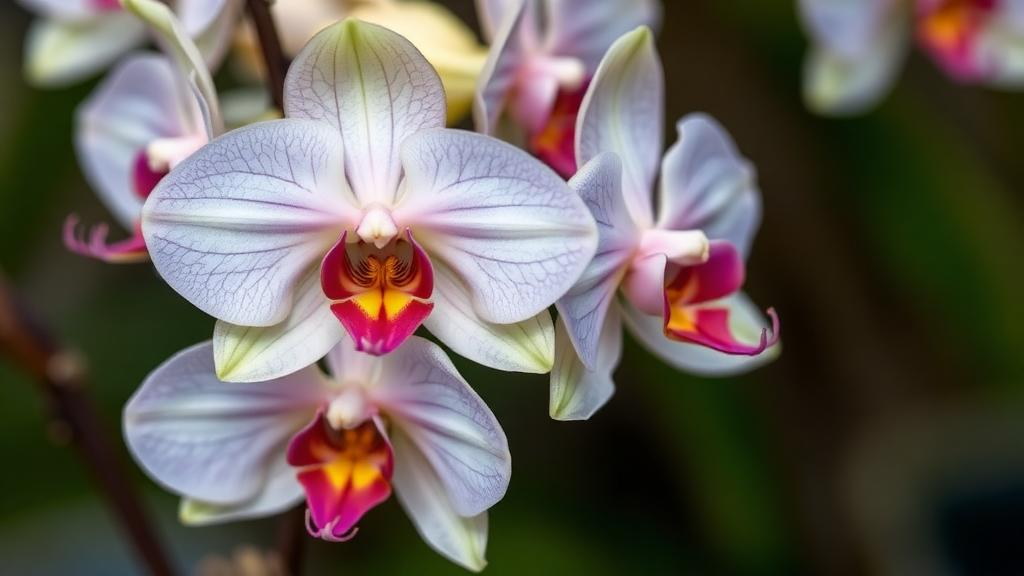
In the shaded understorey forests of South Korea, two wild orchids are running one of nature’s most elegant cons. They display showy flowers, attract a steady stream of insect visitors, and offer nothing in return — no nectar reward, no pollen snack. Yet a new field study shows that this deception works only for a select few: while flies swarmed the blooms in droves, only a handful of bee species actually left carrying the orchid’s pollinaria, the paired pollen packages that make reproduction possible. The findings, published in the Biodiversity Data Journal, offer a rare glimpse into the pollination ecology of Calanthe discolor and Calanthe striata in Korean populations and hint at a surprising possibility — that these closely related orchids may share a pollinator.
The mismatch between who visits and who actually pollinates is one of the most striking patterns to emerge from the study. Across 73 recorded visitation events on Calanthe discolor, flies in the order Diptera made up the bulk of the traffic, yet not a single fly or butterfly left the flowers carrying pollinaria. This pattern illustrates a central challenge in food-deceptive pollination systems: attracting visitors is relatively easy, but converting visits into pollen transfer is not. In deceptive orchids, insects that land on flowers expecting a reward quickly learn or simply fail to make the deep, sustained probing movements needed to contact the reproductive structures. The orchid’s pollinaria, with their sticky adhesive pads, attach only when an insect pushes deep into the floral spur, and shallow or brief visits simply do not produce that contact.
The bees that did carry pollinaria on C. discolor — the mining bee Andrena opacifovea, the Asian honeybee Apis cerana, the small carpenter bee Ceratina japonica and the sweat bee Lasioglossum formosae — represent a taxonomically diverse set of hymenopterans rather than a single specialised partner. This breadth matters for the orchid’s ecology. Generalised food deception, in which a plant mimics the general signals of rewarding flowers without imitating any specific model species, tends to attract a broad but inefficient visitor pool. The Korean observations fit this model well: many insects came, few carried pollen, and the effective pollinators were medium-to-large bees capable of probing deeply into the spur. This aligns with earlier work in Japan and China, where carpenter bees, long-horned bees, bumblebees and sweat bees have been documented as the principal pollinators of various Calanthe species.
Food deception is widespread among orchids and carries well-documented ecological consequences. Because visitors receive no reward, they tend to learn to avoid the deceptive flowers after one or a few unrewarded encounters, which typically depresses visitation rates and fruit set compared with rewarding plants. Deceptive orchids compensate in various ways — through variability in floral display, through exploiting newly emerged or naive insects, and through the sheer longevity of individual flowers, which can remain receptive long enough to accumulate rare effective visits. The low frequency of pollinaria-carrying visitors recorded in the Korean study is consistent with this broader picture: even during peak flowering on clear, sunny days chosen specifically to maximise insect activity, effective pollinator visits were rare events.
The single observation on C. striata is scientifically significant precisely because it is so sparse. One visitation event by the long-horned bee Eucera nipponensis, with pollinaria attached to the head and the insect moving between flowers, mirrors findings from Japan where the same species has been recorded pollinating hybrids between C. discolor and C. striata. Head-borne pollinaria are particularly consequential in orchids because their placement determines where pollen can be deposited on the next flower visited. If E. nipponensis forages across both taxa in Korean populations, as the Japanese evidence suggests it might, then pollen could move between the species, creating opportunities for hybridisation. This is a testable hypothesis rather than a demonstrated fact — the authors are careful to frame it that way — but it provides a concrete direction for future fieldwork involving more sites, longer observation windows and multiple flowering seasons.
The question of pollinator sharing carries real evolutionary weight. Closely related orchid taxa flowering in sympatry face a fundamental tension: shared pollinators can facilitate gene flow that erodes species boundaries, while pollinator partitioning can reinforce reproductive isolation. In orchids, where hybridisation is a well-known evolutionary force, the identity and behaviour of pollinators can therefore shape whether closely related species remain distinct or blend together. Korean botanical literature has long treated C. striata as a putative natural hybrid of C. discolor and C. sieboldii, and the two focal taxa of this study occur together on Jeju Island, where C. striata shows extensive morphological variation. Genetic work has already established that C. discolor and C. striata are closely related. Documenting which insects actually transport pollinaria between them is thus an essential first step toward understanding the reproductive dynamics of this system in Korea.
The fieldwork itself reflects the practical realities of studying pollination in shaded forest understoreys. Both study sites — a mixed forest on Anmyeon Island on the west coast and dense Japanese cedar stands at Darangswi Oreum on Jeju Island — shared a dense canopy that produced a shifting mosaic of sunflecks on the forest floor. Because insect activity tracks these ephemeral patches of light and warmth, the four trained observers moved continuously between orchid patches rather than remaining fixed at single plants. The surveys were timed to peak bloom, defined as the point when more than half the florets on each raceme were open, and conducted over twelve-hour spans from morning to evening on clear days in late April and early May, when ambient temperatures hovered around 15 degrees Celsius. Capturing insects only as they departed the inflorescences minimised disturbance, and every specimen was later re-examined under a stereomicroscope to confirm the presence or absence of pollinaria, with voucher specimens deposited at the Korea National Arboretum.
One methodological caveat deserves attention: because visitors were not individually marked and not all could be captured, the counts represent visitation events rather than unique individuals, and the same insect may have been recorded more than once. This is a standard and honest limitation of field pollination studies, but it means the true number of visiting insects could differ from the raw event counts. Similarly, a single season at two sites cannot capture the full temporal and geographic variation in pollinator assemblages, which is precisely why the authors present their results as baseline evidence and hypothesis-generating observations rather than definitive conclusions about pollinator identity across the Korean range of these orchids.
The conservation context adds urgency to this line of research. Calanthe species are prized ornamentals, and overcollection combined with habitat destruction has driven declines in wild populations, placing some species at risk. In South Korea, seven Calanthe species are recorded, and several carry formal conservation designations: C. aristulifera is listed as a Class II Endangered Wildlife species, while C. reflexa and C. sieboldii are classified as Endangered in the Korean National Red List. These orchids are largely restricted to the understorey of evergreen broad-leaved forests on the southern coastal islands and Jeju Island, where a mild oceanic climate prevails — habitats that are themselves limited and increasingly fragmented. Although artificial propagation techniques have been developed to support ex situ conservation, reintroduced or managed populations ultimately depend on natural pollination for long-term persistence. Understanding which insects actually move pollen, and under what conditions, is therefore not merely an academic question but a practical prerequisite for effective conservation planning.
The study also highlights how much basic pollination ecology remains undocumented even in well-studied temperate regions. Prior to this work, field data on floral visitor assemblages and pollinaria transport in wild Korean Calanthe populations were essentially absent, with only one recent field-based study of C. aristulifera providing a domestic point of comparison. The genus Calanthe comprises roughly 200 species of perennial terrestrial orchids distributed across Africa, Madagascar, China, Japan, tropical Asia and Australia, and only about eight species are known to self-pollinate, leaving the vast majority dependent on cross-pollination by animals. For most of these species, the identity of effective pollinators remains unknown or inferred from a handful of observations. Each regional study, such as this one, fills in a piece of that global picture while revealing how locally variable pollinator assemblages can be.
Looking forward, the framework established here suggests several productive avenues. Broader temporal sampling across multiple flowering seasons would reveal whether the bee-dominated pollinaria transport seen in 2025 is consistent year to year or reflects the particular conditions of a single spring. Population-level replication across the scattered island and coastal habitats where Korean Calanthe occur would show whether pollinator sharing between C. discolor and C. striata is geographically widespread or restricted to sites of sympatry such as Jeju Island. Direct tracking of pollen movement, whether through marked pollinaria or genetic paternity analysis, could confirm whether Eucera nipponensis and other shared visitors actually mediate gene flow between the taxa. And because the dataset underpinning the study has been deposited with the Global Biodiversity Information Facility, other researchers can independently examine and build upon the occurrence records. In the meantime, the study delivers a clear and useful message: in these deceptive Korean orchids, abundance of visitors is no measure of reproductive success, and the fate of each flowering season rests on the behaviour of a small, select guild of bees.
Subject of Research: Floral visitors and potential pollinators of the deceptive orchids Calanthe discolor and Calanthe striata in South Korea
Article Title: Floral visitors and potential pollinators of Calanthe discolor and C. striata in South Korea
Article References: Han, G. Y., Euo, S.-S., Son, S., Lee, H.-S., Choi, K., & Kim, C.-J. (2026). Floral visitors and potential pollinators of Calanthe discolor and C. striata in South Korea. Biodiversity Data Journal, 14, Article e201540. https://doi.org/10.3897/bdj.14.e201540
Image Credits: AI Generated
Keywords: Calanthe discolor, Calanthe striata, food-deceptive orchids, pollination ecology, pollinaria transport, Eucera nipponensis, bees, South Korea, Orchidaceae, field observation, pollinator sharing, biodiversity
News Source: Julie Wynn. (October 17, 2026). Deceptive orchids in South Korea reveal a surprising gap between flower visitors and true pollinators. Scienmag.