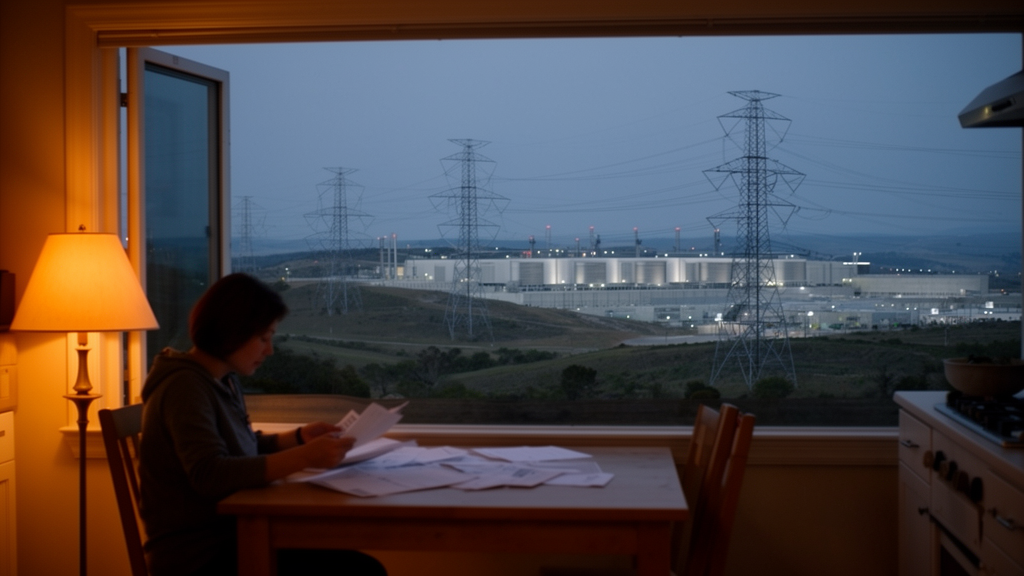
Data centre expansion driven by rapid artificial intelligence growth asymmetrically deepens household energy burdens across the United States. In a study published in Nature Energy, researchers Cheng Feng and Fengqi You investigated the understudied consequences of this energy-intensive expansion on household welfare and electricity systems, showing that impacts compound across multiple operational and regulatory channels.
To evaluate these dynamics, the authors conducted a causal analysis of electricity price records alongside transmission plans and regulatory cost-allocation dockets. Their analytical approach applied a quasi-static counterfactual framework to assess socio-economic disparities in energy burden increases associated with data centre expansion in 2025.
In wholesale electricity markets, the researchers found that cumulative price increases attributable to data centre expansion exceed 10% in the most exposed commercial hubs by 2025.
Beyond wholesale markets, the study identified regressive grid cost shifting embedded within regulated utility tariffs and transmission infrastructure planning. In these regulated tariffs, residential users are allocated a median of 47% of transmission infrastructure costs despite contributing far less to overall demand growth, producing a cross-subsidy between cost attribution and cost allocation for transmission projects attributed to 2025 load growth.
These combined channels generate compounding, asymmetric energy burdens across different demographic and geographic populations. Spatially, transmission cost sharing forces rural communities to absorb energy burden increases that are 76% larger than those borne by urban communities. Economically, the lowest-income households face additional energy burdens of up to 28 percentage points, highlighting severe socio-economic disparities.
Fiscally, the investigation revealed that local economic returns are almost unrelated to data centre spending, demonstrating a spending elasticity of only 0.16 relative to fiscal incentives and energy burdens. The states absorbing the largest energy burden increases capture the smallest economic returns, leading the researchers to perform an incentive compatibility analysis evaluating two potential data centre cost-mitigation pathways.
Subject of Research: Impact of US data centre expansion on electricity prices and household energy burdens
Article Title: Data centres asymmetrically exacerbate energy burdens through wholesale price increases and regressive grid cost shifting
Article References: Feng, C., & You, F. (2026). Data centres asymmetrically exacerbate energy burdens through wholesale price increases and regressive grid cost shifting. Nature Energy. https://doi.org/10.1038/s41560-026-02163-x
Image Credits: AI Generated
DOI: 10.1038/s41560-026-02163-x
Keywords: data centres, energy burdens, wholesale electricity prices, transmission infrastructure, utility tariffs, cost allocation, artificial intelligence, rural communities, Data, centres, asymmetrically, exacerbate
News Source: Denise Maddox. (November 9, 2026). Data Centre Growth Asymmetrically Increases US Household Energy Burdens. Scienmag.