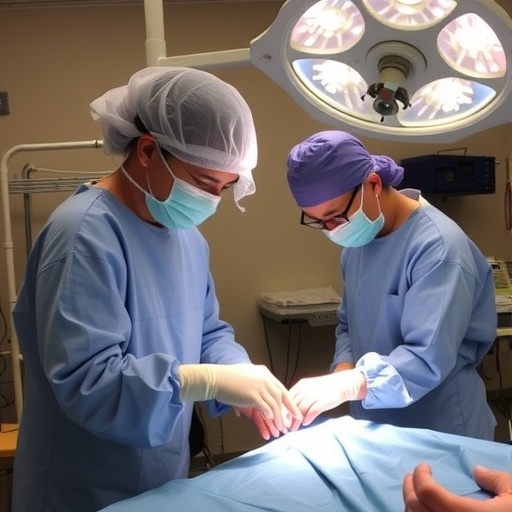
In a groundbreaking advancement poised to reshape ovarian cancer prevention, Canadian researchers have unveiled compelling evidence that opportunistic bilateral salpingectomy (OS) dramatically curtails the risk of serous ovarian cancer, the predominant and most lethal subtype of the disease. Published in the prestigious journal JAMA Network Open, this study epitomizes a decade-long collaboration led by the University of British Columbia (UBC) alongside BC Cancer and Vancouver Coastal Health, signifying a monumental leap forward in gynecological oncology.
Ovarian cancer notoriously ranks as the most fatal gynecological malignancy, with approximately 3,100 new diagnoses and nearly 2,000 deaths annually in Canada alone. A significant challenge in managing this disease stems from the absence of effective early detection methods, resulting in most patients confronting advanced-stage diagnosis when therapeutic options are limited and prognosis is poor. The discovery that most serous ovarian cancers originate within the fallopian tubes rather than the ovaries catalyzed the conception of OS—a preventative surgical strategy involving the removal of fallopian tubes during unrelated routine gynecological procedures.
Opportunistic salpingectomy gains particular relevance because it leverages moments during hysterectomies or tubal ligations—surgical interventions typically unrelated to cancer prevention—to excise fallopian tubes proactively. Crucially, OS preserves ovarian function, bypassing premature menopause and its associated hormonal complications. This strategy’s subtle yet profound innovation lies in its preventive stance—preempting disease rather than attempting treatment post-diagnosis, which represents a paradigm shift in gynecologic cancer care.
The study, orchestrated by the Ovarian Cancer Observatory—a prominent B.C.-based international research consortium—meticulously analyzed population-wide health records of over 85,000 individuals who underwent gynecological surgeries in British Columbia between 2008 and 2020. By employing sophisticated statistical modeling and comparative analyses, researchers quantified the long-speculated protective effect of OS on serous ovarian cancer development, yielding a staggering 78% risk reduction. Furthermore, those rare cases of cancer arising following OS exhibited less aggressive biological behavior, implying a favorable modification of the disease’s natural history.
This monumental finding not only validates prior smaller-scale studies but also addresses critical concerns surrounding the safety, hormonal impact, and cost-effectiveness of OS. The collective evidence confirms that OS does not precipitate earlier menopause, assuaging fears tied to hormonal imbalances. Its integration into standard care pathways also presents a cost-efficient approach for health systems globally, representing a sustainable advancement in public health priorities.
The pioneers behind this transformative approach, including Dr. Dianne Miller—who first coined and refined the OS procedure—emphasize the irreplaceable value of cancer prevention over treatment. Her poignant assertion, “If there is one thing better than curing cancer, it’s never getting the cancer in the first place,” underscores the ultimate ambition of this strategy. OS stands as a testament to how targeted surgical innovation rooted in understanding tumor origin can yield profound life-saving effects.
Remarkably, British Columbia was the first jurisdiction worldwide to systematically implement OS in 2010, setting a global precedent that has inspired similar guidelines across 24 countries. This widespread professional endorsement ranges from governmental health bodies to medical societies like the Society of Obstetrics and Gynaecology of Canada, amplifying the potential to reduce ovarian cancer mortality on a global scale.
The implications extend beyond gynecology. Recent expansions in British Columbia envisage incorporating OS into other types of abdominal and pelvic surgeries, performed by general and urologic surgeons, broadening the pool of individuals who could benefit from this intervention. Supported by provincial health authorities and professional medical associations, these initiatives exemplify an interdisciplinary approach to cancer prevention.
The broader medical community has lauded these advancements as a triumph of translational research seamlessly connecting molecular pathology, epidemiology, and clinical practice. Dr. David Huntsman, an esteemed pathologist and oncologist, highlights that the protective impact of OS “is even greater than we expected,” emphasizing the critical role of integrating surgical innovation with pathophysiological insights.
As OS adoption accelerates worldwide, its direct effect on reducing serous ovarian cancer incidence could translate into thousands of lives saved annually. This research stands as a clarion call to clinicians globally to implement OS as a standard preventive measure, fundamentally altering the landscape of ovarian cancer management.
In summary, opportunistic bilateral salpingectomy represents a trailblazing advancement in cancer prevention, blending surgical innovation, population health data, and molecular oncology to achieve unprecedented reductions in ovarian cancer risk. With continued advocacy and adoption, OS harbors the potential to revolutionize gynecologic oncology and dramatically improve global women’s health outcomes.
Subject of Research: People
Article Title: Serous Ovarian Cancer Following Opportunistic Bilateral Salpingectomy
News Publication Date: 2-Feb-2026
Web References: https://jamanetwork.com/journals/jamanetworkopen/fullarticle/10.1001/jamanetworkopen.2025.57267
References: 10.1001/jamanetworkopen.2025.57267
Keywords: Ovarian cancer, Surgical procedures, Preventive medicine
Tags: BC Cancer research advancementsearly detection challenges in ovarian cancerfallopian tube removal surgerygroundbreaking gynecological oncology researchhormonal implications of salpingectomyhysterectomy and cancer preventionopportunistic bilateral salpingectomyovarian cancer prevention techniquesovarian cancer statistics in Canadaserous ovarian cancer risk reductionsurgical innovations in cancer careUniversity of British Columbia studies