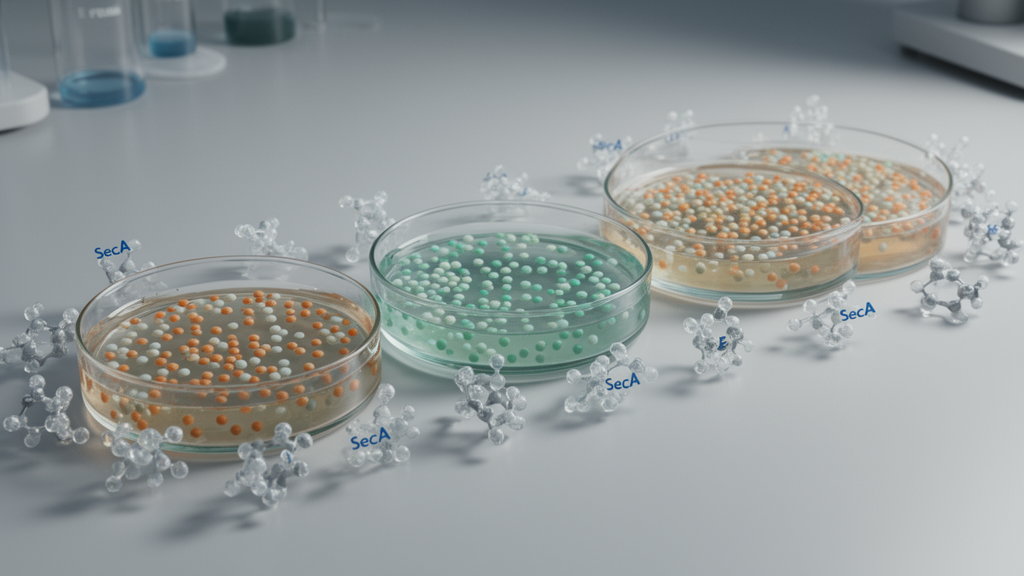
Cumulative mutations in SecA, an essential bacterial ATPase inhibited by sodium azide, enabled substantially improved growth of Escherichia coli under azide stress, according to the study. The researchers built a SecA variant carrying five amino acid substitutions that supported growth in liquid culture at sodium azide concentrations as high as 200 micrograms per milliliter. The result advances a plasmid-based selection strategy that does not itself encode resistance to a conventional antibiotic, but the current prototype still requires tetracycline co-selection and has not achieved stable recovery of transformants with azide alone.
The work addresses a problem created by the global spread of multidrug-resistant bacteria: antibiotic-resistance genes can be difficult to use as genetic selection markers when analyzing such strains. Earlier research had found that the SecA F598L substitution conferred only limited resistance to sodium azide, and the plasmid-borne mutation produced only marginal resistance in an azide-sensitive background. The new experiments indicate that this limited effect resulted from the coexistence of plasmid-derived mutant SecA and chromosomal wild-type SecA, which attenuated the resistant phenotype.
To overcome that suppression, the researchers combined F598L with a newly identified G516C substitution. Together, the two mutations markedly enhanced resistance to azide. Chromosomal replacement with SecA carrying both G516C and F598L then confirmed the underlying relationship: when wild-type SecA coexisted with the mutant protein, it suppressed the resistant phenotype. This coexpression experiment supports the conclusion that a single plasmid-borne SecA mutation is less effective because functional wild-type SecA remains present alongside the mutant enzyme.
The researchers subsequently used error-prone PCR to generate additional cumulative SecA mutants. One variant combined five substitutions—G516C, F598L, L279P, S678I and A867G—and supported substantially improved, though progressively reduced, growth in liquid culture as the sodium azide concentration increased. Its performance at concentrations up to 200 micrograms per milliliter therefore did not represent uniform resistance across all tested conditions. Instead, the observations demonstrate a stepwise improvement in the ability of mutant SecA to overcome azide-mediated inhibition.
Collectively, the experiments provide proof of concept in E. coli for a plasmid-borne genetic marker based on mutations in an essential protein rather than an antibiotic-resistance gene. The reported system is not yet a self-sufficient, azide-only selection method: stable recovery of transformants still required co-selection with tetracycline, and selection by azide alone remains to be achieved. Because SecA is conserved and essential, the authors present the strategy as conceptually extendable to other bacteria, including multidrug-resistant strains, although the study’s demonstrated results concern the E. coli prototype.
Subject of Research: Experimental engineering of cumulative SecA mutations for azide-based genetic selection in Escherichia coli
Article Title: Stepwise accumulation of SecA mutations enables high-stringency azide-based selection in Escherichia coli
Article References: Nakagami, M., & Abe, A. (2026). Stepwise accumulation of SecA mutations enables high-stringency azide-based selection in Escherichia coli. The Journal of Antibiotics. https://doi.org/10.1038/s41429-026-00968-2
Image Credits: AI Generated
DOI: 10.1038/s41429-026-00968-2
Keywords: E. coli, SecA, sodium azide, genetic selection, mutations, plasmid marker, antibiotic resistance, error-prone PCR, bacterial engineering, Stepwise, accumulation, enables
News Source: Ophelia Keating. (October 20, 2026). Cumulative SecA mutations strengthen azide selection in an E. coli prototype. Scienmag.