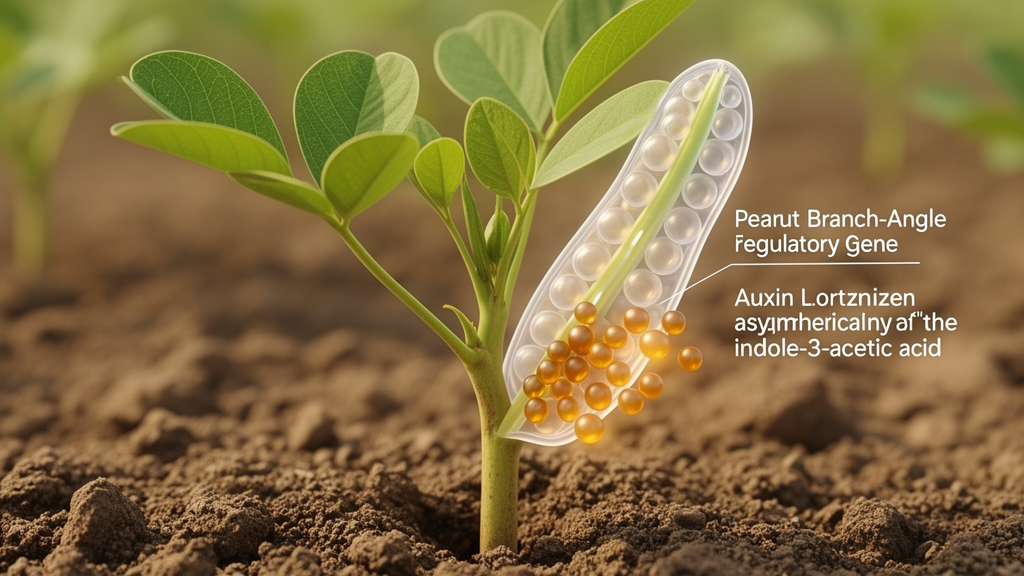
A genetic screen has identified AhPILS, a peanut gene that regulates whether lateral branches grow close to the ground or adopt an erect habit. In an experimental study published in The Crop Journal, researchers in China linked mutations in the gene to the erect phenotype of a mutant line, then traced its effect to asymmetric auxin distribution at the base of lateral branches. The study found that AhPILS-mediated polar auxin transport establishes an auxin concentration gradient, regulates cell elongation and contributes to the transition from prostrate to erect growth.
Peanut is an oilseed and cash crop cultivated in more than 100 countries. Its plant architecture, described in the study as the morphological characteristics and spatial arrangement of a plant, influences planting density, light-use efficiency and final yield. Lateral-branch angle is a central architectural trait because it affects peg-penetration efficiency, planting-density configuration, field-management practices, suitability for mechanized harvesting and aflatoxin prevention and control. The reported work focused on the genetic and hormonal mechanisms controlling this trait rather than on a direct evaluation of all of those agronomic outcomes.
To identify genes involved in peanut architecture, the researchers performed physical mutagenesis on a prostrate-growth peanut variety and screened the resulting mutant library. They isolated a mutant designated eg06g that displayed erect growth. Genetic-mapping results showed that a mutation in AhPILS was responsible for its erect phenotype. The article title describes AhPILS as a PIN-LIKES protein, while the study’s developmental findings connect the gene to polar auxin transport. Together, the experiments provide a link between a specific genetic change, hormone redistribution and the orientation of peanut lateral branches.
The mechanism identified in the study provides a molecular explanation for the altered growth habit. AhPILS-mediated polar auxin transport creates an unequal auxin distribution at the base of lateral branches. This concentration gradient regulates cell elongation and ultimately supports the developmental change from the prostrate habit of the original variety to the erect habit of the mutant. The reported results therefore distinguish the measurable finding—a mutation linked to erect lateral branches and a mechanism involving asymmetric auxin transport—from the broader breeding applications that may follow from it.
Principal investigator Chuanzhi Zhao said varieties with ideal plant architecture could improve photosynthetic efficiency, reduce seed consumption, increase lodging resistance, reduce the application of plant-growth-regulator agrochemicals and facilitate mechanized peanut harvesting. The researchers also describe ideal architecture combined with two-stage harvesting as a practice that can markedly mitigate aflatoxin contamination during harvest. These statements identify proposed breeding and production relevance; the reported study itself centers on experimental gene mapping and the developmental mechanism of branch-angle regulation. Zhao added that mining additional loci and expanding the available gene resources for plant-architecture regulation are important for creating peanut materials with ideal architecture through biotechnology.
The study supplies a candidate genetic target for future work on peanut branching. A quantitative-trait locus controlling lateral-branch angle had previously been reported on peanut chromosome 15, but the molecular mechanism underlying peanut-architecture regulation remained largely unclear. By identifying AhPILS in the eg06g mutant and linking its action to polar auxin transport, asymmetric auxin distribution and cell elongation, the researchers provide new information about how peanut lateral branches change from prostrate to erect growth. The work also offers germplasm and a mechanistic foundation for continued genetic investigation of plant architecture in peanut.
Subject of Research: Experimental identification of a peanut gene that regulates lateral-branch angle through asymmetric auxin transport.
Article Title: Decoding the genetic mechanism of peanut plant architecture for lodging‑resistance and safe production
Article References: Decoding the genetic mechanism of peanut plant architecture for lodging‑resistance and safe production. Original publication (Bibliographic details unavailable.)
Image Credits: AI Generated
DOI: Not provided
Keywords: peanut, AhPILS, plant architecture, auxin transport, lateral-branch angle, cell elongation, crop genetics, mutant screening, plant breeding, Decoding, genetic, mechanism
News Source: Juliet Wilcox. (October 20, 2026). Peanut gene regulates branch angle through asymmetric auxin transport. Scienmag.