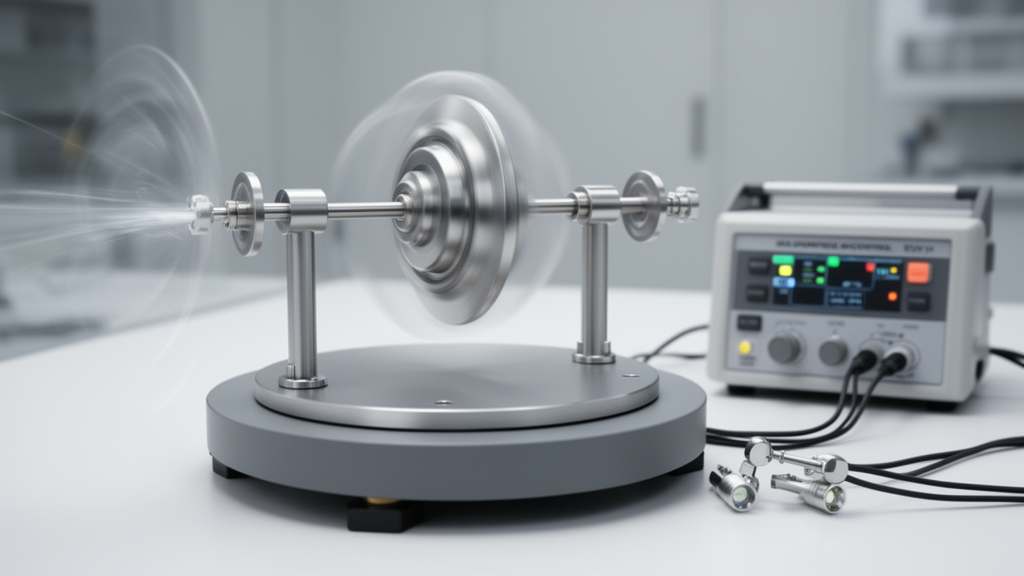
An adaptive neural-network controller using signed power functions outperformed previously proposed controllers in disturbance-rejection tests on an underactuated two-degree-of-freedom control moment gyroscope. Under disturbance-induced conditions, the proposed scheme improved relative root mean square tracking-error performance by 89.7% and control-torque performance by 2.41% compared with the reference controller, according to the study’s abstract. The experiments, reported in Neural Computing and Applications , compared the new controller with control schemes previously proposed in the literature for the same type of gyroscope.
Evaluations were conducted both without an applied disturbance and with induced disturbances. Across those comparisons, the adaptive controller achieved the best relative root mean square performance of the schemes included in the experiment. The approach differs from a neural controller with weights fixed before operation because its network weights are updated online.
The authors state that this design avoids a separate offline training phase and permits real-time disturbance compensation. No pretraining procedure is required for the proposed controller, while its update law incorporates signed power functions. The research also included an analysis of the closed-loop trajectories produced by the proposed control scheme.
These trajectories describe the gyroscope’s behavior under closed-loop operation, complementing the experimental comparisons with the other controllers. The supplied article abstract does not provide the numerical trajectory results or the mathematical details of the closed-loop analysis. The reported tracking result was measured in a laboratory experiment rather than inferred from a simulation or a mathematical prediction.
In the disturbance-induced trials, the adaptive controller’s relative root mean square tracking-error performance improved by 89.7% relative to the reference scheme. The study also reported a 2.41% improvement in control-torque performance under the same conditions. Two kinds of test conditions were used to assess the controller.
Disturbance-free experiments examined its baseline tracking behavior, while disturbance-induced experiments evaluated performance when disturbances were introduced. Adaptive neural networks are used in the study to compensate for incomplete knowledge of a system’s mathematical model, uncertainty in system parameters and external disturbances. Their key operational distinction in this work is the ability to update network weights during the experiment, rather than relying only on weights established beforehand.
Signed power functions form part of that online weight-update law. The evidence is limited to the tested underactuated two-degree-of-freedom control moment gyroscope and the controller configurations included in the experiments. The supplied abstract does not report trial counts, uncertainty intervals, operating environments, deployment tests or results for other gyroscope designs.
The findings therefore demonstrate improved performance in this laboratory setup, not a general advantage across all gyroscopes or control applications.
Subject of Research: Experimental evaluation of online adaptive neural control for disturbance rejection in an underactuated control moment gyroscope
Article Title: Strong disturbance rejection via neuro-adaptive signed power function tracking control for an underactuated control moment gyroscope
Article References: López, S., Montoya–Cháirez, J., Llama, M. A., & Santibáñez, V. (2026). Strong disturbance rejection via neuro-adaptive signed power function tracking control for an underactuated control moment gyroscope. Neural Computing and Applications, 38(20), Article 828. https://doi.org/10.1007/s00521-026-12565-3
Image Credits: AI Generated
DOI: 10.1007/s00521-026-12565-3
Keywords: adaptive neural networks, control moment gyroscope, disturbance rejection, signed power functions, online weight updates, trajectory tracking, underactuated systems, control torque, closed-loop control, Strong, disturbance, rejection
News Source: Cassandra Pierce. (October 20, 2026). Adaptive neural control improves disturbance rejection in laboratory gyroscope tests. Scienmag.