• HOME
  • NEWS
  • EXPLORE
    • CAREER
      • Companies
      • Jobs
    • EVENTS
    • iGEM
      • News
      • Team
    • PHOTOS
    • VIDEO
    • WIKI
  • BLOG
  • COMMUNITY
    • FACEBOOK
    • INSTAGRAM
    • TWITTER
Saturday, June 27, 2026
BIOENGINEER.ORG
No Result
View All Result
  • Login
  • HOME
  • NEWS
  • EXPLORE
    • CAREER
      • Companies
      • Jobs
        • Lecturer
        • PhD Studentship
        • Postdoc
        • Research Assistant
    • EVENTS
    • iGEM
      • News
      • Team
    • PHOTOS
    • VIDEO
    • WIKI
  • BLOG
  • COMMUNITY
    • FACEBOOK
    • INSTAGRAM
    • TWITTER
  • HOME
  • NEWS
  • EXPLORE
    • CAREER
      • Companies
      • Jobs
        • Lecturer
        • PhD Studentship
        • Postdoc
        • Research Assistant
    • EVENTS
    • iGEM
      • News
      • Team
    • PHOTOS
    • VIDEO
    • WIKI
  • BLOG
  • COMMUNITY
    • FACEBOOK
    • INSTAGRAM
    • TWITTER
No Result
View All Result
Bioengineer.org
No Result
View All Result
Home NEWS Science News

Cultivating Matsutake, valuable edible fungi

Bioengineer by Bioengineer
April 14, 2021
in Science News
Reading Time: 2 mins read
0
IMAGE
Share on FacebookShare on TwitterShare on LinkedinShare on RedditShare on Telegram

IMAGE

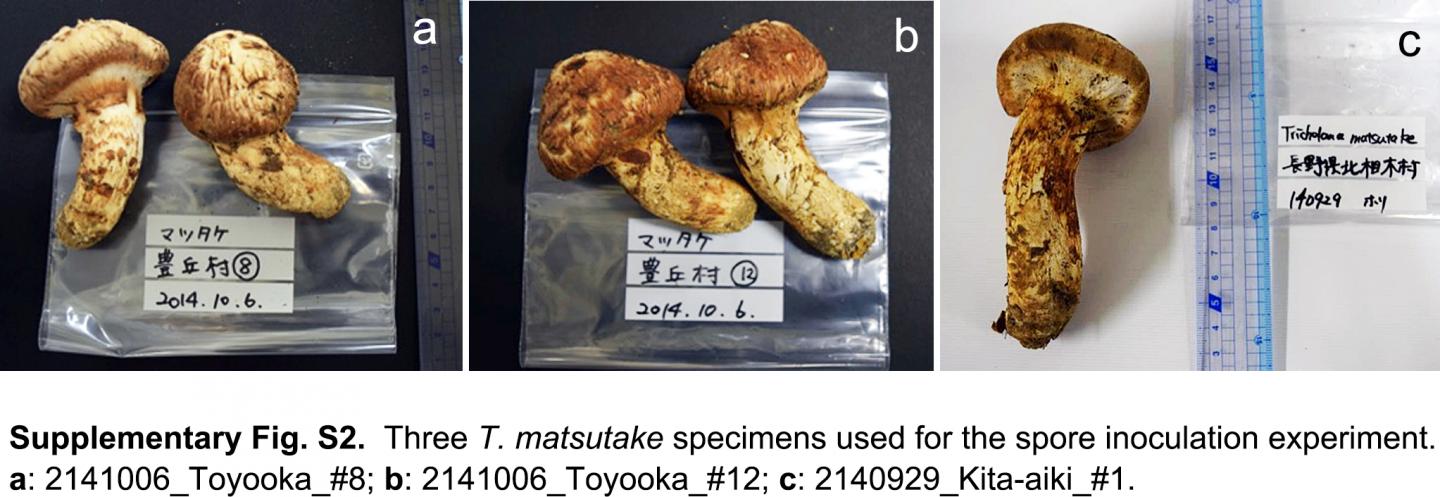
Credit: Copyright © 2021, Akiyoshi Yamada et al., under exclusive license to Springer-Verlag GmbH Germany, part of Springer Nature

Costing anywhere from 15 to 70 dollars per mushroom depending on the quality, matsutake mushrooms are some of the most valuable edible fungi in the world. Revered for their delicate scent, matsutake mushrooms are cooked in rice or soups as an Autumn celebration delicacy in Japan. However, there is no way to cultivate matsutake mushrooms and naturally occurring habitats are decreasing with fewer forests conducive to their growth with the changing climate.

Corresponding author Professor Akiyoshi Yamada of Shinshu University’s Department of Agriculture, Department of Bioscience and Biotechnology, and Institute for Mountain Science with 9 other researchers set out to present concrete evidence that matsutake spores germinate, reach the roots of the host, and coexist to produce offspring that starts a new symbiosis.

When matsutake spores germinate, mycelia in the soil corresponding to their parents induce germination and form a genetically diverse population on the root system of the host. It is therefore hypothesized that the next generation can be created while maintaining a diverse pool.

With this novel experiment, matsutake mushrooms and Japanese red pine were cultured in a vessel, and spores collected from the fruiting bodies of matsutake mushrooms collected outdoors were inoculated to germinate in order to successfully establish a new hypha in the roots of Japanese red pine.

The researchers were successful in germinating the spore of matsutake by proving that artificially controlling the phenomenon of generational change of matsutake mushrooms in the natural world. They hope to establish an artificial cultivation technique for matsutake mushrooms in the forest.

Since this study introduces fresh matsutake spores into the experimental system, it is difficult to carry out this study unless there is a supply of matsutake nearby. In other words, it can be said that this research finding best utilized the location of the Faculty of Agriculture, Shinshu University to germinate the spore of matsutake, the most valuable wild edible mushrooms in the world.

###

Acknowledgements: Masamichi Ichikawa for the supply of fresh Tricholoma matsutake samples in the spore inoculation experiment, and Hitoshi Murata in Forestry and Forest Products Research Institute for the technical advice in DNA analyses. The members of Applied Mycology Laboratory, Shinshu University for their support of this study.

Funding: This study was supported in part by KAKENHI Grant Number 15H01751 from the Japan Society for the Promotion of Science (JSPS), and a grant from the Ministry of Agriculture, Forestry and Fisheries of Japan, “Technology development for the optimal use of forest resources.”

Media Contact
Hitomi Thompson
[email protected]

Related Journal Article

http://dx.doi.org/10.1007/s00572-021-01028-3

Tags: AgricultureBiotechnologyFood/Food ScienceGenesGeneticsMycology
Share13Tweet8Share2ShareShareShare2

Related Posts

Tracking Lanthanide-Labeled Microplastics in Plants

June 25, 2026

POSTECH Researchers Slash Cost of Reconstituted Cell-Free Systems by 95%

June 25, 2026

AI and Physics Collaborate to Design Advanced Hydrogen Storage Materials

June 25, 2026

Natural Hallucinogens: Evolution’s Ecological Tools, Not Mere Chemical Byproducts

June 25, 2026
Please login to join discussion

POPULAR NEWS

  • Saying Goodbye to PGY-6: Pediatric Fellowship Realities

    103 shares
    Share 41 Tweet 26
  • Multi-Hospital Study Reveals Long Covid Burden Is Twice as High as Current Estimates

    92 shares
    Share 36 Tweet 23
  • Detection of EDCs in Breast Milk and Infant Urine Up to Six Months Highlights Early Exposure Risks

    77 shares
    Share 31 Tweet 19
  • New Drug Candidate Developed at McMaster Shows Potential for Treating Brain Cancer

    58 shares
    Share 23 Tweet 15

About

We bring you the latest biotechnology news from best research centers and universities around the world. Check our website.

Follow us

Recent News

Tracking Lanthanide-Labeled Microplastics in Plants

POSTECH Researchers Slash Cost of Reconstituted Cell-Free Systems by 95%

AI and Physics Collaborate to Design Advanced Hydrogen Storage Materials

Subscribe to Blog via Email

Success! An email was just sent to confirm your subscription. Please find the email now and click 'Confirm' to start subscribing.

Join 82 other subscribers
  • Contact Us

Bioengineer.org © Copyright 2023 All Rights Reserved.

Welcome Back!

Login to your account below

Forgotten Password?

Retrieve your password

Please enter your username or email address to reset your password.

Log In
No Result
View All Result
  • Homepages
    • Home Page 1
    • Home Page 2
  • News
  • National
  • Business
  • Health
  • Lifestyle
  • Science

Bioengineer.org © Copyright 2023 All Rights Reserved.