


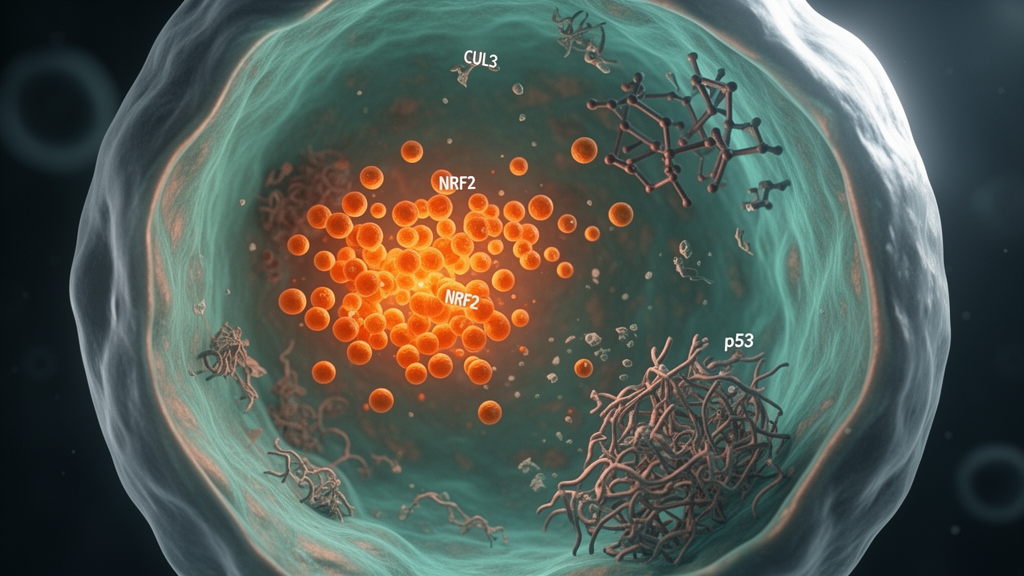
While mutations in KEAP1 and NFE2L2, the classic regulators of the NRF2 stress-response pathway, are well documented in lung cancer, the role of CUL3 mutations has remained poorly defined. The research, led by Poobana Dharmalingam and Sudandiradoss C at Vellore Institute of Technology, now positions CUL3 as a TP53-associated modifier of NRF2 regulation within EGFR-driven lung cancer, operating through structural changes in the neddylation-active CRL3 complex.
The team interrogated a multi-cohort NSCLC dataset comprising 47,862 patients, of whom 10,228 carried oncogenic EGFR mutations and confirmed CUL3 sequencing coverage. Using two-layer Fisher’s exact testing and logistic regression models that included an EGFR × TP53 interaction term, the researchers found that CUL3 mutations were conditionally enriched in tumours carrying both TP53 mutations and oncogenic EGFR alterations, with an odds ratio of 2.92 and a p-value of 4.68 × 10⁻²⁹. Crucially, the interaction term between EGFR and TP53 itself was not significant, with an odds ratio of 0.86 and a p-value of 0.547, indicating that the enrichment is driven by TP53 loss rather than by any synergistic effect of EGFR signalling.
This statistical distinction matters because it reframes how CUL3 should be interpreted in lung cancer genetics. Rather than acting as a partner that amplifies EGFR-driven tumorigenesis, CUL3 mutation appears to travel with TP53 alteration as a defined disease background. The EGFR-oncogenic subset served instead as the clinical context in which the association was measured. The authors validated their findings transcriptomically using data from The Cancer Genome Atlas for lung adenocarcinoma and lung squamous cell carcinoma, confirming that the genomic signal translated into measurable changes in gene expression.
At the transcriptomic level, CUL3-mutant tumours showed elevated NRF2 activation across three independent gene signatures. The researchers also observed increased proliferative signalling and altered drug metabolism in these tumours. Under normal conditions, the Cullin-RING Ligase 3 complex, built around Cullin-3 as its scaffold, mediates the proteasomal degradation of NRF2 through KEAP1-dependent ubiquitination, keeping the pathway in check.
To understand how specific CUL3 mutations might disrupt this regulatory machinery at the molecular level, the team turned to all-atom molecular dynamics simulations. They modelled four versions of the CUL3:KEAP1 complex in both inactive and neddylation-active states: the wild-type protein and three missense variants, L321F, G402E and M711I.
The simulations revealed strikingly variant-specific conformational behaviour. The L321F substitution drove the neddylated complex into a conformationally restricted state, characterised by reduced backbone flexibility, a decreased radius of gyration and a shifted free energy minimum. Free energy landscape analysis confirmed that the L321F plus NEDD8 complex occupied a shifted conformational energy minimum relative to wild-type, indicating impaired catalytic flexibility despite the complex remaining structurally intact.
The other two variants behaved differently. G402E showed progressive destabilisation of the complex over the course of the simulations, suggesting a distinct mechanism of functional disruption. M711I, by contrast, remained comparable to wild-type throughout, indicating that not all CUL3 missense variants carry the same structural consequences.
The study’s integrated design, combining large-scale multi-cohort genomic analysis with transcriptomic validation and atomistic structural simulation, offers a template for dissecting mutations whose effects are conditional on tumour context. By demonstrating that CUL3 enrichment depends on TP53 status rather than EGFR synergy, and that specific variants produce distinct conformational signatures in the neddylation-active CRL3 complex, the findings provide a mechanistic bridge between a statistical association and a plausible molecular pathway. The work was received on 24 June 2026 and accepted on 14 October 2026, and is published as open access under the Creative Commons Attribution License.
As with all computational and observational studies, the findings will require experimental validation in biological systems before they can inform clinical decision-making.
Subject of Research: CUL3 mutations, NRF2 pathway dysregulation and neddylation-associated structural perturbations in TP53-mutant non-small cell lung cancer
Article Title: CUL3-mediated NRF2 dysregulation in TP53-driven non-small cell lung cancer: neddylation-associated structural perturbations
Article References: Dharmalingam, P., & Sudandiradoss, C. (2026). CUL3-mediated NRF2 dysregulation in TP53-driven non-small cell lung cancer: neddylation-associated structural perturbations. Frontiers in Bioinformatics, 6, Article 1918128. https://doi.org/10.3389/fbinf.2026.1918128
Image Credits: AI Generated
DOI: 10.3389/fbinf.2026.1918128
Keywords: CUL3, NRF2, TP53, EGFR, non-small cell lung cancer, Cullin-RING Ligase 3, neddylation, molecular dynamics, KEAP1, cancer genomics, TCGA, Frontiers in Bioinformatics
News Source: Nathaniel Bowman. (October 30, 2026). CUL3 mutations reshape NRF2 control in TP53-mutant lung cancer. Scienmag.



