• HOME
  • NEWS
  • EXPLORE
    • CAREER
      • Companies
      • Jobs
    • EVENTS
    • iGEM
      • News
      • Team
    • PHOTOS
    • VIDEO
    • WIKI
  • BLOG
  • COMMUNITY
    • FACEBOOK
    • INSTAGRAM
    • TWITTER
Wednesday, October 21, 2026
BIOENGINEER.ORG
No Result
View All Result
  • Login
  • HOME
  • NEWS
  • EXPLORE
    • CAREER
      • Companies
      • Jobs
        • Lecturer
        • PhD Studentship
        • Postdoc
        • Research Assistant
    • EVENTS
    • iGEM
      • News
      • Team
    • PHOTOS
    • VIDEO
    • WIKI
  • BLOG
  • COMMUNITY
    • FACEBOOK
    • INSTAGRAM
    • TWITTER
No Result
View All Result
Bioengineer.org
No Result
View All Result
Home NEWS Science News Health

ctDNA Patterns Track Genomic Risk and Treatment Response in Advanced Breast Cancer

by
October 21, 2026
in Health
Reading Time: 2 mins read
0
ctDNA Patterns Track Genomic Risk and Treatment Response in Advanced Breast Cancer

ctDNA Patterns Track Genomic Risk and Treatment Response in Advanced Breast Cancer

Share on FacebookShare on TwitterShare on LinkedinShare on RedditShare on Telegram

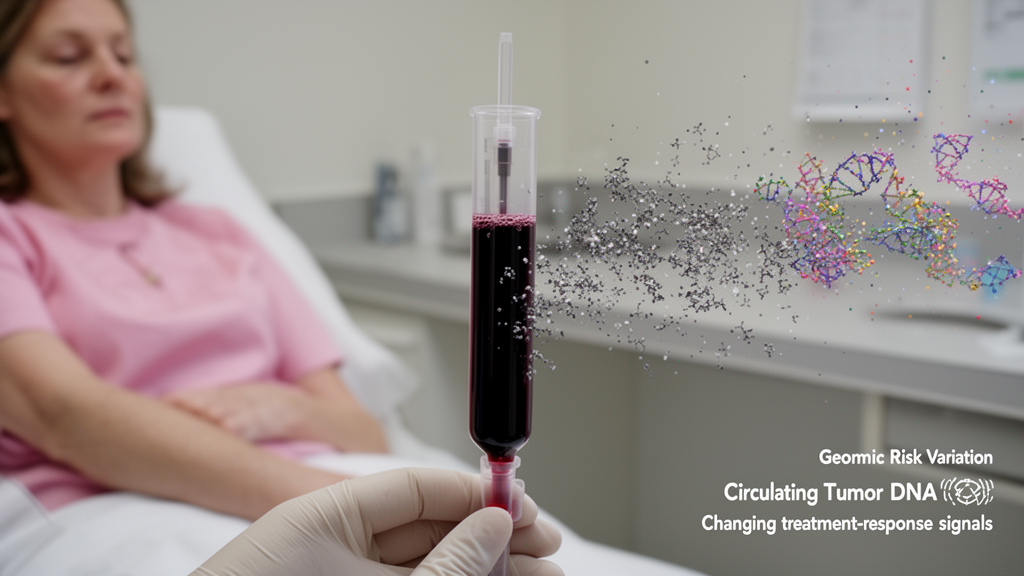
An exploratory analysis of the randomized phase III BRIGHT-2 trial found that circulating tumor DNA (ctDNA) profiles collected during treatment were associated with progression-free survival, molecular response and candidate resistance alterations in advanced breast cancer. Researchers profiled 596 plasma samples from female patients with hormone receptor-positive, HER2-negative advanced breast cancer using a 1,021-gene panel. Samples were collected at baseline, on treatment and at the end of treatment, allowing the investigators to examine changes in tumor-derived genetic material over time.

At baseline, detectable ctDNA and a higher molecular tumor burden were each associated with shorter progression-free survival in both treatment arms. The authors said the pattern was consistent with greater underlying disease burden and intrinsic risk; the observational associations do not show that ctDNA detectability or molecular burden caused the poorer outcomes. The genomic analysis also identified adverse risk features involving MYC, the PI3K–AKT pathway and BRCA or homologous recombination repair genes.

These features characterized an adverse genomic-risk profile among the patients analyzed. PIK3CA and ESR1 status produced an exploratory treatment-informative signal, indicating that their relationship with outcomes differed according to treatment context in the analysis. In separate landmark analyses, on-treatment ctDNA clearance and reductions in molecular tumor burden were associated with favorable subsequent outcomes.

Profiling at the end of treatment identified candidate resistance-associated alterations following bireociclib, including FGFR1, MDM2 and MYC amplifications and activation of the MAPK pathway. These are candidate markers associated with treatment-emergent genomic changes, not definitive resistance biomarkers or evidence of a causal resistance mechanism. Overall, the results indicate that longitudinal ctDNA profiling may provide information for risk stratification, response monitoring and resistance tracking during CDK4/6 inhibitor-based therapy, with the analysis presented as exploratory.

Subject of Research: Longitudinal ctDNA profiling of bireociclib in advanced breast cancer

Article Title: Longitudinal ctDNA profiling reveals genomic risk and molecular response to bireociclib in advanced breast cancer

Article References: Wang, Y., Xu, H., Zhou, Y., Cui, L., Sa, Q., Cheng, H., Gao, R., Zhang, Q., Li, H., Tong, Z., Ouyang, Q., Tan, X., Bai, J., Wang, L., Duan, X., Yang, F., Wang, J., & Xu, B. (2026). Longitudinal ctDNA profiling reveals genomic risk and molecular response to bireociclib in advanced breast cancer. Nature Communications. https://doi.org/10.1038/s41467-026-78782-5

Image Credits: AI Generated

DOI: 10.1038/s41467-026-78782-5

Keywords: ctDNA, bireociclib, advanced breast cancer, BRIGHT-2 trial, genomic risk, molecular response, drug resistance, CDK4/6 inhibition, progression-free survival, PIK3CA, ESR1, MAPK pathway

News Source: Nathaniel Bowman. (October 21, 2026). ctDNA Patterns Track Genomic Risk and Treatment Response in Advanced Breast Cancer. Scienmag.


Tags: advanced breast cancerbireociclibBRIGHT-2 trialCDK4/6 inhibitionctDNAdrug resistanceESR1genomic riskMAPK pathwaymolecular responsePIK3CAprogression-free survival
Share12Tweet7Share2ShareShareShare1

Related Posts

Aging Disc Failure Links Cellular Stress, Instability and Pain

Aging Disc Failure Links Cellular Stress, Instability and Pain

October 21, 2026
BabyMERIT Trial to Test Trametinib for Severe Infantile Hypertrophic Cardiomyopathy

BabyMERIT Trial to Test Trametinib for Severe Infantile Hypertrophic Cardiomyopathy

October 21, 2026

Arabic child oral-health scale shows provisional four-factor structure in Saudi mothers

October 21, 2026

Anisotropic conductivity modeling for tDCS in Parkinson’s disease using multidimensional diffusion MRI

October 21, 2026

POPULAR NEWS

  • Validated HPLC assay detects trace impurity in montelukast synthesis

    Validated HPLC assay detects trace impurity in montelukast synthesis

    29 shares
    Share 12 Tweet 7
  • Aging Disc Failure Links Cellular Stress, Instability and Pain

    29 shares
    Share 12 Tweet 7
  • Review: PGPR show context-dependent drought relief in sugarcane

    29 shares
    Share 12 Tweet 7
  • Smart Glasses Could Trigger a War on Human Expression

    29 shares
    Share 12 Tweet 7

About

We bring you the latest biotechnology news from best research centers and universities around the world. Check our website.

Follow us

Recent News

Validated HPLC assay detects trace impurity in montelukast synthesis

Aging Disc Failure Links Cellular Stress, Instability and Pain

Review: PGPR show context-dependent drought relief in sugarcane

Subscribe to Blog via Email

Enter your email address to subscribe to this blog and receive notifications of new posts by email.

Join 85 other subscribers
  • Contact Us

Bioengineer.org © Copyright 2023 All Rights Reserved.

Welcome Back!

Login to your account below

Forgotten Password?

Retrieve your password

Please enter your username or email address to reset your password.

Log In
No Result
View All Result
  • Homepages
    • Home Page 1
    • Home Page 2
  • News
  • National
  • Business
  • Health
  • Lifestyle
  • Science

Bioengineer.org © Copyright 2023 All Rights Reserved.