• HOME
  • NEWS
  • EXPLORE
    • CAREER
      • Companies
      • Jobs
    • EVENTS
    • iGEM
      • News
      • Team
    • PHOTOS
    • VIDEO
    • WIKI
  • BLOG
  • COMMUNITY
    • FACEBOOK
    • INSTAGRAM
    • TWITTER
Friday, September 25, 2026
BIOENGINEER.ORG
No Result
View All Result
  • Login
  • HOME
  • NEWS
  • EXPLORE
    • CAREER
      • Companies
      • Jobs
        • Lecturer
        • PhD Studentship
        • Postdoc
        • Research Assistant
    • EVENTS
    • iGEM
      • News
      • Team
    • PHOTOS
    • VIDEO
    • WIKI
  • BLOG
  • COMMUNITY
    • FACEBOOK
    • INSTAGRAM
    • TWITTER
  • HOME
  • NEWS
  • EXPLORE
    • CAREER
      • Companies
      • Jobs
        • Lecturer
        • PhD Studentship
        • Postdoc
        • Research Assistant
    • EVENTS
    • iGEM
      • News
      • Team
    • PHOTOS
    • VIDEO
    • WIKI
  • BLOG
  • COMMUNITY
    • FACEBOOK
    • INSTAGRAM
    • TWITTER
No Result
View All Result
Bioengineer.org
No Result
View All Result
Home NEWS Science News Chemistry

Crystal structure prediction of multi-elements random alloy

Bioengineer by Bioengineer
March 17, 2021
in Chemistry
Reading Time: 2 mins read
0
IMAGE
Share on FacebookShare on TwitterShare on LinkedinShare on RedditShare on Telegram

IMAGE

Credit: POSTECH

Alchemy, which attempted to turn cheap metals such as lead and copper into gold, has not yet succeeded. However, with the development of alloys in which two or three auxiliary elements are mixed with the best elements of the times, modern alchemy can produce high-tech metal materials with high strength, such as high entropy alloys. Now, together with artificial intelligence, the era of predicting the crystal structure of high-tech materials has arrived without requiring repetitive experiments.

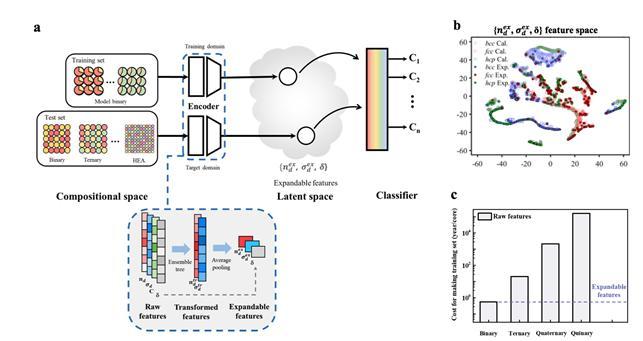
A joint research team of Professor Ji Hoon Shim and Dr. Taewon Jin (first author, currently at KAIST) of POSTECH’s Department of Chemistry, and Professor Jaesik Park of POSTECH Graduate School of Artificial Intelligence have together developed a system that predicts the crystal structures of multi-element alloys with expandable features without needing massive training data. These research findings were recently published in Scientific Reports.

Properties of solid-state materials depend on their crystal structures. In solid solution high entropy alloy (HEA) – a material that has the same crystal structure but continuously changes its chemical composition within a certain range – mechanical properties such as strength and ductility vary depending on the structural phase. Therefore, predicting the crystal structure of a material plays a crucial role in finding new functional materials. Methods to predict the crystal structure through machine learning have been studied recently, but there is an enormous cost attached to prepare the data necessary for training.

To this, the research team designed an artificial intelligence model that predicts the crystal structure of HEAs through expandable features and binary alloy data instead of the conventional models that use more than 80% of the HEA data in the training process. This is the first study to predict the crystal structure of multi-element alloys, including HEAs, with an artificial intelligence model trained only with the compositions and structural phase data of binary alloys.

Through experiments, the researchers confirmed that the structural phase of the multi-element alloy was predicted with an accuracy of 80.56%, even though the multi-element alloy data were not involved in the training process. In the case of HEAs, it was predicted with an accuracy of 84.20%. According to the method developed by the research team, it is anticipated that the calculation cost can be saved by about 1,000 times compared to previous methods.

“An immense dataset is required to apply an artificial intelligence methodology to the development of new materials,” explained Professor Ji Hoon Shim who led the research. “This study is significant in that it enables to effectively predict the crystal structure of advanced materials without securing a huge data set.”

###

The research was conducted with the support from the National Research Foundation, POSTECH Graduate School of Artificial Intelligence Institute of Information & Communications Technology Planning and Evaluation (IITP) and the SRC Center for Quantum Dynamics.

Media Contact
Jinyoung Huh
[email protected]

Original Source

http://postech.ac.kr/eng/crystal-structure-prediction-of-multi-elements-random-alloy/

Related Journal Article

http://dx.doi.org/10.1038/s41598-021-84544-8

Tags: Chemistry/Physics/Materials SciencesEnergy/Fuel (non-petroleum)Industrial Engineering/ChemistryMaterialsPolymer ChemistryResearch/DevelopmentRobotry/Artificial IntelligenceTechnology/Engineering/Computer Science
Share13Tweet8Share2ShareShareShare2

Related Posts

Tea Compounds Show Surprising Power Against Cancer and Aging Proteins

Tea Compounds Show Surprising Power Against Cancer and Aging Proteins

September 25, 2026
Volcanic Rock Buoys Could End Microplastic Pollution in Oyster Farms

Volcanic Rock Buoys Could End Microplastic Pollution in Oyster Farms

September 25, 2026

Metal-Organic Framework Nanoparticles Turn Biopolymer Hydrogel into Antibacterial Wound Dressing

September 25, 2026

Fig Latex and Sodium Phytate Team Up to Tenderize and Protect Cooked Beef

September 25, 2026
Please login to join discussion

POPULAR NEWS

  • New Study Maps How Hospital AI Turns Information Chaos into Faster, Cheaper Care

    29 shares
    Share 12 Tweet 7
  • AI Forecasting Reshapes Doctor Schedules in a Pediatric Emergency Room

    29 shares
    Share 12 Tweet 7
  • Damiana Plant Polysaccharides Extend Lifespan in Worms and Flies, Study Finds

    29 shares
    Share 12 Tweet 7
  • Forever Chemicals in Pregnancy Tied to Higher Gestational Diabetes Risk, Vitamin D May Blunt the Effect

    29 shares
    Share 12 Tweet 7

About

We bring you the latest biotechnology news from best research centers and universities around the world. Check our website.

Follow us

Recent News

New Study Maps How Hospital AI Turns Information Chaos into Faster, Cheaper Care

AI Forecasting Reshapes Doctor Schedules in a Pediatric Emergency Room

Damiana Plant Polysaccharides Extend Lifespan in Worms and Flies, Study Finds

Subscribe to Blog via Email

Enter your email address to subscribe to this blog and receive notifications of new posts by email.

Join 85 other subscribers
  • Contact Us

Bioengineer.org © Copyright 2023 All Rights Reserved.

Welcome Back!

Login to your account below

Forgotten Password?

Retrieve your password

Please enter your username or email address to reset your password.

Log In
No Result
View All Result
  • Homepages
    • Home Page 1
    • Home Page 2
  • News
  • National
  • Business
  • Health
  • Lifestyle
  • Science

Bioengineer.org © Copyright 2023 All Rights Reserved.