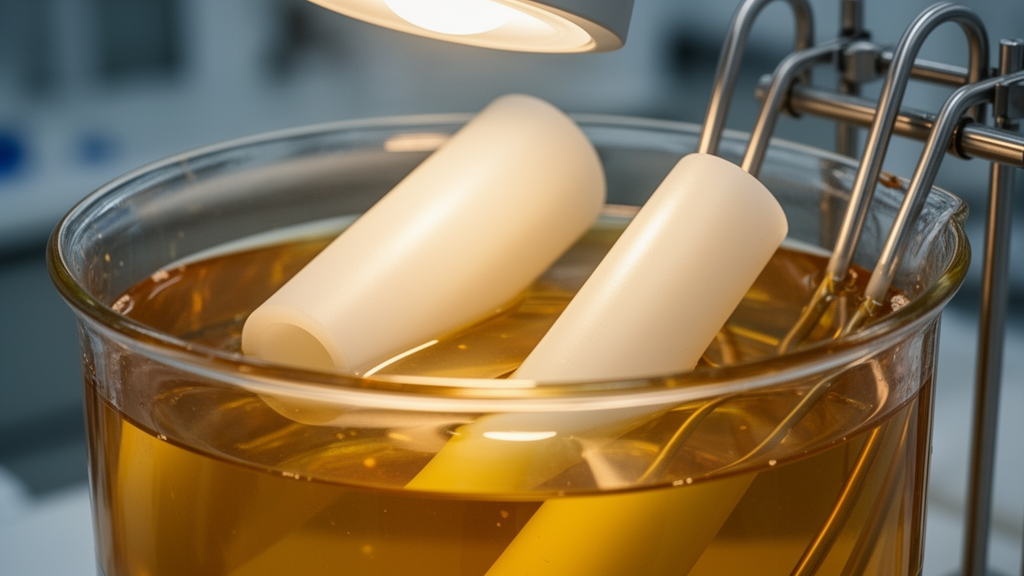
A study published in Discover Polymers compared the aging responses of three thermoplastic polymers when immersed in a standardized petroleum-based reference oil. The research team investigated polypropylene impact copolymer (PP), polyethylene of raised temperature (PERT), and an impact-modified polyphenylene sulfide (PPS) grade. These materials were processed using two distinct fabrication routes: injection molding and extrusion. The specimens were exposed to IRM 902 reference oil at both room temperature and an elevated temperature of 95 degrees Celsius. The study aimed to evaluate how polymer chemistry, processing history, and thermal capability influence fluid uptake, mechanical property retention, and thermal behavior.
The experimental design involved immersing coupons in separate glass jars to prevent cross-contamination between different polymer types. For each material, specimen geometry, and aging temperature, ten coupons were immersed together but tracked separately to allow comparison between fabrication routes. The exposure period lasted approximately two months, with monitoring extending to 1,512 hours at room temperature and 1,368 hours at 95 degrees Celsius. This duration provided a comparative laboratory aging window to evaluate time-dependent fluid uptake and associated mechanical responses. The 95-degree condition was used to intensify temperature-dependent transport and aging-related changes within the practical test window.
At room temperature, all materials exhibited limited mass change, generally remaining below one percent. This indicated low oil uptake under ambient conditions. However, clear differences were observed among the low-uptake curves. Extruded PERT coupons showed the highest room-temperature uptake, with certain specimens reaching higher values than the polypropylene punch-shear coupons. In contrast, PPS remained close to zero mass uptake, with occasional negative values attributed to experimental scatter associated with surface cleaning and gravimetric measurement sensitivity. The results suggest that PERT, particularly in the extruded condition, was more susceptible to IRM 902 uptake at room temperature than PP and PPS.
The mass uptake response at 95 degrees Celsius became much more pronounced, resulting in a markedly different ordering of the materials. PP exhibited the highest mass uptake among all materials, with injection-molded tensile specimens reaching approximately 39 percent by the end of the aging period. The injection-molded PP punch-shear coupons reached approximately 23 percent, while extruded PP tensile and punch-shear coupons reached approximately 20 percent. These results indicate that elevated temperature strongly promoted the uptake of IRM 902 in PP, particularly for injection-molded tensile specimens. In contrast, PERT showed a faster initial increase and approached a plateau at approximately 11 to 12 percent, indicating faster stabilization of mass uptake than PP.
Mass uptake for PPS remained close to zero at 95 degrees Celsius, consistent with its stronger resistance to IRM 902 absorption. The overall trend at elevated temperature followed PP greater than PERT greater than PPS. However, observed differences between coupon groups indicated that fabrication route, specimen geometry, and surface condition also influenced the measured mass uptake. The unusually high uptake of injection-molded PP was accompanied by visible surface changes, including localized blister-like or dotted surface regions. These surface-affected regions remained visible on tensile specimens after aging and mechanical testing. The aged PP specimens also exhibited a yellowish appearance compared with the representative unaged specimens.
Mechanical property retention was evaluated using tensile testing and punch-shear testing. Tensile tests were conducted ex situ after removal from the aging fluid, while 95-degree punch-shear tests were conducted in situ with the specimens immersed in IRM 902. At room temperature, mechanical property retention ranged from 89 to 113 percent across the investigated materials. These deviations were smaller in magnitude than the substantial tensile property losses observed for PP and PERT at 95 degrees Celsius. The low room-temperature mass uptake and retention values near 100 percent indicated a comparatively limited response over the investigated interval.
For specimens aged at 95 degrees Celsius, the retention behavior became strongly dependent on polymer type, fabrication route, and testing mode. PP exhibited the most severe property loss, with tensile modulus retention decreasing to approximately 34 to 36 percent and tensile yield strength retention decreasing to approximately 48 to 64 percent. PERT showed intermediate aging sensitivity, with tensile modulus retention of approximately 60 to 74 percent and tensile yield strength retention of approximately 81 to 84 percent. In contrast, PPS specimens retained or exceeded their unaged tensile properties, with tensile modulus and tensile yield strength retention reaching approximately 123 to 139 percent.
The comparison between tensile and punch-shear retention showed that the testing mode influenced the measured aging response. Although the 95-degree punch-shear tests were conducted in situ, PP and PERT showed notably higher punch-shear yield strength retention than tensile yield strength retention. For example, PP showed tensile and punch-shear yield strength retention values of 48.5 and 90.4 percent, respectively. This does not necessarily indicate that the specimens were less degraded during in situ punch-shear testing; rather, it suggests that the measured retention was governed by both the fluid-contact condition and the deformation mode. The localized shear-dominated punch-shear response appears to be less sensitive to bulk tensile softening, swelling, and ductility changes than conventional uniaxial tensile testing.
Differential scanning calorimetry (DSC) and Fourier-transform infrared spectroscopy (FTIR) were used to examine changes in thermal transitions, crystallinity, and chemical structure. DSC data showed that PP underwent the most pronounced changes after IRM 902 aging at 95 degrees Celsius. For injection-molded PP, the first-heating melting temperature decreased from 165.1 to 157.7 degrees Celsius, accompanied by a reduction in melting enthalpy. These thermal changes were consistent with the high mass uptake, visible surface alteration, and substantial tensile property reduction observed for injection-molded PP. In contrast, the DSC response for extruded PP differed, with the first-heating melting enthalpy remaining nearly unchanged despite substantial mechanical property reduction.
For the impact-modified PPS samples, two melting regions were observed: a low-temperature endotherm associated with the impact-modifier phase and a higher-temperature endotherm corresponding to the PPS phase. The principal PPS melting peak remained within a relatively narrow range of 277.4 to 281.5 degrees Celsius, indicating that IRM 902 aging did not substantially affect the principal melting transition of PPS. A cold-crystallization exotherm observed in baseline injection-molded PPS was absent in both the aged injection-molded and the extruded specimens. The disappearance of cold crystallization after aging suggests that prolonged exposure at 95 degrees Celsius altered the initial morphology of injection-molded PPS through structural relaxation or further crystalline ordering.
The degree of crystallinity for injection-molded PPS increased from 17.6 to 28.7 percent, consistent with thermal conditioning and additional crystalline ordering. In contrast, the blend crystallinity of extruded PPS decreased from 31.3 to 25.1 percent, although its tensile modulus and yield strength retention remained above the corresponding baseline values. These differing responses indicate that orientation, residual-stress relaxation, crystal organization, and processing history may also have contributed to the behavior of the PPS-based specimens. The results demonstrate that the relationship between thermal structure and mechanical property retention was both material- and fabrication-route-dependent.
FTIR spectra of the baseline and aged specimens showed that principal absorption bands remained at similar wavenumbers, with no major new absorption bands observed after aging. For PP and PERT, the spectra retained the same principal bands without clear formation of new functional groups. For PPS, characteristic aromatic and C-S-related bands remained after aging, with no major new peaks or disappearance of PPS-specific features. The spectral stability, together with the negligible mass uptake and high mechanical property retention of PPS, is consistent with its greater resistance to IRM 902 aging under the investigated conditions.
The study concludes that mass uptake alone is insufficient for material qualification. Reliable assessment of oil-aging performance requires consideration of mechanical property retention together with processing history, specimen geometry, and testing conditions. Among the materials examined, impact-modified PPS provided the highest resistance to IRM 902 aging, PERT showed intermediate performance, and PP was the most susceptible. The combined findings provide a comparative assessment of material responses over exposure periods of 1,512 hours at room temperature and 1,368 hours at 95 degrees Celsius. These intervals are much shorter than the long-term reference horizons used in pressure-pipe design evaluation and cannot be translated into an equivalent service duration.
Subject of Research: Aging behavior of injection-molded and extruded thermoplastics in IRM 902 reference oil
Article Title: Effects of IRM 902 aging on the mechanical thermal and chemical properties of injection molded and extruded thermoplastics
Article References: Wang, Y., Hammami, A., & Mertiny, P. (2026). Effects of IRM 902 aging on the mechanical thermal and chemical properties of injection molded and extruded thermoplastics. Discover Polymers, 3(1), Article 35. https://doi.org/10.1007/s44347-026-00073-5
Image Credits: AI Generated
DOI: 10.1007/s44347-026-00073-5
Keywords: thermoplastics, IRM 902, polypropylene, PERT, polyphenylene sulfide, oil aging, mechanical properties, DSC, FTIR, mass uptake, Effects, aging
News Source: Beatrice Stafford. (November 10, 2026). PPS Resists Oil Aging Better Than PP and PERT. Scienmag.