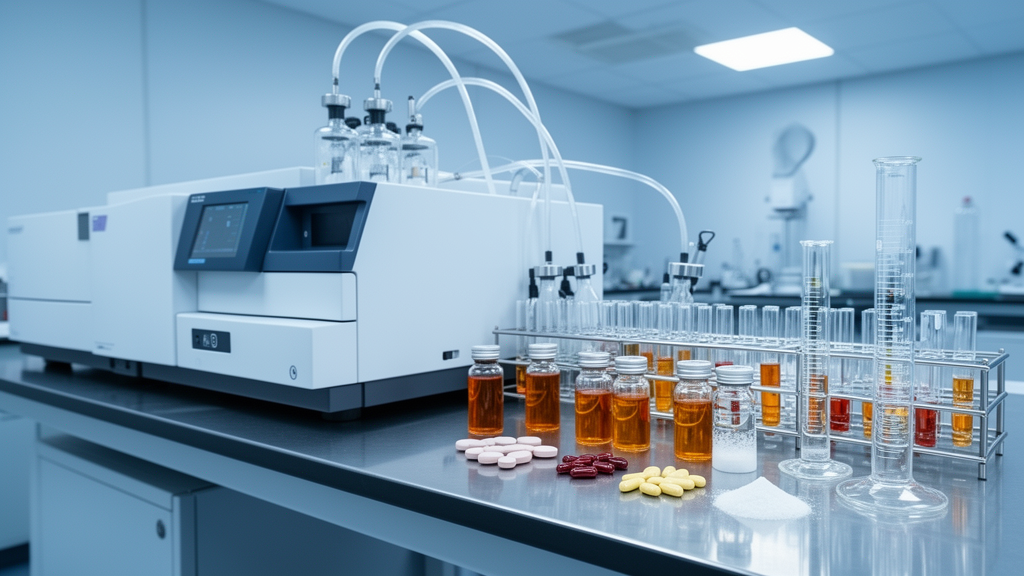
Analytical chemists have developed and validated an analytical quality-by-design reversed-phase high-performance liquid chromatography procedure capable of quantifying ascorbic acid across distinct commercial nutraceutical formulations in five-minute analytical runs. Guided by the method development framework outlined in International Council for Harmonisation guideline Q14 and evaluated against the validation characteristics described in guideline Q2(R2), the investigation established a standardized testing platform designed to overcome analytical constraints associated with historical liquid chromatography methods. Traditional chromatographic procedures for vitamin C quantification in dietary supplements and pharmaceutical dosage forms have frequently relied on extended run durations ranging from 2.1 to 7.5 minutes, elevated proportions of organic modifiers such as acetonitrile and methanol, and narrow applicability restricted to single dosage presentations like tablets or field preparations. By systematically optimizing chromatographic parameters through statistical modeling, the research team demonstrated that ascorbic acid can be accurately separated and quantified within approximately 1.77 minutes while restricting organic solvent consumption to one milliliter of methanol per five-milliliter analytical injection cycle.
The study established an Analytical Target Profile focused on simultaneously delivering acceptable separation efficiency, brief retention behavior, reduced environmental burden, and verified regulatory transferability across multiple commercial product matrices. To systematically isolate the operational factors exerting the greatest influence on chromatographic performance, the researchers initially performed a structured risk assessment utilizing an Ishikawa fishbone diagram to categorize potential variability originating from instrument configurations, sample preparation protocols, and chromatographic parameters. A Failure Mode and Effects Analysis scoring system subsequently ranked these factors based on severity, occurrence, and detectability on a five-point scale, generating Risk Priority Numbers. Mobile-phase organic proportion, mobile-phase flow rate, and buffer pH yielded risk numbers of 40, 50, and 40, respectively, classifying them as high-risk Critical Method Parameters. In contrast, operational variables including column operating temperature, injection volume, ultraviolet detection wavelength, analyte stock concentration, and extraction conditions were categorized as lower-risk parameters and maintained under fixed controls throughout experimental multivariate testing.
To capture the multi-dimensional behavior of the separation system, the investigators designated retention time, peak tailing factor, and theoretical plate count as the three Critical Analytical Attributes for formal optimization. These analytical responses quantitatively reflect chromatographic speed, peak symmetry, and separation efficiency across the analytical column. Multivariate optimization was executed through a seventeen-run, three-factor, three-level Box-Behnken experimental design analyzed with response-surface methodology in Design-Expert software. Analysis of variance indicated that mobile-phase composition, flow rate, and pH exerted distinct, response-specific influences across the experimental design space. Flow rate emerged as the primary determinant governing chromatographic efficiency and retention time, where elevated linear velocities decreased theoretical plate counts due to shortened analyte interaction durations with the stationary phase. In parallel, mobile-phase organic fraction and buffer pH demonstrated significant quadratic and linear effects on analyte retention and chromatographic peak symmetry, allowing mathematical mapping of the underlying separation dynamics across the investigated factor ranges.
The mathematical models selected from the Box-Behnken experimental runs comprised a linear model for theoretical plate counts and second-order quadratic models for peak tailing factor and retention time. Analysis of variance confirmed overall model statistical significance, yielding an F-value of 3.97 with a p-value of 0.0329 for theoretical plates, an F-value of 6.88 with a p-value of 0.0093 for the tailing factor, and an F-value of 12.03 with a p-value of 0.0017 for retention time. Experimental observations varied across defined response intervals, with theoretical plate counts ranging from 3097 to 3250 plates, tailing factors spanning 1.37 to 1.77, and retention times registering between 1.53 and 2.23 minutes. Diagnostic residual evaluations supported the broader factor-response trends, although externally studentized residuals highlighted two experimental runs as potentially influential observations. Because isolated statistical deviations do not prove experimental error, these data points were retained within the analytical model rather than being arbitrarily excluded from the experimental dataset.
Careful examination of model adequacy statistics identified important statistical boundaries regarding the predictive scope of the generated response surfaces. The calculated lack-of-fit tests yielded statistically significant values with p-values below 0.0001 across all evaluated response models, demonstrating that the polynomial equations did not capture every source of systematic variation within the measured responses. Furthermore, the regression models exhibited negative predicted R-squared values of minus 0.6240 for tailing factor and minus 0.0238 for theoretical plate count, alongside a modest predicted R-squared value of 0.0340 and an adjusted R-squared of 0.8612 for retention time. Consequently, the authors emphasized that the fitted response equations must be interpreted strictly as empirical descriptions characterizing factor relationships within the investigated experimental domain rather than universally predictive mathematical tools. Numerical optimization utilizing a desirability function nevertheless identified optimal conditions targeting minimized tailing and retention alongside maximized plate counts, achieving an overall multi-criteria desirability score of 0.880.
The optimized chromatographic system utilized a ZORBAX Eclipse XDB-C18 analytical column measuring 150 millimeters in length by 4.6 millimeters internal diameter packed with five-micrometer particles, maintained at a controlled temperature of 35 degrees Celsius. Detection was performed via an ultraviolet photodiode array detector set at 242 nanometers following a sample injection volume of 20 microliters. Physical preparation of the mobile phase involved filtration through a 0.45-micrometer nylon membrane followed by 15 minutes of ultrasonic degassing. Independent confirmation experiments conducted under these finalized operational settings produced empirical retention times, tailing factors, and theoretical plate numbers showing percentage deviations below 1% relative to model predictions, confirming the practical validity of the established Method Operable Design Region.
Under these validated chromatographic conditions, ascorbic acid eluted as a symmetrical and sharply resolved peak at approximately 1.767 to 1.77 minutes within a total run time of 5.0 minutes. System suitability was formally verified through five replicate injections of a 100 microgram per milliliter standard solution. Analytical linearity was documented across a concentration range spanning 50 to 150 micrograms per milliliter, utilizing five calibration levels evaluated in triplicate. Linear regression analysis generated the calibration equation y equals 0.8793x minus 0.4134, demonstrating an R-squared coefficient of 0.9976, a Pearson correlation coefficient of 0.9988, and a statistically significant slope with a p-value of 0.000049. Individual response precision exhibited relative standard deviations between 0.0095% and 0.1099%, with calibration residuals confined between minus 2.606 and positive 1.814 peak-area units. Based on residual standard deviation modeling, the estimated limit of detection was 1.54 micrograms per milliliter and the limit of quantification was 4.66 micrograms per milliliter.
Method selectivity was verified by contrasting chromatograms generated from procedural blanks, matrix placebos, reference standards, unspiked commercial preparations, and spiked formulation samples, which revealed no co-eluting chromatographic interferences at the retention window of ascorbic acid. Quantitative recovery studies utilizing standard additions of 0.5, 1.0, and 1.5 milligrams to commercial sample matrices confirmed absence of excipient interference, yielding mean recoveries close to 100%. Precision assessments demonstrated intra-day repeatability values below 2% relative standard deviation across all matrices, while intermediate precision testing conducted across two independent analysts yielded relative standard deviations below 1%. Benchtop solution stability testing of prepared ascorbic acid sample extracts stored in darkness at 25 degrees Celsius established that analytical responses remained stable without meaningful degradation for at least six hours. Deliberate minor adjustments in flow rate, buffer pH, and methanol concentration during robustness testing caused statistically observable shifts in theoretical plates and retention times under one-way analysis of variance, but analytical performance remained within acceptable operational limits.
Practical applicability was evaluated on three commercial nutraceutical products: a 500-milligram vitamin C tablet, a 150-milligram ascorbic acid multivitamin tablet, and an oral liquid drop formulation containing 28 milligrams per dosage unit. Quantitative assays revealed active ingredient contents ranging between approximately 104% and 112% of labeled quantities. While Indian Food Safety and Standards Authority regulations specify a permissible nutrient manufacturing overage of up to 20% for vitamin C to offset processing degradation, storage decline, and analytical variability, the investigators noted that these regulatory provisions do not confirm intentional overage in the absence of verified manufacturing records. The assay results were contextualized through descriptive comparisons against a published nutrient evaluation protocol by Andrews and colleagues, alongside one-way analysis of variance comparisons. The authors highlighted that analytical evaluations examined single commercial production batches, meaning the resulting figures cannot establish broad batch-to-batch manufacturing reproducibility across industrial scale production.
The analytical procedure was systematically appraised for environmental sustainability using three complementary Green Analytical Chemistry metrics: the Analytical Greenness Calculator, the Green Analytical Procedure Index, and the National Environmental Methods Index. The method attained an AGREE numerical score of 0.67 out of 1.0, reflecting favorable alignment with the twelve principles of green chemistry, primarily driven by the aqueous-rich 80% phosphate buffer mobile phase, low organic solvent volume, absence of chemical derivatization, and simple sample extraction. The GAPI assessment profile showed predominantly green and yellow assessment fields, while NEMI criteria confirmed the complete absence of persistent, bioaccumulative, toxic reagents or regulated hazardous waste generation. The investigators observed that while these tools provide useful comparative profiles, they do not quantify total life-cycle variables such as instrument electrical power consumption, solvent synthesis, transportation, or downstream waste processing. The study noted the lack of formal photodiode array peak-purity calculations as an analytical limitation, concluding that the validated procedure provides an efficient, environmentally conscious platform for routine nutraceutical quality control.
Subject of Research: Analytical quality-by-design optimization and greenness evaluation of reversed-phase high-performance liquid chromatography for ascorbic acid estimation in nutraceutical products
Article Title: Development and validation of a green AQbD based RPHPLC method for quantitative estimation of ascorbic acid in nutraceutical formulations
Article References: Gupta, K. R., Kathoke, P., Dakhole, M. R., & Umekar, M. J. (2026). Development and validation of a green AQbD based RPHPLC method for quantitative estimation of ascorbic acid in nutraceutical formulations. Discover Green Chemistry, 1(1), Article 40. https://doi.org/10.1007/s44509-026-00043-x
Image Credits: AI Generated
DOI: 10.1007/s44509-026-00043-x
Keywords: Ascorbic Acid, Nutraceutical Formulations, Analytical Quality by Design, RP-HPLC, Box-Behnken Design, Green Analytical Chemistry, Method Validation, ICH Q14, ICH Q2(R2), AGREE Metric, GAPI Pictogram, NEMI Assessment, Chromatographic Separation, ZORBAX Eclipse XDB-C18, Multivitamin Assay, Vitamin C Oral Drops, Method Operable Design Region
News Source: Bethany Barker. (November 12, 2026). Green Liquid Chromatography Method Quantifies Ascorbic Acid Across Nutraceutical Dosage Forms. Scienmag.