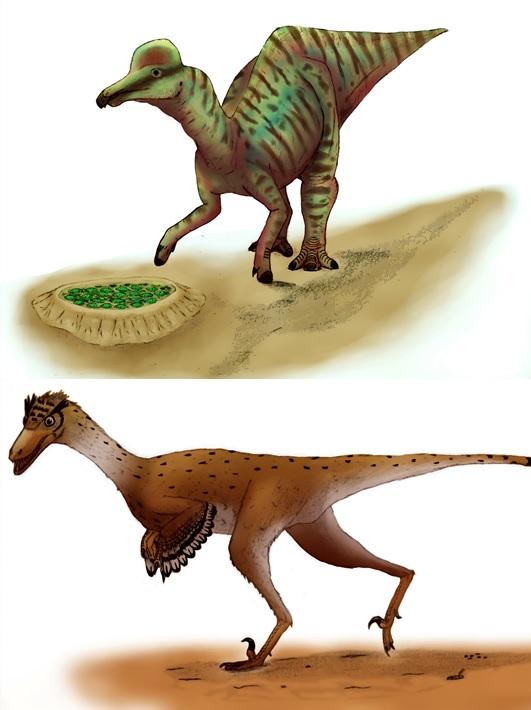
Credit: Adapted from ACS Omega 2020, DOI: 10.1021/acsomega.0c03334
Since the famous discovery of dinosaur eggs in the Gobi Desert in the early 1920s, the fossilized remains have captured the imaginations of paleontologists and the public, alike. Although dinosaur eggs have now been found on every continent, it’s not always clear to scientists which species laid them. Now, researchers reporting in ACS Omega have narrowed down the list for an unknown eggshell from Mexico by comparing its microstructure and composition with four known samples.
Because many dinosaur eggs are similar in size and shape, it can be difficult to determine what type of dinosaur laid them. Clues can come from fossilized embryos (which are rare), hatchlings in the same nest or nearby adult remains. Scientists also have identified microscopic features of eggshells that differ among groups of dinosaurs. In addition, researchers have studied the elemental composition of fossil eggshells to learn more about the paleoenvironment and conditions that led to the eggs’ fossilization. Abel Moreno and colleagues wanted to compare the microstructure and composition of five dinosaur eggshells from nests in the El Gallo Formation of Baja California, Mexico. Based on the eggs’ shapes and sizes and the fossil record of the area, the researchers had concluded that three of the eggs were laid by ornithopods (bipedal herbivores) of the hadrosaur family (duck-billed dinosaurs) and one by a theropod (bipedal carnivores) of the troodontidae family (small, bird-like dinosaurs). The remaining sample was too damaged to classify by the naked eye.
Using scanning electron microscopy, the team examined the external and internal surfaces and a cross-section of each eggshell. In contrast to the smooth outer surface of the theropod shell, the shells from the ornithopods and the unknown sample had nodes at different distances across the shell. Images of shell cross-sections from the ornithopods revealed that mammillary cones — calcite crystals on the inner surface of the shell — formed thin, elongated columns arranged in parallel, with irregular pores. In contrast, the eggshell from the theropod showed thicker, shorter cones arranged in a bilayer, with wider pores. The unknown sample more closely resembled the ornithopod eggshells, leading the researchers to hypothesize that it was probably also from the hadrosaur family. In addition, the researchers conducted an elemental composition analysis, which they say is the first such analysis on dinosaur eggshells collected in Mexico. They say the findings might help reveal how the fossilization process varied among species and locales.
###
The authors acknowledge funding from FOMIX-Yucatan, the National Council of Science and Technology (CONACYT) of Mexico and the General Directorate of Academic Personnel Affairs (DGAPA)-Support Program for Research and Technological Innovation Projects (PAPIIT).
The article is freely available as an ACS AuthorChoice article here.
The American Chemical Society (ACS) is a nonprofit organization chartered by the U.S. Congress. ACS’ mission is to advance the broader chemistry enterprise and its practitioners for the benefit of Earth and its people. The Society is a global leader in providing access to chemistry-related information and research through its multiple research solutions, peer-reviewed journals, scientific conferences, eBooks and weekly news periodical Chemical & Engineering News. ACS journals are among the most cited, most trusted and most read within the scientific literature; however, ACS itself does not conduct chemical research. As a specialist in scientific information solutions (including SciFinder® and STN®), its CAS division powers global research, discovery and innovation. ACS’ main offices are in Washington, D.C., and Columbus, Ohio.
To automatically receive news releases from the American Chemical Society, contact [email protected].
Follow us: Twitter | Facebook
Media Contact
Katie Cottingham
[email protected]