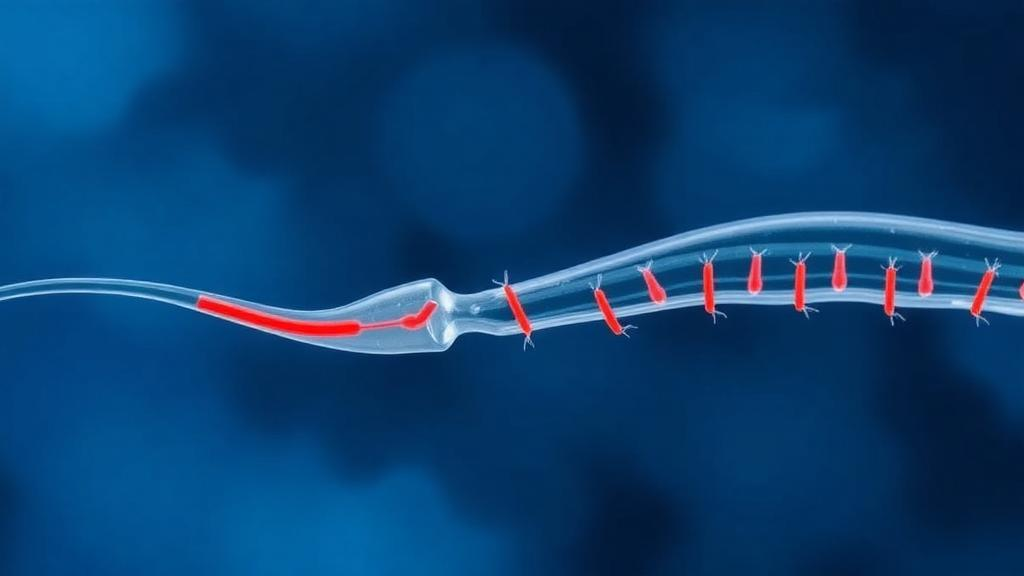
Few biological systems walk a tighter tightrope than the cells that make sperm. In a new open-access review published in Cellular and Molecular Life Sciences, Theresa Schöpp and Isabelle M. Mansuy of the University of Zurich and ETH Zurich synthesize recent advances in our understanding of the epigenome of the postnatal male germline, arguing that its defining feature is a delicate balance between two seemingly opposing demands: the flexibility needed to reprogram gene activity across dramatic developmental transitions, and the stability needed to preserve critical regulatory information all the way into the next generation. The review, which carries the evocative title describing the epigenome as a double-edged sword, maps how this balance is struck from the formation and differentiation of spermatogonial stem cells through the mitosis-to-meiosis transition and finally to post-meiotic maturation, when spermatozoa take their final shape.
The stage for this balancing act is spermatogenesis, the process by which spermatozoa are produced through the differentiation of spermatogonial stem cells, or SSCs, and their subsequent spermatogenic descendants. In the male gonads of mice, the model organism at the heart of most of this research, epigenetic regulation is central to controlling this process. Epigenetic regulation, broadly defined, refers to the layer of chemical tags and chromatin structures that governs which parts of the genome are active without altering the underlying DNA sequence. As male germ cells progress through spermatogenesis, their transcriptional activity changes dynamically to enable the transition from mitotically dividing SSCs to meiotic spermatocytes, and then through the profound morphological changes necessary to generate spermatozoa. Each of these steps demands a wholesale reconfiguration of the epigenetic landscape.
The review emphasizes that an ensemble of fine-tuned epigenetic factors and mechanisms regulates this transcriptional activity. These include DNA methylation, the addition of methyl groups to cytosine bases; a rich vocabulary of histone modifications, such as the methylation and acetylation marks on histone H3 that the authors catalog by residue and modification type, including H3K4me1/2/3, H3K27ac, H3K27me3 and H3K9me2; and the action of architectural proteins such as CTCF and its germline-specific relative BORIS, which organize the genome into three-dimensional domains known as topologically associated domains. Enzyme families including DNA methyltransferases, histone acetyltransferases, histone deacetylases, histone methyltransferases and lysine demethylases write and erase these marks, while polycomb repressive complexes 1 and 2 help lock down inappropriate gene expression. Modern mapping technologies, from chromatin immunoprecipitation followed by sequencing to ATAC assays for accessible chromatin, CUT&RUN, CUT&Tag and chromosome conformation capture methods, have made it possible to chart these features at ever finer resolution.
The first act of the drama concerns the SSCs themselves. These stem cells must maintain their own population through self-renewal while also committing to differentiation, and the review describes how epigenetic plasticity underpins this choice. Regulatory factors such as the promyelocytic leukemia zinc finger, PLZF, are associated with the stem cell state, and the chromatin of undifferentiated spermatogonia remains comparatively open and responsive, allowing these cells to respond to cues that tip them toward either maintenance or differentiation. As differentiating spermatogonia emerge, the epigenome begins to shift, priming the cells for the sweeping changes ahead. This plasticity is not a flaw but a feature: without it, the germline could not replenish itself across the reproductive lifespan of the animal.
The second act is the mitosis-to-meiosis transition, arguably the most dramatic reprogramming event in the entire process. Cells that have been faithfully copying themselves through mitosis must now halve their genetic content, and their transcriptional program must change accordingly to support entry into meiosis as spermatocytes. The review describes how epigenetic mechanisms coordinate this switch, with changes in DNA methylation patterns, histone marks and chromatin accessibility working in concert to silence mitotic programs and activate the meiotic machinery. Super-enhancers, clusters of regulatory elements that drive high-level expression of key identity genes, are part of this coordination, as are changes in the three-dimensional folding of the genome that bring distant regulatory elements into contact with their target genes.
The third act is post-meiotic maturation, and it is here that the tension between flexibility and stability becomes most visible. Round spermatids must transform into elongated spermatozoa, a process that involves replacing the majority of histones with protamines, the small, highly basic proteins that allow DNA to be packed with extraordinary density into the head of the sperm. Transition proteins bridge this exchange. This near-total repackaging means that most histone-based regulatory information is dismantled, yet the review highlights that some epigenetic marks are stably maintained in spermatozoa. DNA methylation, in particular, must be preserved through this upheaval, and a subset of retained histones and their modifications may carry information forward as well.
That preserved information matters beyond the sperm itself. The review describes how some epigenetic marks maintained in spermatozoa can, in some cases, be passed to the embryo and influence offspring phenotypes. This possibility, which connects germline epigenetics to the broader and often debated field of intergenerational inheritance, gives the stability side of the double-edged sword its full weight. Marks that survive the protamine exchange and the early embryonic reprogramming that follows fertilization represent a channel through which the paternal germline can, in principle, shape the development of the next generation. The Mansuy laboratory has a long history of work on how environmental experience can leave traces in the germline, and this review situates the molecular machinery of the postnatal male germline within that larger question.
The sword cuts both ways, however, and the review is explicit about the consequences of disruption. When the fine-tuned ensemble of epigenetic factors goes awry, the result can be sub- or infertility. Spermatogenesis is a long, staged process with many checkpoints, and errors in DNA methylation establishment or maintenance, misregulated histone modification, or faulty chromatin remodeling at any stage can compromise the production or quality of spermatozoa. The germline’s need for plasticity makes it inherently vulnerable: the very openness that allows stem cells to self-renew and differentiating cells to reprogram their transcription also exposes the genome to instability. Conversely, excessive rigidity would prevent the transitions that spermatogenesis requires. Hence the double-edged sword of the title.
The review also draws attention to the germline’s relationship with transposable elements, the mobile genetic sequences, including endogenous retroviruses and LINE-1 elements, that litter the mammalian genome. Keeping these elements silent is a perennial task in germ cells, where their activity would be especially damaging because changes would be heritable. Epigenetic silencing mechanisms, particularly DNA methylation and repressive histone marks, are deployed against these sequences throughout the postnatal stages, adding another layer to the stability mandate. The authors’ abbreviation list, spanning everything from fluorescence-activated cell sorting to unit-gravity sedimentation cell separation, hints at the technical sophistication of the field, which now combines cell-type purification with genome-wide epigenomic profiling to dissect individual stages of spermatogenesis that were once studied only in bulk tissue.
What emerges from Schöpp and Mansuy’s synthesis is a picture of the postnatal male germline epigenome as a system in constant, controlled motion. From the formation and differentiation of SSCs, through the mitosis-to-meiosis transition, to post-meiotic maturation and the final packaging of the sperm genome, epigenetic marks are written, erased, rewritten and selectively preserved. The review closes by outlining open questions about how these processes are coordinated across developmental stages and what their biological importance is, acknowledging that the field is still assembling the full choreography. How the three-dimensional organization of the genome is reconfigured at each transition, how retained histones are chosen and what they carry, and how the balance between flexibility and stability is enforced at the molecular level all remain active frontiers. For researchers interested in fertility, in developmental biology, and in the mechanisms by which information travels from one generation to the next, the postnatal male germline has become one of the most instructive systems available, and this review provides a timely map of where the field stands and where it must go next.
Subject of Research: Epigenetic regulation of spermatogenesis in the postnatal male germline
Article Title: The epigenome of the postnatal male germline: A double-edged sword between flexibility and stability
Article References: Schöpp, T., & Mansuy, I. M. (2026). The epigenome of the postnatal male germline: A double-edged sword between flexibility and stability. Cellular and Molecular Life Sciences. https://doi.org/10.1007/s00018-026-06427-3
Image Credits: AI Generated
DOI: 10.1007/s00018-026-06427-3
Keywords: epigenetics, male germline, spermatogenesis, spermatogonial stem cells, DNA methylation, histone modifications, chromatin, spermatozoa, meiosis, infertility, transposable elements, intergenerational inheritance
News Source: Juliet Wilcox. (October 5, 2026). Sperm’s Epigenetic Balancing Act: Flexibility Versus Stability in the Male Germline. Scienmag.