Researchers have produced the first comparative histological account of how the stomach and hepatopancreas mature in two mangrove crabs, Episesarma singaporense and Episesarma versicolor, reared from the egg-carrying female stage through every larval form to the juvenile crab. The study, published in Discover Developmental Biology, tracked ontogenetic change in the digestive system using light microscopy of paraffin and resin semithin sections, and it identified apoptotic cells with a TUNEL assay. The work was carried out on material obtained from a hatchery at Rajamangala University of Technology Srivijaya in Trang Province, Thailand, where ten ovigerous females of each species were collected from local mangroves and their newly hatched larvae were raised under laboratory conditions.
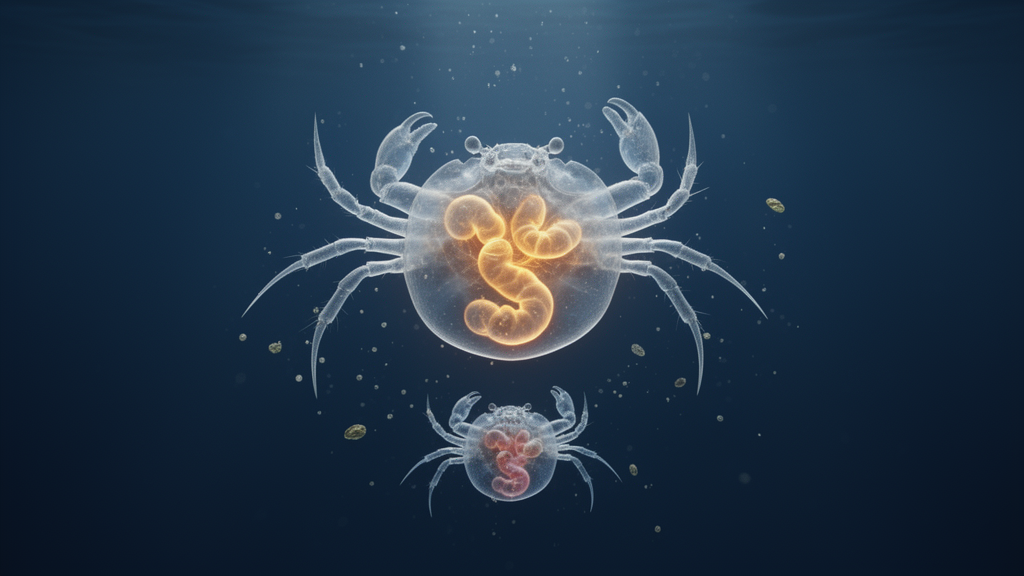
The central finding is a clear developmental timetable. In the first two zoeal stages, the boundary between the cardiac and pyloric chambers of the stomach could not be reliably distinguished in either species. By the third and fourth zoeal stages the two chambers were plainly separated, and the cardiac stomach grew as a sac-like chamber with a well-developed cardio-pyloric valve and visible pyloric filter setae. In the megalopa and crab stages, all stomach structures were more fully formed than in the zoeae, most notably the well-developed lateral teeth of the gastric mill in the cardiac stomach, which were lined with hard epicuticle and procuticle.
The hepatopancreas followed a parallel trajectory. In the first zoeal stage it appeared as paired organs made of small clusters of cells forming tubules with narrow lumens, and four epithelial cell types were already distinguishable: embryonic E-cells at the base of the epithelium, blister-like B-cells with small apical vacuoles and basal nuclei, fibrillar F-cells with basophilic cytoplasm and central nucleoli, and resorptive R-cells with large round nuclei and numerous small cytoplasmic vacuoles. By the second zoeal stage the organ was larger and more complicated, and the cell types were more specialized; some B-cells now carried a single large vacuole that filled most of the cytoplasm and pressed the nucleus toward the basal side.
The third zoeal stage emerged as a turning point. The hepatopancreas was fully developed by this stage, its tubules lined with columnar epithelium and covered by a thin layer of connective tissue. B-cell vacuoles enlarged as development proceeded from the third to the fourth zoeal stage, a pattern the authors link to intracellular digestion and the extrusion phase of these cells. From the megalopa to the crab stage, the hepatopancreatic structure stayed similar in composition but grew larger and more intricately branched, eventually dominating the cephalothorax region. Throughout the sampled stages the epithelium contained the same four major cell types, in contrast to the five types, including midget M-cells, reported for larvae of the spider crab Maja brachydactyla in earlier work.
The TUNEL assay added a layer of detail that the authors say has not been described before for these species. Apoptotic cells were absent from the cardiac stomach in the fourth zoeal stage but were detected in epithelial cells of the pyloric stomach, where brown nuclear staining marked the dying cells. In the megalopa, positive TUNEL reactions appeared in the stomach epithelium, and in E. singaporense the E-cells and B-cells of the hepatopancreas reacted positively. The authors suggest that this programmed cell death may be tied to normal developmental remodeling, and they speculate that it could relate to functional regulation of stomach homeostasis, while noting that environmental pollutants can also trigger such responses in other contexts.
Because the digestive tract is directly involved in feeding, its maturation has practical consequences for rearing the animals. The authors argue that the developmental progression of the gastric mill reflects the onset of functional digestive capacity, information that can guide feeding schedules and diet transitions during larval rearing. They recommend providing live feed during the first two zoeal stages, since live prey carries complete nutrition and can be self-autolyzed within a still-developing digestive tract. The transition from the second to the third zoeal stage is energetically demanding, and insufficient energy at this point can cause high mortality, which makes the timing of the Z3 milestone particularly relevant for hatchery managers.
Once the digestive system is fully developed at the third zoeal stage, the authors suggest that non-living feed could become a more suitable alternative to supplement or replace live food for the later zoeal stages through the juvenile stage. This aligns with earlier findings on the same species complex: previous work cited in the paper reported that juvenile E. singaporense perform best on a diet containing 45 percent protein, supporting improved survival and growth.
The two species themselves carry ecological and economic weight. E. singaporense and E. versicolor are brachyuran crabs of the family Sesarmidae, widely distributed across mangrove forests of the Indo-West Pacific, where they play a crucial role in litter turnover. They are also an important protein source for local communities in Southeast Asia. Wild populations have declined significantly because of mangrove destruction, water pollution and overfishing, prompting attempts at conservation and commercial exploitation through aquaculture. The authors note that the histological characteristics and ontogenetic development of larval Episesarma had remained poorly understood, which is why the present study set out to document these processes from larva to juvenile.
Methodologically, the study was substantial in scale. A total of 300 individuals per species, covering all developmental stages from the first zoea to the crab stage, were divided into two fixation groups. One group, with 40 individuals per stage and species, was fixed in 10 percent neutral buffered formalin and processed into 4-micrometer paraffin sections stained with Harris’s hematoxylin and eosin. The other group, with 10 individuals per stage and species, was fixed in 2.5 percent glutaraldehyde, post-fixed in osmium tetroxide, embedded in epoxy resin, and cut into 500-nanometer semithin sections stained with toluidine blue. All slides were examined and photographed with a digital slide scanning system. The authors acknowledge some limitations, including that their histological and semithin-section methods may not have been reliable enough to identify M-cells, and they propose ultrastructural work to resolve cell differentiation patterns in future studies.
The broader significance lies in filling a gap in comparative crustacean biology. The authors point out that studies on digestive system ontogeny in brachyuran crabs are relatively scarce, with the work of Castejón and colleagues on Maja brachydactyla among the most comprehensive accounts available. Against that benchmark, the digestive organization of the two Episesarma species is consistent with what has been reported for other brachyurans, from the general foregut, midgut and hindgut division to the structure of the pyloric filter, which in decapods typically consists of outer and inner setae layers that direct fine particles toward the hepatopancreas and larger particles toward the midgut. The authors conclude that the dramatic development of the stomach and hepatopancreatic tissue in both species reflects distinct physiological adaptation during larval development, and they suggest that further study of digestive function and dietary effects could refine feeding procedures and rearing plans for these commercially and ecologically important mangrove crabs.
Subject of Research: Histological development of the stomach and hepatopancreas in two Episesarma crab species from larvae to juvenile
Article Title: Histological development of the stomach and hepatopancreas of two laboratory-reared sesarmid crabs, Episesarma species (Decapoda: sesarmidae)
Article References: Sudtongkong, C., Kong-oh, S., Kongtueng, P., Kenthao, A., Iida, A., Tongtako, W., Thaochan, N., Imsonpang, S., & Senarat, S. (2026). Histological development of the stomach and hepatopancreas of two laboratory-reared sesarmid crabs, Episesarma species (Decapoda: sesarmidae). Discover Developmental Biology, 236(1), Article 5. https://doi.org/10.1007/s00427-026-00732-4
Image Credits: AI Generated
DOI: 10.1007/s00427-026-00732-4
Keywords: Episesarma, sesarmid crabs, histology, hepatopancreas, stomach development, larval development, aquaculture, decapoda, mangrove crabs, TUNEL assay, larviculture, Histological
News Source: Drew Townsend. (October 28, 2026). Crab Larvae Digestive Systems Traced From Zoea to Juvenile in New Study. Scienmag.