Infection has been reduced up to 70% as of May 1st. Thanks to developed model, scenarios can be drawn regarding future containment measures
Credit: none
Infection has been reduced up to 70% as of May 1st. Thanks to developed model, scenarios can be drawn regarding future containment measures.
While the pandemic caused by SARS-CoV-2 is still ravaging most countries of the world and containment measures are implemented worldwide, a debate is emerging on whether these measures might be partially alleviated, and in case how and when. This discussion requires appropriate models that guide decision-makers through alternative actions via scenarios of the related trajectories of the epidemic. This is the subject of a research whose results are published today in the journal Nature Communications by a team of Italian scientists from Università Ca’ Foscari (Venice), Politecnico di Milano (Milan), Università di Padova (Padua), and École Polytechnique Fédérale de Lausanne (Lausanne, Switzerland).
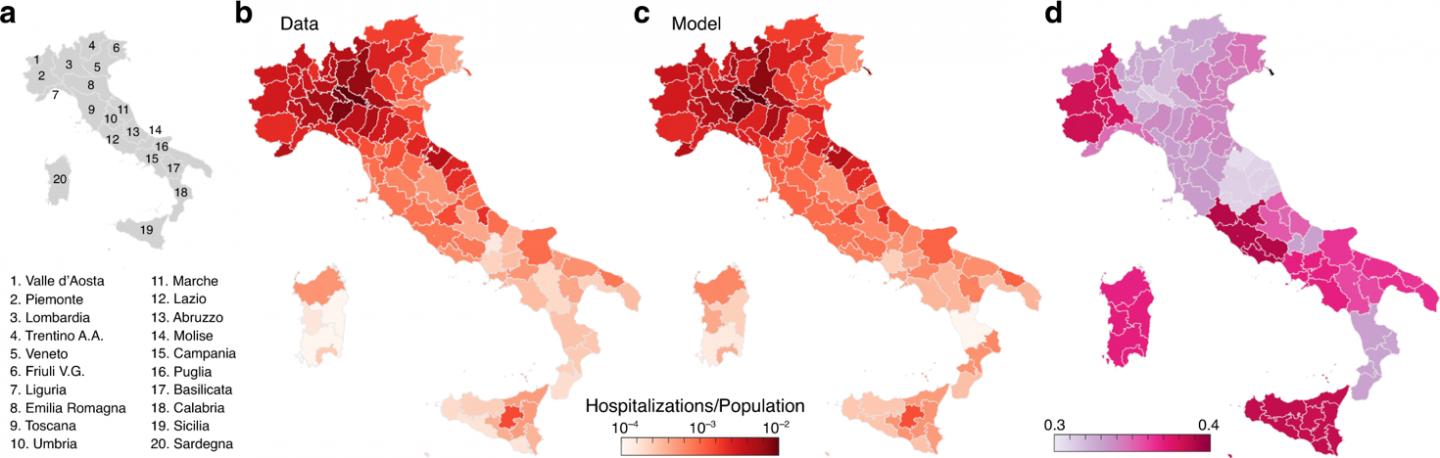
The analysis is based on a spatially explicit model of the COVID-19 spread in Italy (first published in the journal Proceedings of the National Academy of Sciences USA by the team in April), inclusive of mobility among communities, progressive mobility restrictions and social distancing. The benchmark model has been updated through the estimation of parameters using the number of daily hospitalized cases in all 107 Italian provinces from February 24 to May 1st.
The researchers have generated scenarios of the Italian infection dynamics resulting from the bulk effect of lockdown lifting, which initiated on May 4. They wondered how the modes of relaxation of previous confinement measures might affect residual epidemic trajectories. The answer to this question is not trivial, because different activities have been allowed to resume at different times. In addition, acquired awareness may have different lasting effects on social behaviour regardless of imposed measures, and compliance to proper use of Personal Protective Equipment (such as masks) may fade away in time.
Using the epidemiological data up to June 17 the researchers have provided an ex-post assessment of the explored scenarios comparing them with the actual space-time progression of the outbreak. The actual change in overall transmission has been tracked via the departure of the epidemic curve from the one projected by using the transmission rate achieved during the lockdown (termed the baseline scenario). The great majority of Italian regions have been close to the baseline scenario for the considered one-month-and-a-half period.
Scientists have then addressed the mitigation of the likely increased exposure, in particular by estimating the sufficient number of case isolation interventions that would prevent rebounding of the epidemics. A control effort capable of isolating daily about 5.5% of the exposed and highly infectious individuals is necessary to maintain the epidemic curve onto the decreasing baseline trajectory.
###
References
The geography of COVID-19 spread in Italy and implications for the relaxation of confinement measures. Enrico Bertuzzo, Lorenzo Mari, Damiano Pasetto, Stefano Miccoli, Renato Casagrandi, Marino Gatto, and Andrea Rinaldo. Nature Communications, 26 August 2020. DOI: 10.1038/s41467-020-18050-2
Spread and dynamics of the COVID-19 epidemic in Italy: Effects of emergency containment measures. Marino Gatto, Enrico Bertuzzo, Lorenzo Mari, Stefano Miccoli, Luca Carraro, Renato Casagrandi and Andrea Rinaldo. PNAS, 23 April 2020. DOI: 10.1073/pnas.2004978117
Media Contact
Cristina Perini
[email protected]
Related Journal Article
http://dx.