


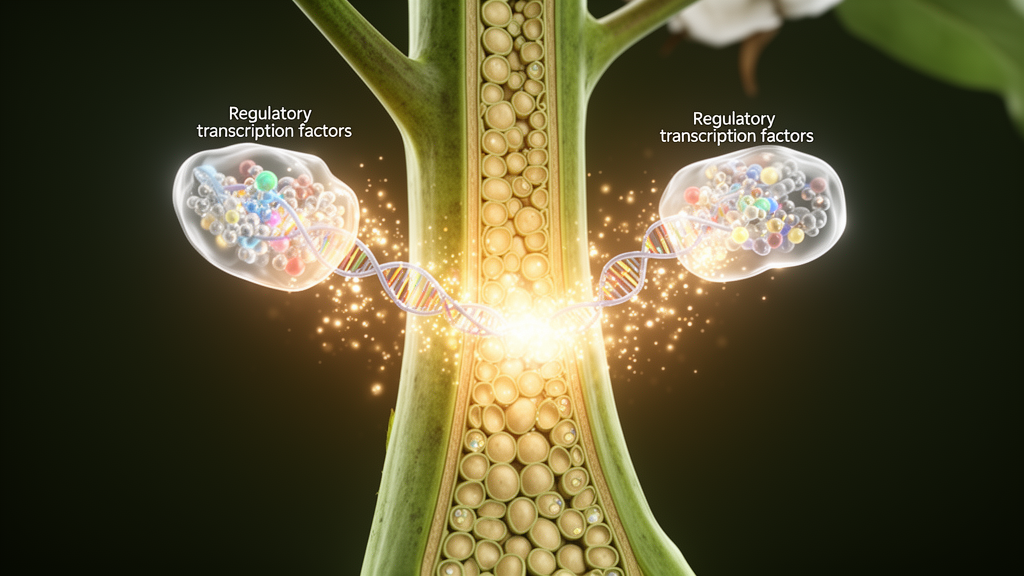
Premature boll abscission is a major constraint on cotton yield, and the molecular machinery behind it has remained poorly understood. A new study in upland cotton (Gossypium hirsutum L.) now identifies a regulatory pathway centered on the IDA-like peptide gene GhIDL1 and its upstream activator, the R2R3-MYB transcription factor GhMYB63. Using RNA-seq, the researchers found that GhIDL1 expression is induced in the abscission zone after stigma removal, marking the gene as a candidate driver of the cell separation process that causes bolls to drop.
Functional tests supported that role. Virus-induced gene silencing of GhIDL1 increased the force required to detach bolls, delayed abscission, and enhanced boll retention. Silenced plants also showed reduced expression of cell wall-remodeling genes, including GhPG and GhCEL1, which are consistent with a slower breakdown of the cell walls that hold the boll in place. Conversely, ectopic expression of GhIDL1 in Arabidopsis accelerated floral organ abscission and complemented the abscission-defective ida-2 mutant, indicating that the peptide’s activity is conserved across species.
Deletion analysis narrowed down which parts of the peptide matter. The N-terminal signal peptide and the conserved C-terminal bioactive motif were both required for the gene to rescue the mutant phenotype, pointing to EPIP-dependent activity of the mature peptide. The authors also explored how the signal is received. Structural modeling, together with simultaneous silencing of GhIDL1, GhHAE, and GhHSL2, implicated the receptor kinases GhHAE and GhHSL2 as candidate receptors in GhIDL1-associated signaling, although the study frames them as candidates rather than confirmed receptors.
Upstream, yeast one-hybrid, electrophoretic mobility shift, and dual-luciferase assays demonstrated that GhMYB63 binds to the GhIDL1 promoter and enhances its activity. In cotton, silencing GhMYB63 reduced GhIDL1 transcript abundance, and silencing GhMYB63 alone or together with GhIDL1 decreased boll abscission. Together these results support a GhMYB63–GhIDL1 regulatory model for boll abscission and suggest potential targets for genetic improvement of cotton yield. The findings come from controlled experiments in cotton and Arabidopsis, and the authors present the receptor components as candidates requiring further validation, but the work provides a concrete molecular entry point into a process that has long limited cotton harvests.
Subject of Research: Molecular regulation of cotton boll abscission by the GhMYB63–GhIDL1 peptide pathway
Article Title: GhMYB63 activates the IDA‑like peptide gene GhIDL1 to promote boll abscission in cotton
Article References: Jia, M., Geng, C., Han, S., Xue, L., Li, Y., Zhao, X., Cheng, X., Lv, S., Liu, L., & Jiang, J. (2026). GhMYB63 activates the IDA‑like peptide gene GhIDL1 to promote boll abscission in cotton. Plant Cell Reports, 45(11), Article 348. https://doi.org/10.1007/s00299-026-04036-9
Image Credits: AI Generated
DOI: 10.1007/s00299-026-04036-9
Keywords: cotton, boll abscission, GhMYB63, GhIDL1, IDA-like peptide, Gossypium hirsutum, abscission zone, cell wall remodeling, GhHAE, GhHSL2, transcription factor, plant molecular biology
News Source: Drew Townsend. (October 29, 2026). Cotton study reveals how GhMYB63 and GhIDL1 drive boll abscission. Scienmag.



