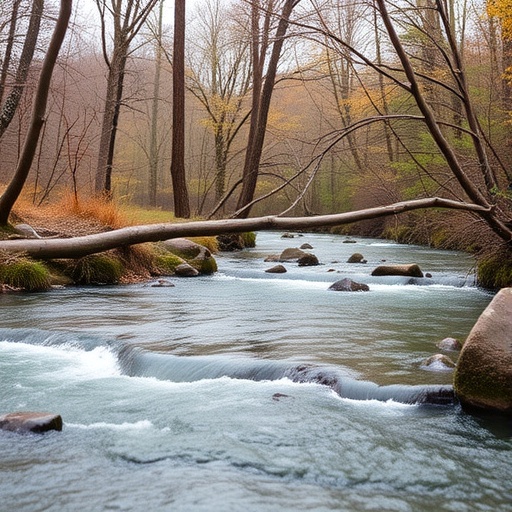
Fish migration between freshwater and saltwater ecosystems is a vital natural phenomenon, essential to the survival of many species, including salmon and steelhead. However, this delicate migratory balance is increasingly disrupted by the fragmentation of river networks due to man-made structures such as dams and roads. These barriers not only interrupt traditional migratory routes but also pose profound risks to fish populations, their health, and the broader biodiversity of aquatic environments.
Efforts to restore fish passage by removing or modifying barriers have been initiated nationwide, yet these restoration projects often demand significant financial investment. A pressing question facing conservationists and policymakers is whether the large sums of money allocated toward these projects are being used most effectively. This challenge was central to a recent study published in PLOS One on June 3, 2026, by researchers from the University of Washington, who critically examined the prevailing methods for prioritizing fish passage restoration projects.
The widely used “score and rank” approach assigns scores to barriers individually based on estimated benefits, such as the expected gain in accessible habitat after removal. Projects with the highest scores are ranked and prioritized for funding. However, this method inadequately considers the entire river system’s connectivity. Barriers that score highly in isolation may become ineffective restoration targets if downstream or adjacent barriers obstruct fish passage, leading to what scientists call “stranded investments.”
Lead author Dr. Sunny Jardine, an associate professor of marine and environmental affairs at the University of Washington, highlights this fundamental flaw. “Ideally, barriers positioned furthest downstream should receive higher priority because their removal opens the way for fish to access upstream habitats. Unfortunately, scoring systems are inconsistent, and high-priority targets sometimes lack the downstream context necessary to guarantee restoration success,” Jardine explains.
To overcome these limitations, the research team proposed the application of an advanced mathematical computer program—optimization algorithms—that integrate numerous variables across whole watersheds to effectively maximize the ecological benefits achieved within fixed budgets. Unlike traditional methods that evaluate barriers independently, optimization assesses portfolios of barriers simultaneously, explicitly accounting for river connectivity and interdependent effects, thus providing a holistic restoration strategy.
Optimization, while powerful, has been underutilized partly due to its complexity and the requirement for extensive data and technical expertise. However, the study results convey that even moderate refinements to current score and rank methodologies, informed by principles derived from optimization modeling, can significantly improve restoration outcomes without necessitating a complete system overhaul.
The context for this study is urgent and expansive. Fragmented river systems threaten aquatic species and their ecosystems on a broad scale. Recent research shows that most river lengths in the United States lack legal protections from human impacts, underscoring the urgent need for strategic restoration. Washington State, for instance, is implementing a massive, court-mandated, multibillion-dollar barrier removal initiative specifically aimed at salmon and steelhead recovery. This program employs a hybrid approach combining score and rank with optimization to balance accessibility and feasibility.
Dr. Jardine remarks on stakeholder perceptions around optimization, noting, “People often view optimization as a ‘black box’ because it’s not immediately clear why a particular barrier is ranked highest. In contrast, score and rank methods are more intuitive, though they carry greater uncertainty about ultimate restoration success.”
Through their case study focusing on Western Washington’s fish passage networks, the researchers demonstrated that while score and rank approaches perform adequately when prioritizing projects solely for maximum habitat expansion, their efficacy diminishes noticeably when complex variables like habitat quality and connectivity are included. Optimization, by contrast, excels at navigating these multi-dimensional challenges to identify the best restoration portfolios.
Despite the promising advantages of optimization, the researchers acknowledge practical hurdles in its adoption. Sophisticated data collection and modeling expertise may be out of reach for some agencies or organizations. Therefore, a pragmatic pathway forward might lie in integrating hybrid approaches, refining existing heuristic-based systems with insights gained from optimization techniques.
Finally, the study stresses a critical principle in fish passage restoration: prioritizing downstream barriers first ensures that upstream investments in habitat access yield meaningful ecological returns. “If projects depend on other upstream or downstream removals, failure to sequence actions properly can lead to wasted resources. Given that restoration costs outstrip available budgets, maximizing the efficiency of investments is imperative,” Jardine emphasizes.
This comprehensive work, supported by Washington Sea Grant and a faculty fellowship named in memory of Warren S. Wooster, involved a multidisciplinary team of researchers from the University of Washington and NOAA, combining expertise in environmental affairs, quantitative ecology, and fishery science. Their collective insights offer a valuable guide for future restoration efforts not only in Washington but also throughout fragmented river systems worldwide.
For further information, Dr. Sunny Jardine can be contacted at [email protected].
Subject of Research: Animals
Article Title: Improving restoration heuristics to support anadromous fish passage
News Publication Date: 3-Jun-2026
Web References:
PLOS One article DOI: 10.1371/journal.pone.0348150
Washington Department of Fish and Wildlife Fish Passage Strategy: wdfw.wa.gov/species-habitats/habitat-recovery/fish-passage/about
University of Washington news on river protections: washington.edu/news/2026/01/09
References:
Jardine, S., Blair, L., Burch, C., Kahn, J., Cooke, A., Rogers, L., Scheuerell, M., Fonner, R., Holland, D., Lewis-Smith, C., Van Deynze, B. (2026). Improving restoration heuristics to support anadromous fish passage. PLOS One. DOI: 10.1371/journal.pone.0348150
Keywords: Fish migration, river fragmentation, barrier removal, habitat restoration, score and rank, optimization, fish passage, anadromous fish, computational modeling, watershed connectivity, environmental conservation, restoration prioritization.
Tags: aquatic biodiversity preservationconservation investment strategiesdam removal impactecological connectivity in riversfish migration conservationfish passage restoration projectsfreshwater and saltwater ecosystemsprioritizing environmental fundingriver ecosystem restoration planningriver network fragmentationsalmon migration barrierssteelhead fish populations