• HOME
  • NEWS
  • EXPLORE
    • CAREER
      • Companies
      • Jobs
    • EVENTS
    • iGEM
      • News
      • Team
    • PHOTOS
    • VIDEO
    • WIKI
  • BLOG
  • COMMUNITY
    • FACEBOOK
    • INSTAGRAM
    • TWITTER
Thursday, April 23, 2026
BIOENGINEER.ORG
No Result
View All Result
  • Login
  • HOME
  • NEWS
  • EXPLORE
    • CAREER
      • Companies
      • Jobs
        • Lecturer
        • PhD Studentship
        • Postdoc
        • Research Assistant
    • EVENTS
    • iGEM
      • News
      • Team
    • PHOTOS
    • VIDEO
    • WIKI
  • BLOG
  • COMMUNITY
    • FACEBOOK
    • INSTAGRAM
    • TWITTER
  • HOME
  • NEWS
  • EXPLORE
    • CAREER
      • Companies
      • Jobs
        • Lecturer
        • PhD Studentship
        • Postdoc
        • Research Assistant
    • EVENTS
    • iGEM
      • News
      • Team
    • PHOTOS
    • VIDEO
    • WIKI
  • BLOG
  • COMMUNITY
    • FACEBOOK
    • INSTAGRAM
    • TWITTER
No Result
View All Result
Bioengineer.org
No Result
View All Result
Home NEWS Science News Health

Cortex-wide variation of neuronal cellular energy levels depending on the sleep-wake states

Bioengineer by Bioengineer
October 7, 2020
in Health
Reading Time: 2 mins read
0
IMAGE
Share on FacebookShare on TwitterShare on LinkedinShare on RedditShare on Telegram

IMAGE

Credit: TMIMS

It is assumed that the brain has homeostatic mechanisms to prevent the depletion of cellular energy, required for all cellular activities. For example, the blood flow increases, and oxygen and glucose are actively delivered in the brain region in which neural firing activity occurs. Besides, the cerebral blood flow and glucose uptake into the cells fluctuate accompanying the variations of cellular activities in the brain across the sleep-wake states of animals. Under these brain energy homeostatic mechanisms, it is assumed that the cellular energy status in the brain could be maintained constant in all physiological conditions including across the sleep-wake states of animals. However, this has not been experimentally proven.

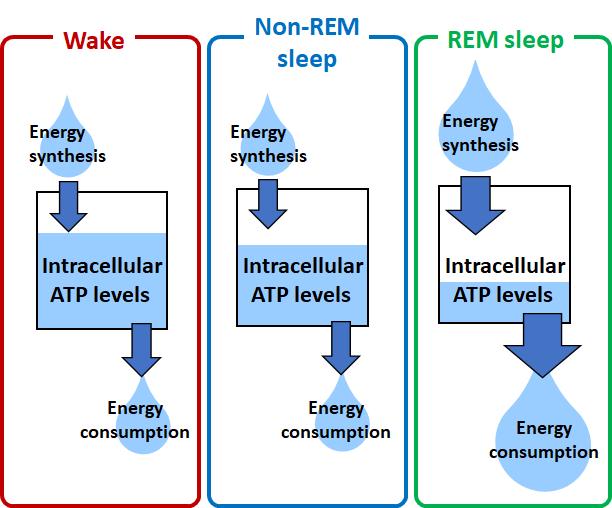
To investigate whether the cellular energy status in the brain of living animals is always constant or variated, the researchers measured the neuronal intracellular concentration of adenosine 5′-triphosphate (ATP), the major cellular energy metabolite, using a fluorescent sensor in the brain of living mice. Using an optical fiber and wide-field microscopy, they showed a cortex-wide variation of cytosolic ATP levels in the cortical neurons depending on the sleep-wake states of animals: The ATP levels were high during the waking state, decreased during non-REM sleep, and profoundly decreased during REM sleep. On the other hand, cerebral blood flow, as a metabolic parameter for energy supply, slightly increased during non-REM sleep and greatly increased during REM sleep, compared with the waking state. The reduction in neuronal ATP levels was also observed under general anesthesia in mice and response to local brain electrical stimulation for neuronal activation, whereas the hemodynamics was simultaneously enhanced.

Since the neuronal ATP levels increase throughout the cortex in the waking state, which is when the cellular energy demand increases, brain mechanisms for energy modulation could increase the neuronal ATP levels in a cortex-wide manner in response to the sleep-to-wake transition of animals. Meanwhile, the great reduction of neuronal ATP levels during REM sleep despite a simultaneous increase of cerebral hemodynamics for energy supply suggests negative energy balance in neurons, which could be due to REM sleep-specific promotion of energy-consuming activities such as heat production. The significant reduction of ATP levels in the cortical neurons during REM sleep is expected to use as a novel biomarker of REM sleep. Eventually, cerebral energy metabolism may not always meet neuronal energy demands, consequently resulting in physiological fluctuations of intracellular ATP levels in neurons.

###

Media Contact
Akiyo Natsubori
[email protected]

Original Source

https://www.nature.com/articles/s42003-020-01215-6

Related Journal Article

http://dx.doi.org/10.1038/s42003-020-01215-6

Tags: BiochemistryMedicine/HealthneurobiologyPhysiologySleep/Sleep Disorders
Share12Tweet8Share2ShareShareShare2

Related Posts

Predicting Hidden Blood Loss in Elderly Femur Fractures

April 23, 2026

Global Trial Finds Low-Dose Triple Pill Reduces Recurrent Stroke Risk by Approximately 40%

April 23, 2026

SNMMI Annual Meeting Scheduled for May 30–June 2, 2026

April 23, 2026

PELSA: Mapping Protein-Ligand Binding Sites Proteome-Wide

April 23, 2026
Please login to join discussion

POPULAR NEWS

  • Research Indicates Potential Connection Between Prenatal Medication Exposure and Elevated Autism Risk

    804 shares
    Share 322 Tweet 201
  • Scientists Investigate Possible Connection Between COVID-19 and Increased Lung Cancer Risk

    65 shares
    Share 26 Tweet 16
  • Salmonella Haem Blocks Macrophages, Boosts Infection

    59 shares
    Share 24 Tweet 15
  • NSF funds machine-learning research at UNO and UNL to study energy requirements of walking in older adults

    101 shares
    Share 40 Tweet 25

About

We bring you the latest biotechnology news from best research centers and universities around the world. Check our website.

Follow us

Recent News

Predicting Hidden Blood Loss in Elderly Femur Fractures

Icaritin Reverses STAT3-Driven EGFR-TKI Resistance

Global Trial Finds Low-Dose Triple Pill Reduces Recurrent Stroke Risk by Approximately 40%

Subscribe to Blog via Email

Enter your email address to subscribe to this blog and receive notifications of new posts by email.

Join 81 other subscribers
  • Contact Us

Bioengineer.org © Copyright 2023 All Rights Reserved.

Welcome Back!

Login to your account below

Forgotten Password?

Retrieve your password

Please enter your username or email address to reset your password.

Log In
No Result
View All Result
  • Homepages
    • Home Page 1
    • Home Page 2
  • News
  • National
  • Business
  • Health
  • Lifestyle
  • Science

Bioengineer.org © Copyright 2023 All Rights Reserved.