• HOME
  • NEWS
  • EXPLORE
    • CAREER
      • Companies
      • Jobs
    • EVENTS
    • iGEM
      • News
      • Team
    • PHOTOS
    • VIDEO
    • WIKI
  • BLOG
  • COMMUNITY
    • FACEBOOK
    • INSTAGRAM
    • TWITTER
Wednesday, October 7, 2026
BIOENGINEER.ORG
No Result
View All Result
  • Login
  • HOME
  • NEWS
  • EXPLORE
    • CAREER
      • Companies
      • Jobs
        • Lecturer
        • PhD Studentship
        • Postdoc
        • Research Assistant
    • EVENTS
    • iGEM
      • News
      • Team
    • PHOTOS
    • VIDEO
    • WIKI
  • BLOG
  • COMMUNITY
    • FACEBOOK
    • INSTAGRAM
    • TWITTER
  • HOME
  • NEWS
  • EXPLORE
    • CAREER
      • Companies
      • Jobs
        • Lecturer
        • PhD Studentship
        • Postdoc
        • Research Assistant
    • EVENTS
    • iGEM
      • News
      • Team
    • PHOTOS
    • VIDEO
    • WIKI
  • BLOG
  • COMMUNITY
    • FACEBOOK
    • INSTAGRAM
    • TWITTER
No Result
View All Result
Bioengineer.org
No Result
View All Result
Home NEWS Science News Chemistry

Concert of magnetic moments

Bioengineer by Bioengineer
June 13, 2019
in Chemistry
Reading Time: 2 mins read
0
IMAGE
Share on FacebookShare on TwitterShare on LinkedinShare on RedditShare on Telegram

IMAGE

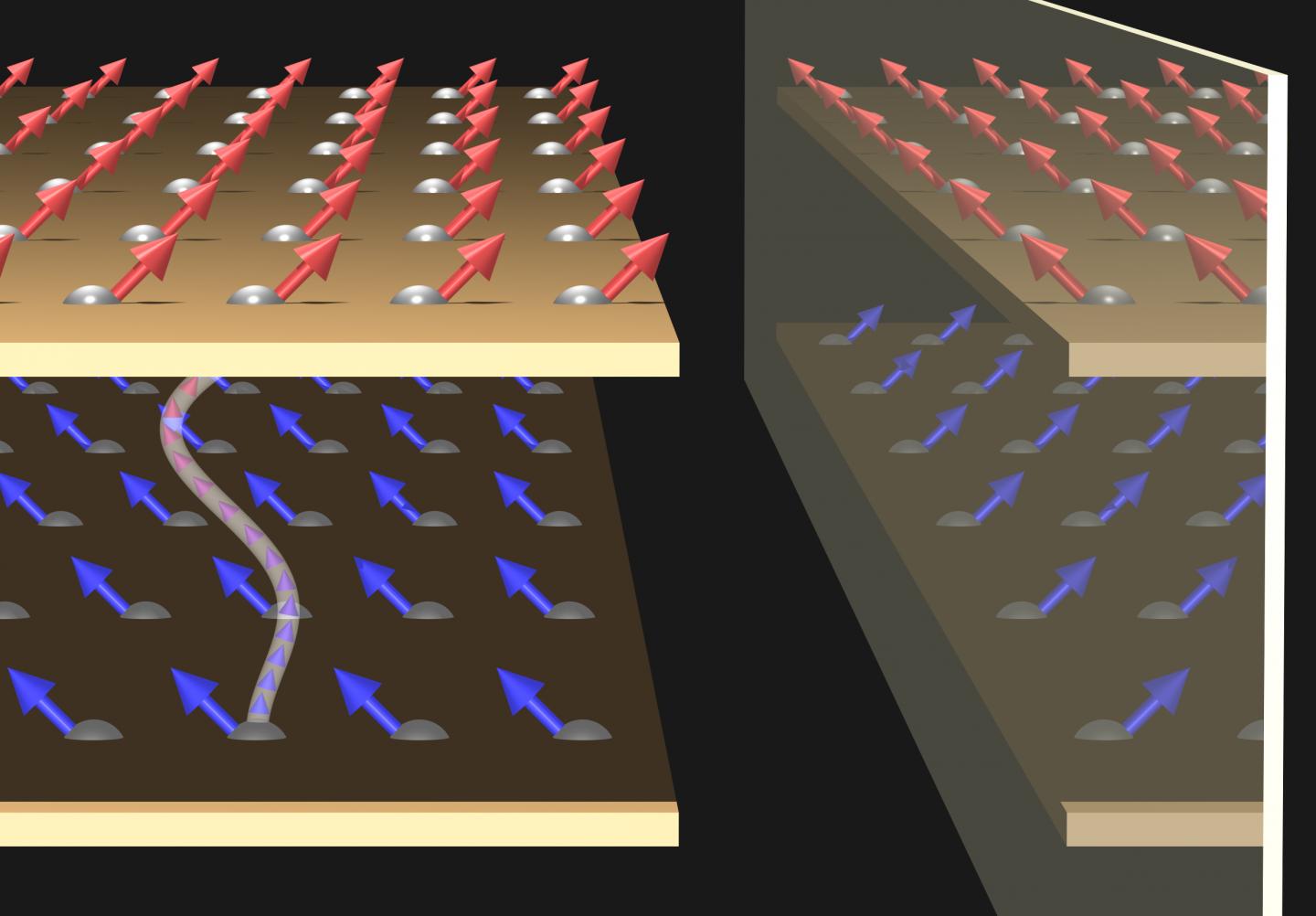
Credit: Forschungszentrum Jülich / Jan-Philipp Hanke

An international collaboration between researchers from Germany, the Netherlands, and South Korea has uncovered a new way how the electron spins in layered materials can interact. In their publication in the journal Nature Materials, the scientists report a hitherto unknown chiral coupling that is active over relatively long distances. As a consequence, spins in two different magnetic layers that are separated by non-magnetic materials can influence each other even though they are not adjacent.

Magnetic solids form the foundation of modern information technology. For example, these materials are ubiquitous in memories such as hard disk drives. Functionality and efficiency of these devices is determined by the physical properties of the magnetic solids. The latter originate from the “concert of spins” – the interactions between microscopically small magnetic moments within the material. Understanding and directing this concert is a fundamental question for both research and applications.

Two magnetic materials can influence each other over long distances even if they are not in direct contact. In the past, such a long-range interaction has been observed, for example, in heterostructures of magnetic iron layers that are separated by a thin chromium spacer. A unique fingerprint of the so-called interlayer coupling is the parallel or antiparallel alignment of the magnetic moments in the iron layers. This phenomenon is technologically important since the electrical resistance of the two possible configurations is drastically different – which is known as giant magnetoresistance effect. It is used in operating magnetic memories and sensors, and in 2007 the Nobel Prize in Physics was awarded jointly to Peter Grünberg and Albert Fert for their discovery.

A group of scientists has now extended this “concert of spins” by a new type of long-range interlayer coupling. They report in the journal Nature Materials that the discovered interaction leads to a special configuration of the magnetic moments, which is neither parallel nor antiparallel but has a specific chirality. This means that the resulting arrangement of spins is not identical to its mirror image – just like our left hand is different from our right hand. Such chiral interactions in crystals are very rare in nature. Using theoretical simulations on the supercomputer JURECA in Jülich, the researchers identified the interplay between the crystal structure and relativistic effects as origin of the observed chiral interlayer coupling. This flavor of the “concert of spins” offers novel opportunities for engineering complex magnetic configurations that could be useful to store and process data more efficiently in the future.

###

Media Contact
Tobias Schlößer
[email protected]

Original Source

https://www.fz-juelich.de/SharedDocs/Pressemitteilungen/UK/EN/2019/notifications/2019-06-13-chirale-ww.html

Related Journal Article

http://dx.doi.org/10.1038/s41563-019-0370-z

Tags: Atomic/Molecular/Particle PhysicsChemistry/Physics/Materials SciencesElectromagneticsMaterials
Share12Tweet8Share2ShareShareShare2

Related Posts

Ice Water Beats Room Temperature: Simple Cooling Trick Supercharges Shape Memory Rubber

Ice Water Beats Room Temperature: Simple Cooling Trick Supercharges Shape Memory Rubber

October 7, 2026
Ghana's rivers, hospitals and landfills are steeped in antibiotic pollution, review finds

Ghana’s rivers, hospitals and landfills are steeped in antibiotic pollution, review finds

October 7, 2026

Heavy Fermions Spotted Forming at a One-Atom-Thick Interface

October 7, 2026

Peel and Pulp Decisions Reshape Kiwi Wine Flavor and Methanol Risk

October 7, 2026
Please login to join discussion

POPULAR NEWS

  • Alloys That Shrink Their Own Grains: New PIX Mechanism Refines Metals With Heat Alone

    Alloys That Shrink Their Own Grains: New PIX Mechanism Refines Metals With Heat Alone

    29 shares
    Share 12 Tweet 7
  • Endurance Exercise Reshapes the Liver in Males and Females Through Distinct Molecular Routes

    29 shares
    Share 12 Tweet 7
  • Single Transcription Factor PU.1 Rapidly Converts Fibroblasts into Macrophage-Lineage Cells

    29 shares
    Share 12 Tweet 7
  • New Scale Measures How Ready Nurse Educators Really Are for the AI Era

    29 shares
    Share 12 Tweet 7

About

We bring you the latest biotechnology news from best research centers and universities around the world. Check our website.

Follow us

Recent News

Alloys That Shrink Their Own Grains: New PIX Mechanism Refines Metals With Heat Alone

Endurance Exercise Reshapes the Liver in Males and Females Through Distinct Molecular Routes

Single Transcription Factor PU.1 Rapidly Converts Fibroblasts into Macrophage-Lineage Cells

Subscribe to Blog via Email

Success! An email was just sent to confirm your subscription. Please find the email now and click 'Confirm' to start subscribing.

Join 85 other subscribers
  • Contact Us

Bioengineer.org © Copyright 2023 All Rights Reserved.

Welcome Back!

Login to your account below

Forgotten Password?

Retrieve your password

Please enter your username or email address to reset your password.

Log In
No Result
View All Result
  • Homepages
    • Home Page 1
    • Home Page 2
  • News
  • National
  • Business
  • Health
  • Lifestyle
  • Science

Bioengineer.org © Copyright 2023 All Rights Reserved.