• HOME
  • NEWS
  • EXPLORE
    • CAREER
      • Companies
      • Jobs
    • EVENTS
    • iGEM
      • News
      • Team
    • PHOTOS
    • VIDEO
    • WIKI
  • BLOG
  • COMMUNITY
    • FACEBOOK
    • INSTAGRAM
    • TWITTER
Monday, May 11, 2026
BIOENGINEER.ORG
No Result
View All Result
  • Login
  • HOME
  • NEWS
  • EXPLORE
    • CAREER
      • Companies
      • Jobs
        • Lecturer
        • PhD Studentship
        • Postdoc
        • Research Assistant
    • EVENTS
    • iGEM
      • News
      • Team
    • PHOTOS
    • VIDEO
    • WIKI
  • BLOG
  • COMMUNITY
    • FACEBOOK
    • INSTAGRAM
    • TWITTER
  • HOME
  • NEWS
  • EXPLORE
    • CAREER
      • Companies
      • Jobs
        • Lecturer
        • PhD Studentship
        • Postdoc
        • Research Assistant
    • EVENTS
    • iGEM
      • News
      • Team
    • PHOTOS
    • VIDEO
    • WIKI
  • BLOG
  • COMMUNITY
    • FACEBOOK
    • INSTAGRAM
    • TWITTER
No Result
View All Result
Bioengineer.org
No Result
View All Result
Home NEWS Science News Chemistry

Compressive fluctuations heat ions in space plasma

Bioengineer by Bioengineer
December 18, 2020
in Chemistry
Reading Time: 2 mins read
0
IMAGE
Share on FacebookShare on TwitterShare on LinkedinShare on RedditShare on Telegram

IMAGE

Credit: Yohei Kawazura

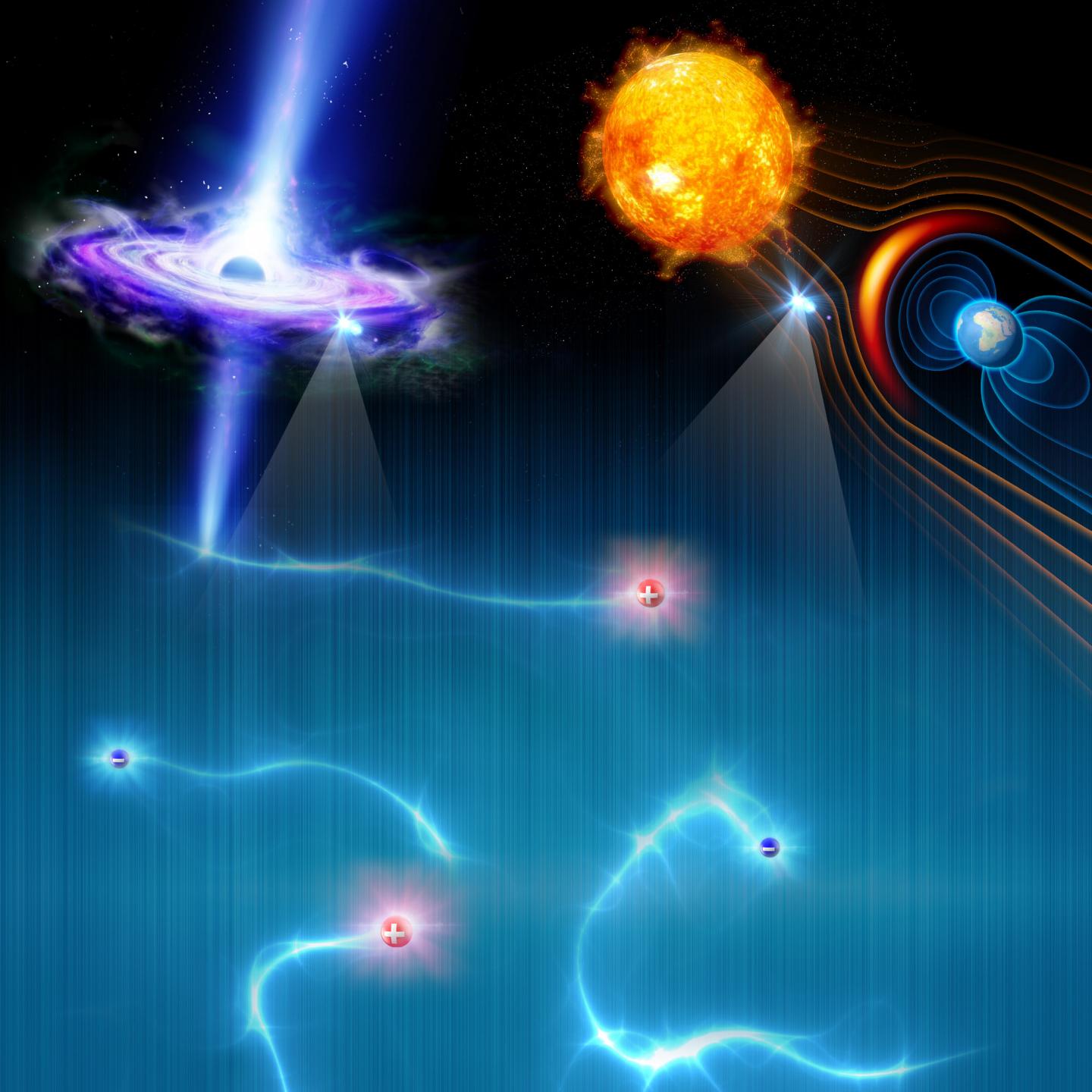
New simulations carried out in part on the ATERUI II supercomputer in Japan have found that the reason ions exist at higher temperatures than electrons in space plasma is because they are better able to absorb energy from compressive turbulent fluctuations in the plasma. These finding have important implications for understanding observations of various astronomical objects such as the images of the accretion disk and shadow of the M87 supermassive black hole captured by the Event Horizon Telescope.

In addition to the normal three states of matter (solid, liquid, and gas) which we see around us every day, there is an additional state called plasma which exists only at high temperatures. Under these conditions, electrons become separated from their parent atoms leaving behind positively charged ions. In space plasma the electrons and ions rarely collide with each other, meaning that they can coexist in different conditions, such as at different temperatures. However, there is no obvious reason why they should have different temperatures unless some force affects them differently. So why ions are usually hotter than electrons in space plasma has long been a mystery.

One way to heat plasma is by turbulence. Chaotic fluctuations in turbulence smoothly mix with particles, and then their energy is converted into heat. To determine the roles of different types of fluctuations in plasma heating, an international team led by Yohei Kawazura at Tohoku University in Japan performed the world’s first simulations of space plasma including two types of fluctuations, transverse oscillations of magnetic field lines and longitudinal oscillations of pressure. They used nonlinear hybrid gyrokinetic simulations which are particularly good at modeling slow fluctuations. These simulations were conducted on several supercomputers, including ATERUI II at the National Astronomical Observatory of Japan.

The results showed that the longitudinal fluctuations like to mix with ions but leave electrons. On the other hand the transverse fluctuations can mix with both ions and electrons. “Surprisingly, the longitudinal fluctuations are picky about the partner species to mix with,” says Kawazura. This is a key result for understanding the ion to electron heating ratios in plasmas observed in space, like that around the supermassive black hole in Galaxy M87.

###

These results appeared as Y. Kawazura et al. “Ion versus Electron Heating in Compressively Driven Astrophysical Gyrokinetic Turbulence” in Physical Review X, on December 11, 2020.

Media Contact
Dr. Hinako Fukushi
[email protected]

Original Source

https://www.nao.ac.jp/en/news/science/2020/20201218-cfca.html

Related Journal Article

http://dx.doi.org/10.1103/PhysRevX.10.041050

Tags: AstronomyAstrophysicsSpace/Planetary Science
Share12Tweet8Share2ShareShareShare2

Related Posts

Miniature Sensor Uses Light to Detect Touch — Chemistry

Miniature Sensor Uses Light to Detect Touch

May 8, 2026
Iron Minerals Determine Whether Dissolved Organic Matter Fuels Microbes or Becomes Long-Term Carbon Storage — Chemistry

Iron Minerals Determine Whether Dissolved Organic Matter Fuels Microbes or Becomes Long-Term Carbon Storage

May 8, 2026

Kate Evans Appointed Associate Lab Director for Biological and Environmental Systems Science at ORNL

May 8, 2026

Advancing Multiscale Modeling and Overcoming Operational Challenges in Autothermal COâ‚‚-to-Methanol Reactors

May 8, 2026
Please login to join discussion

POPULAR NEWS

  • Research Indicates Potential Connection Between Prenatal Medication Exposure and Elevated Autism Risk

    840 shares
    Share 336 Tweet 210
  • New Study Reveals Plants Can Detect the Sound of Rain

    727 shares
    Share 290 Tweet 181
  • Salmonella Haem Blocks Macrophages, Boosts Infection

    61 shares
    Share 24 Tweet 15
  • Breastmilk Balances E. coli and Beneficial Bacteria in Infant Gut Microbiomes

    57 shares
    Share 23 Tweet 14

About

We bring you the latest biotechnology news from best research centers and universities around the world. Check our website.

Follow us

Recent News

New Post-Hoc Analysis Explores Daily Oral Orforglipron Use in Adults Over 65 with Obesity, Regardless of Diabetes Status

Evaluating Digoxin Use in Patients with Symptomatic Rheumatic Heart Disease

Evaluating the Effectiveness and Safety of Digitalis Glycosides in Treating Heart Failure

Subscribe to Blog via Email

Enter your email address to subscribe to this blog and receive notifications of new posts by email.

Join 82 other subscribers
  • Contact Us

Bioengineer.org © Copyright 2023 All Rights Reserved.

Welcome Back!

Login to your account below

Forgotten Password?

Retrieve your password

Please enter your username or email address to reset your password.

Log In
No Result
View All Result
  • Homepages
    • Home Page 1
    • Home Page 2
  • News
  • National
  • Business
  • Health
  • Lifestyle
  • Science

Bioengineer.org © Copyright 2023 All Rights Reserved.