Researchers have developed a novel organic-inorganic composite membrane designed for water treatment applications, demonstrating distinct cation-selective behavior through electrochemical testing. The study, published in Discover Chemical Engineering, focuses on the fabrication and characterization of a membrane combining cellulose acetate as a continuous binding polymer with zirconium carbonate as the inorganic component. This hybrid material was created using a solvent-free direct compression method, aiming to enhance mechanical strength, chemical stability, and electro-transport properties for potential use in ion separation technologies.
The primary objective of the research was to address limitations found in traditional ion exchange membranes, which often suffer from insufficient mechanical durability and chemical stability under industrial conditions. By integrating zirconium carbonate into a cellulose acetate matrix, the team sought to leverage the film-forming capacity of the polymer alongside the structural robustness and ion-exchange efficiency of the inorganic compound. The resulting composite membrane was subjected to rigorous material characterization to evaluate its suitability for aqueous applications, with a specific focus on its ability to separate ions based on mobility and charge.
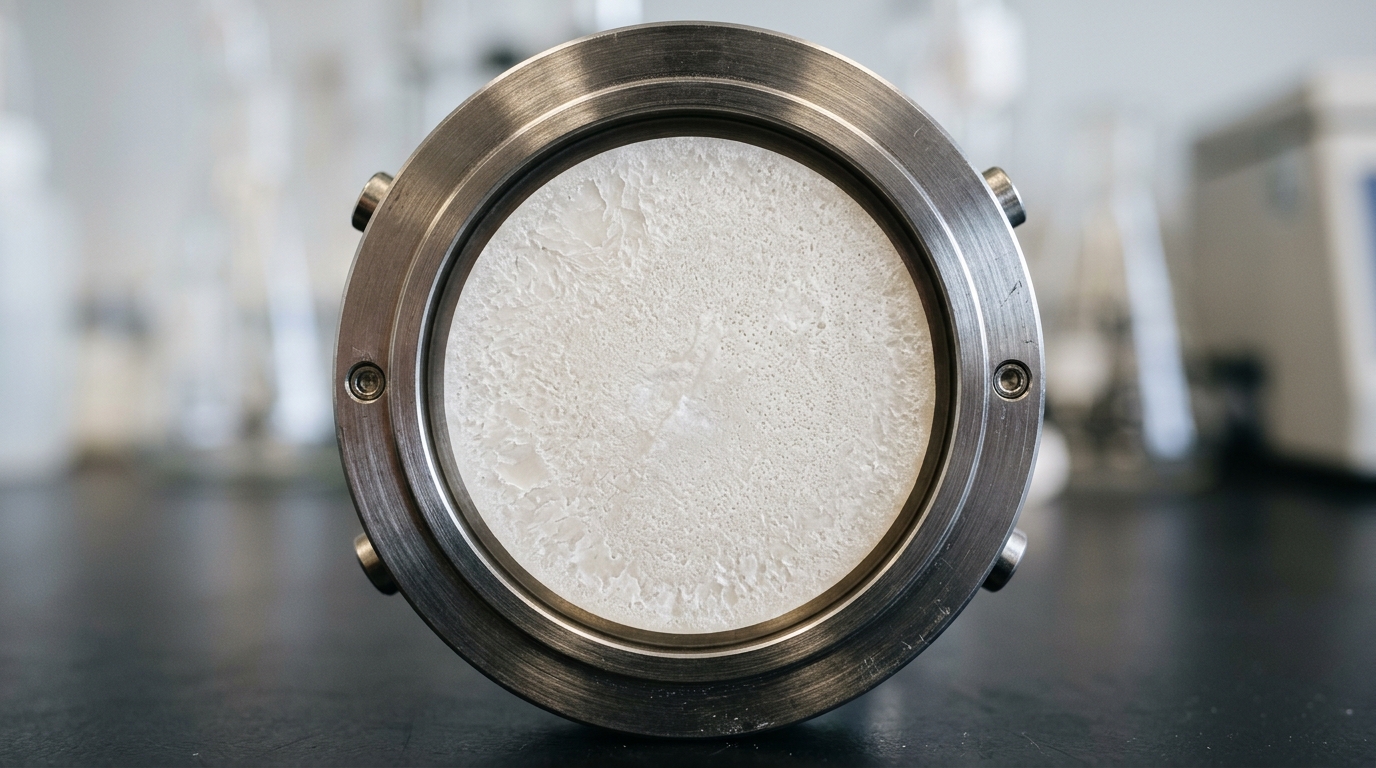
The fabrication process involved a direct compression technique that bypasses conventional solvent casting methods. A mixture of zirconium carbonate and cellulose acetate, maintained at a 3:1 weight ratio, was compressed in a stainless-steel die under 8 tons of pressure for 10 minutes at ambient temperature. This mechanical approach was selected to achieve sufficient particle densification and interfacial bonding while preserving a linked porous structure advantageous for ion transport. The solvent-free nature of the process offers a scalable and cost-effective route for producing hybrid ion-exchange membranes.
Structural analysis using X-ray diffraction revealed that the composite membrane possesses a semi-crystalline nature, with a calculated crystallinity index of approximately 31%. This structure consists of a dominant amorphous phase interspersed with crystalline regions, where the cellulose acetate binder contributes to the amorphous domains and the zirconium carbonate provides the crystalline peaks. The presence of discrete peaks at specific angles confirmed the monoclinic phase of the zirconium compound, while the amorphous cellulose acetate phase was indicated by a wide halo in the diffraction pattern.
Fourier-transform infrared spectroscopy confirmed the chemical interaction between the two components, identifying characteristic functional groups from both the organic and inorganic phases. The spectra displayed absorption bands corresponding to ester groups in cellulose acetate and zirconium-oxygen stretching vibrations, indicating successful incorporation of zirconium carbonate into the polymer matrix. Peak shifting between the individual components and the composite further suggested improved structural cohesiveness through interfacial contact, which is critical for maintaining the integrity of the membrane during use.
Scanning electron microscopy and energy-dispersive X-ray spectroscopy provided insights into the surface morphology and elemental composition of the membrane. The SEM images showed a smooth surface at lower magnifications, with the distribution of inorganic particles becoming visible at higher magnifications. Micro-scale pores were observed, confirming the porosity of the membrane and supporting a balance between permeability and selectivity. EDS analysis verified the presence of zirconium, carbon, and oxygen, confirming the successful integration of both the inorganic and organic phases within the synthesized composite.
Electrochemical performance was evaluated by measuring membrane potential using monovalent electrolytes across varying concentration gradients. The membrane exhibited consistent cation-selective behavior, evidenced by positive membrane potentials and a selectivity trend following potassium, sodium, and lithium ions. This order aligns with the relative ionic mobilities, where potassium ions, having lower hydration energy, interact less strongly with the membrane matrix compared to the more heavily hydrated lithium ions. The highest membrane potential was recorded with potassium nitrate, reaching 28.3 mV at a specific concentration ratio, indicating stronger interaction with potassium ions.
The ion-exchange capacity of the composite membrane was measured at 0.045 mmol per gram, reflecting the fixed ionic sites contributed primarily by the zirconium carbonate. This moderate value supports the observed electrochemical performance and indicates the potential of the membrane for ion-selective separation applications. The membrane thickness was determined to be 0.066 cm, offering mechanical stability while maintaining functional performance. The combination of moderate crystallinity and specific pore structure facilitates the diffusion of ions, particularly those with reduced hydration resistance such as potassium.
Theoretical models, including the Teorell-Meyer-Sievers model, were used to interpret the electro-transport behavior, integrating Donnan equilibrium and Nernst-Planck equations. The experimental membrane potential values showed strong consistency with these theoretical predictions, validating the effectiveness of the developed composite. The positive potentials confirm that the membrane acts as a negatively charged, cation-selective barrier, likely due to the adsorption of anions onto the surface, which imparts a net negative charge. This mechanism allows for the selective transport of counter-ions while restricting co-ions, a fundamental requirement for effective ion exchange membranes.
Swelling behavior and moisture content were also assessed to determine the membrane’s stability in aqueous environments. The results indicated negligible swelling, suggesting strong polymer-inorganic material interaction and structural stability. These properties are crucial for maintaining dimensional stability and selectivity during prolonged use in water treatment systems. The solvent-free fabrication method contributes to the uniform structure and reproducible performance of the membrane, ensuring minimal residual moisture that could otherwise affect viscosity and film-forming behavior.
While the study demonstrates promising results for ion separation and water purification, the authors note that further performance optimization is required for practical implementation. The inclusion of zirconium carbonate in a cellulose acetate binder utilizing electro-transport modeling and solvent-free compression techniques represents a novel approach compared to conventional ion exchangers. The findings highlight the potential of CA-ZC membranes for applications in electrodialysis, electrochemical separation, and related fields, subject to additional testing in real-world water treatment scenarios.
The research contributes to the growing field of hybrid ion-exchange membranes by providing detailed electrochemical insight into ion transport behavior within a sustainable and scalable fabrication framework. By combining mechanical characterization with electrochemical analysis, the study offers a comprehensive understanding of how structural features influence functional performance. This work underscores the importance of material innovation in advancing separation technologies for industrial water treatment and environmental remediation.
The development of modern ion exchange membranes traces back to mid-twentieth-century electrodialysis systems, which initially relied on simple ion-exchange resins and inorganic structures that suffered from limited mechanical endurance and chemical instability under continuous operation. Later research addressed those structural shortcomings by adopting synthetic organic polymers, including polyvinyl chloride, polystyrene, and polyethersulfone. In the current design, zirconium carbonate was selected over standard mineral fillers such as calcium carbonate or silica because zirconium-based compounds can establish coordination and cross-linking interactions with the surrounding polymeric binder. These interactions enhance interfacial compatibility, mechanical durability, and thermal stability within the composite matrix, overcoming the low selectivity typically observed in pure cellulose acetate membranes.
To prepare the composite material, researchers blended 0.375 grams of analytical-grade zirconium carbonate with 0.125 grams of cellulose acetate, producing uniform mixture portions to form individual 0.5-gram discs, with acetone utilized for apparatus cleaning. Evaluation of moisture retention was conducted gravimetrically by heating the fresh membrane material in a hot air furnace at 80 degrees Celsius for six hours. This thermal treatment removed physically adsorbed, loosely bound water without disturbing the chemical structure, ensuring reproducible drying behavior and structural consistency. In parallel, water immersion trials measured dimensional variation by soaking dry samples in double-distilled water at ambient temperature for six hours, confirming that negligible swelling occurred and demonstrating strong bonding between the organic binder and inorganic particles.
Structural and spectroscopic investigations relied on specialized instrumentation to map the material’s internal phases and bonding patterns. Diffraction profiles were recorded on a Rigaku Miniflex diffractometer utilizing copper K-alpha radiation across a 2-theta scanning range from 10 to 80 degrees at a rate of 4 degrees per minute. Quantitative crystallinity estimates applied the empirical relation established by Nara and Komiya, comparing crystalline peak area against total diffraction area. Infrared characterization using potassium bromide pellets identified distinct spectral markers, including a broad band near 3420 inverse centimeters linked to hydrogen-bonded water molecules of crystallization, carbon-hydrogen bending vibrations at 1370 inverse centimeters, and carbon-oxygen stretching modes at 1220 inverse centimeters, while new bands between 680 and 750 inverse centimeters confirmed zirconium-oxygen coordination within the composite.
Morphological investigations using scanning electron microscopy operated at an accelerating voltage of 20 kilovolts tracked structural evolution across several magnification scales. Initial imaging at 1,000, 2,500, and 5,000 times magnification confirmed a smooth, defect-free membrane exterior, while higher resolution at 30,000 times revealed the dispersion of inorganic particles, and subsequent imaging confirmed microscopic pores that facilitate transport channels. During potentiometric testing, vertical clamping within two collared glass chambers fitted with saturated calomel electrodes prevented edge leakage across well-stirred compartments. Testing across a ten-fold concentration gradient demonstrated that measured membrane potentials systematically increased as electrolytes were diluted, a response driven by diminished interionic interactions in dilute solutions that aligns directly with classical Donnan membrane potential theory.
Beyond primary desalination contexts, the authors noted that this solvent-free fabrication route and semi-crystalline hybrid matrix offer useful utility across broader electrochemical domains. Because the combination of crystalline stability and amorphous transport zones balances structural integrity with counter-ion diffusion, these composite membranes show relevant promise for industrial effluent recycling, fuel cells, electrodialysis, and biosensors. Further optimization of compaction pressure and constituent ratios will remain necessary to scale the material for demanding industrial separations.
Subject of Research: Fabrication and electrochemical characterization of a cellulose acetate-zirconium carbonate composite membrane for ion separation.
Article Title: Material characterization and electro-transport of cellulose acetate (CA) based zirconium carbonate (ZC) composite membrane for water treatment technologies
Article References: Khan, I., Khan, M. M. A., Ali, S. A., Qamar, F., & Kumar, M. (2026). Material characterization and electro-transport of cellulose acetate (CA) based zirconium carbonate (ZC) composite membrane for water treatment technologies. Discover Chemical Engineering, 6(1), Article 29. https://doi.org/10.1007/s43938-026-00131-1
Image Credits: AI Generated
DOI: 10.1007/s43938-026-00131-1
Keywords: composite membrane, zirconium carbonate, cellulose acetate, water treatment, cation selectivity, ion exchange, electro-transport, material characterization, Material, characterization, cellulose, acetate
News Source: Bethany Barker. (November 7, 2026). Zirconium Carbonate Membrane Shows Cation Selectivity. Scienmag.