• HOME
  • NEWS
  • EXPLORE
    • CAREER
      • Companies
      • Jobs
    • EVENTS
    • iGEM
      • News
      • Team
    • PHOTOS
    • VIDEO
    • WIKI
  • BLOG
  • COMMUNITY
    • FACEBOOK
    • INSTAGRAM
    • TWITTER
Sunday, December 28, 2025
BIOENGINEER.ORG
No Result
View All Result
  • Login
  • HOME
  • NEWS
  • EXPLORE
    • CAREER
      • Companies
      • Jobs
        • Lecturer
        • PhD Studentship
        • Postdoc
        • Research Assistant
    • EVENTS
    • iGEM
      • News
      • Team
    • PHOTOS
    • VIDEO
    • WIKI
  • BLOG
  • COMMUNITY
    • FACEBOOK
    • INSTAGRAM
    • TWITTER
  • HOME
  • NEWS
  • EXPLORE
    • CAREER
      • Companies
      • Jobs
        • Lecturer
        • PhD Studentship
        • Postdoc
        • Research Assistant
    • EVENTS
    • iGEM
      • News
      • Team
    • PHOTOS
    • VIDEO
    • WIKI
  • BLOG
  • COMMUNITY
    • FACEBOOK
    • INSTAGRAM
    • TWITTER
No Result
View All Result
Bioengineer.org
No Result
View All Result
Home NEWS Science News Chemistry

Common antioxidant enzyme may provide potential treatment for COVID-19

Bioengineer by Bioengineer
September 29, 2020
in Chemistry
Reading Time: 2 mins read
0
IMAGE
Share on FacebookShare on TwitterShare on LinkedinShare on RedditShare on Telegram

IMAGE

Credit: Yunfeng Lu research group/UCLA

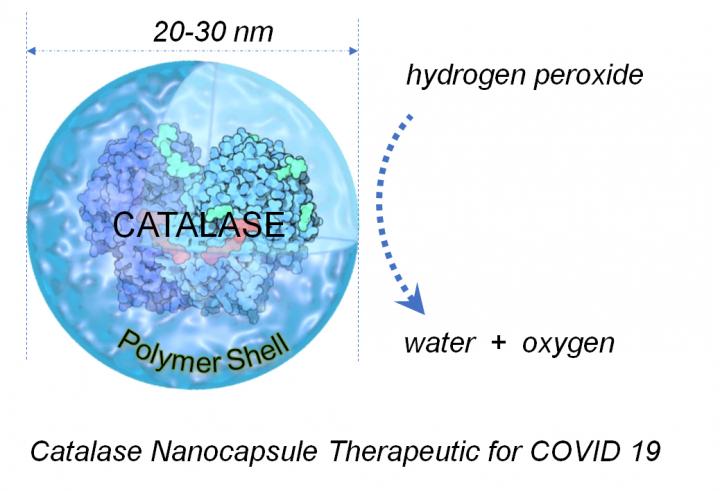
Researchers from UCLA and China have found that catalase, a naturally occurring enzyme, holds potential as a low-cost therapeutic drug to treat COVID-19 symptoms and suppress the replication of coronavirus inside the body. A study detailing the research was published in Advanced Materials.

Catalase is produced naturally and used by humans, animals and plants. Inside cells, the antioxidant enzyme kick starts the breakdown of hydrogen peroxide, which can be toxic, into water and oxygen. The enzyme is also commonly used worldwide in food production and as a dietary supplement.

“There is a lot of focus on vaccines and antiviral drugs, and rightly so,” said Yunfeng Lu, a UCLA Samueli School of Engineering professor of chemical and biomolecular engineering and a senior author on the study. “In the meantime, our research suggests this enzyme could offer a very effective therapeutic solution for treatment of hyperinflammation that occurs due to SARS-CoV-2 virus, as well as hyperinflammation generally.”

Lu’s group developed the drug-delivery technology used in the experiments. Three types of tests were conducted, each addressing a different symptom of COVID-19.

First, they demonstrated the enzyme’s anti-inflammatory effects and its ability to regulate the production of cytokines, a protein that is produced in white blood cells. Cytokines are an important part of the human immune system, but they can also signal the immune system to attack the body’s own cells if too many are made — a so-called “cytokine storm” that is reported in some patients diagnosed with COVID-19.

Second, the team showed that catalase can protect alveolar cells, which line the human lungs, from damage due to oxidation.

Finally, the experiments showed that catalase can repress the replication of SARS?CoV?2 virus in rhesus macaques, a type of monkey, without noticeable toxicity.

“This work has far-reaching implications beyond the treatment of COVID-19. Cytokine storm is a lethal condition that can complicate other infections, such as influenza, as well as non-infectious conditions, like autoimmune disease,” said Dr. Gregory Fishbein, an author on the study and a pathologist at the UCLA David Geffen School of Medicine.

###

The co-lead authors are Zheng Cao, a graduate student involved in Lu’s UCLA laboratory; Jing Wen, an assistant professor of UCLA School of Medicine; and Meng Qin from Beijing University of Chemical Technology.

In addition to Fishbein, Bin Xu — a visiting professor with Lu’s laboratory — is another author from UCLA.

Researchers on the study are also from the Institute of Medical Biology at the Chinese Academy of Medical Sciences; Jinan University, China; and Vivibaba, a UCLA startup company.

The study was supported in part by Beijing Science Sun Pharmaceutical Co. Ltd.

Media Contact
Christine Wei-li Lee
[email protected]

Related Journal Article

http://dx.doi.org/10.1002/adma.202004901

Tags: Biomedical/Environmental/Chemical EngineeringInfectious/Emerging DiseasesMedicine/HealthPharmaceutical/Combinatorial Chemistry
Share12Tweet8Share2ShareShareShare2

Related Posts

Cutting Electrolyte Reduction Boosts High-Energy Battery Performance

Cutting Electrolyte Reduction Boosts High-Energy Battery Performance

December 19, 2025
Microenvironment Shapes Gold-Catalysed CO2 Electroreduction

Microenvironment Shapes Gold-Catalysed CO2 Electroreduction

December 11, 2025

Photoswitchable Olefins Enable Controlled Polymerization

December 11, 2025

Cation Hydration Entropy Controls Chloride Ion Diffusion

December 10, 2025
Please login to join discussion

POPULAR NEWS

  • Robotic Waist Tether for Research Into Metabolic Cost of Walking

    NSF funds machine-learning research at UNO and UNL to study energy requirements of walking in older adults

    71 shares
    Share 28 Tweet 18
  • Nurses’ Views on Online Learning: Effects on Performance

    70 shares
    Share 28 Tweet 18
  • Exploring Audiology Accessibility in Johannesburg, South Africa

    51 shares
    Share 20 Tweet 13
  • SARS-CoV-2 Subvariants Affect Outcomes in Elderly Hip Fractures

    44 shares
    Share 18 Tweet 11

About

We bring you the latest biotechnology news from best research centers and universities around the world. Check our website.

Follow us

Recent News

Discovering Metabolic Diversity in Sjögren’s Syndrome

Compassion Fatigue and Moral Intelligence in Tehran Nurses

High Blood Sugar Affects IVF Embryo Development

Subscribe to Blog via Email

Enter your email address to subscribe to this blog and receive notifications of new posts by email.

Join 71 other subscribers
  • Contact Us

Bioengineer.org © Copyright 2023 All Rights Reserved.

Welcome Back!

Login to your account below

Forgotten Password?

Retrieve your password

Please enter your username or email address to reset your password.

Log In
No Result
View All Result
  • Homepages
    • Home Page 1
    • Home Page 2
  • News
  • National
  • Business
  • Health
  • Lifestyle
  • Science

Bioengineer.org © Copyright 2023 All Rights Reserved.