• HOME
  • NEWS
  • EXPLORE
    • CAREER
      • Companies
      • Jobs
    • EVENTS
    • iGEM
      • News
      • Team
    • PHOTOS
    • VIDEO
    • WIKI
  • BLOG
  • COMMUNITY
    • FACEBOOK
    • INSTAGRAM
    • TWITTER
Tuesday, May 12, 2026
BIOENGINEER.ORG
No Result
View All Result
  • Login
  • HOME
  • NEWS
  • EXPLORE
    • CAREER
      • Companies
      • Jobs
        • Lecturer
        • PhD Studentship
        • Postdoc
        • Research Assistant
    • EVENTS
    • iGEM
      • News
      • Team
    • PHOTOS
    • VIDEO
    • WIKI
  • BLOG
  • COMMUNITY
    • FACEBOOK
    • INSTAGRAM
    • TWITTER
  • HOME
  • NEWS
  • EXPLORE
    • CAREER
      • Companies
      • Jobs
        • Lecturer
        • PhD Studentship
        • Postdoc
        • Research Assistant
    • EVENTS
    • iGEM
      • News
      • Team
    • PHOTOS
    • VIDEO
    • WIKI
  • BLOG
  • COMMUNITY
    • FACEBOOK
    • INSTAGRAM
    • TWITTER
No Result
View All Result
Bioengineer.org
No Result
View All Result
Home NEWS Science News Chemistry

Colliding solitons in optical microresonators

Bioengineer by Bioengineer
April 24, 2020
in Chemistry
Reading Time: 2 mins read
0
IMAGE
Share on FacebookShare on TwitterShare on LinkedinShare on RedditShare on Telegram

IMAGE

Credit: Weng Wenle/EPFL

Solitons are self-reinforcing particle-like wave packets enabled by the balance between dispersion and nonlinearity. Occurring in hydrodynamics, lasers, cold atoms, and plasmas, solitons are generated when a laser field is confined in a circular resonator with ultra-low loss, which produces multiple solitons travelling around the resonator.

Normally, these solitons travel with the same speed, so they rarely get close to each other. However, when solitons do collide into each other, they can reveal important fundamental physics of the system, including the properties of the host resonator and its nonlinearity. What this means is that demonstrating and controlling soliton collisions in optical microresonators is a major goal for researchers in nonlinear dynamics and soliton physics.

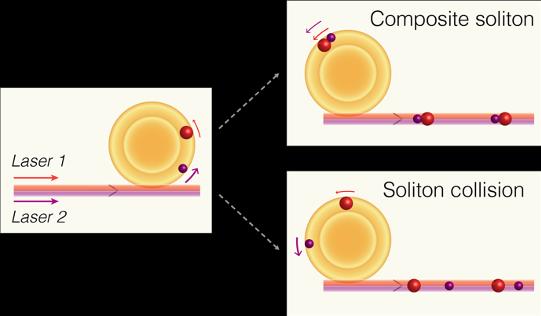
Published in Physical Review X, researchers at Tobias Kippenberg’s lab at EPFL have now developed a novel and effective method for generating soliton collisions in microresonators. The approach uses two lasers to generate two different soliton species – each species has a unique traveling speed – in a crystalline whispering gallery mode resonator.

The researchers input two laser fields in the microresonator, driving two soliton species whose speed mismatch can be flexibly controlled. As a result, solitons with different speeds collide into each other.

Depending on the difference between the solitons’ speeds, different solitons can either bind with each other after they collide or cross each other. Since each collision happens in a very short time, conventional techniques cannot resolve individual soliton behaviors.

Here the researchers used a pulse train produced by high-speed modulators to probe the solitons. The interference between the pulses and the solitons generates electronic signals that can be recorded and analyzed, allowing the researchers to compare the results with theoretical simulations that accurately predict the experimental observations.

This phenomenon shows how robust these solitons in optical microresonators can be. “During the soliton collision an individual soliton’s shape can be significantly distorted, and its energy exhibits dramatic vibrations,” explains Wenle Weng, the paper’s first author. “Yet, they can survive the strong impact from the collision, and they can unite with or disengage from each other after the collision.”

The work introduces a convenient yet powerful platform to study complex soliton interactions and transient nonlinear dynamics. But it can also have help generate synchronized frequency combs and soliton-based optical telecommunications. The collision and binding mechanisms can be utilized to construct frequency combs with unconventional structures for optical metrology, and to enhance the bandwidth of frequency combs in general.

###

Reference

Wenle Weng, Romain Bouchand, Tobias J. Kippenberg. Formation and collision of multistability-enabled composite dissipative Kerr solitons. Physical Review X, 23 April 2020. DOI: 10.1103/PhysRevX.10.021017

Contact

Professor Tobias J. Kippenberg

+41 21 69 34428, +41 21 69 34452

Email: [email protected]

Media Contact
Nik Papageorgiou
[email protected]

Related Journal Article

http://dx.doi.org/10.1103/PhysRevX.10.021017

Tags: Chemistry/Physics/Materials SciencesElectromagneticsMaterialsParticle PhysicsTelecommunications
Share12Tweet8Share2ShareShareShare2

Related Posts

Humans and Zebra Finches Share Similar Speech Learning Techniques #ASA190 — Chemistry

Humans and Zebra Finches Share Similar Speech Learning Techniques #ASA190

May 11, 2026
Unveiling Dark Matter Through Molecular Insights — Chemistry

Unveiling Dark Matter Through Molecular Insights

May 11, 2026

From Touch to Sight: A Bioinspired Multisensory Framework Endows Robots with Human-Like Perception

May 11, 2026

Announcing the 2026 Carbon Future Young Investigator Award Winners

May 11, 2026
Please login to join discussion

POPULAR NEWS

  • Research Indicates Potential Connection Between Prenatal Medication Exposure and Elevated Autism Risk

    841 shares
    Share 336 Tweet 210
  • New Study Reveals Plants Can Detect the Sound of Rain

    728 shares
    Share 290 Tweet 182
  • Salmonella Haem Blocks Macrophages, Boosts Infection

    62 shares
    Share 25 Tweet 16
  • Breastmilk Balances E. coli and Beneficial Bacteria in Infant Gut Microbiomes

    57 shares
    Share 23 Tweet 14

About

We bring you the latest biotechnology news from best research centers and universities around the world. Check our website.

Follow us

Recent News

Humans and Zebra Finches Share Similar Speech Learning Techniques #ASA190

New Study Uncovers How Fungal Parasites Attack Strawberries and Raspberries

City of Hope Researchers to Present Groundbreaking Immunotherapy and Precision Medicine Advances Across Multiple Cancer Types at ASCO 2026

Subscribe to Blog via Email

Enter your email address to subscribe to this blog and receive notifications of new posts by email.

Join 82 other subscribers
  • Contact Us

Bioengineer.org © Copyright 2023 All Rights Reserved.

Welcome Back!

Login to your account below

Forgotten Password?

Retrieve your password

Please enter your username or email address to reset your password.

Log In
No Result
View All Result
  • Homepages
    • Home Page 1
    • Home Page 2
  • News
  • National
  • Business
  • Health
  • Lifestyle
  • Science

Bioengineer.org © Copyright 2023 All Rights Reserved.