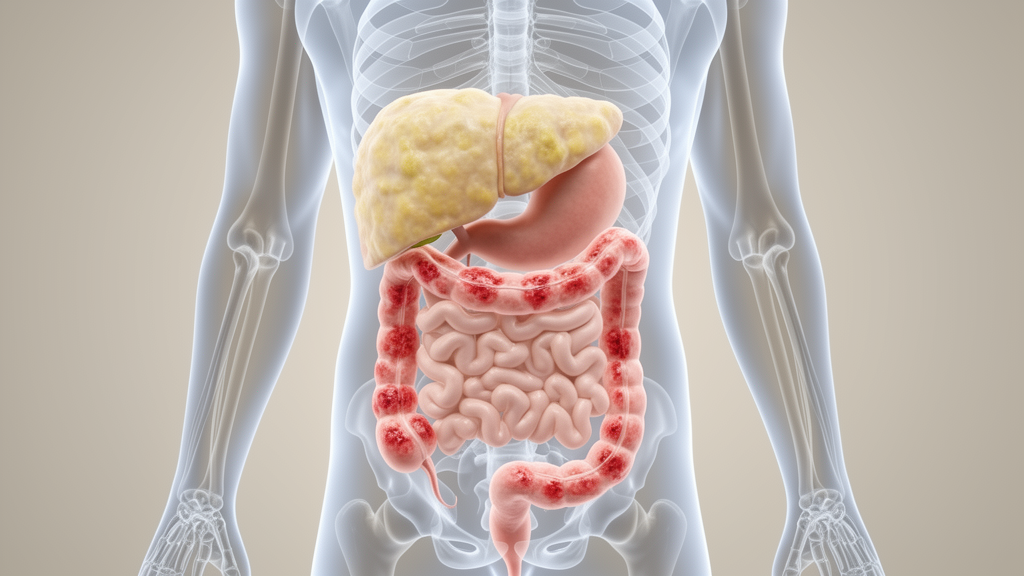
Obese adults with fatty liver disease detected by FibroScan showed a substantial burden of colonic disease in a new cross-sectional study from Ain Shams University Hospitals in Egypt. Among 130 patients examined with full colonoscopy and biopsy analysis, colitis was identified in 40% of the cohort, with moderate colitis the most frequent severity category at 23.08%, mild colitis at 10%, and severe colitis at 6.92%. The remaining 60% of patients had a normal colonic status. The findings, published in the Egyptian Liver Journal, describe the spectrum of inflammatory, precancerous, and malignant lesions observed in this selected group of patients, while the authors caution that the absence of a comparison group means the study cannot establish whether these frequencies differ from those in the general population.
The study enrolled obese adults aged 18 years or older of both sexes between October 2023 and October 2025. Eligibility required a body mass index of at least 30 kilograms per square meter together with central obesity, defined as a waist-to-hip ratio above 0.80 in women and above 0.95 in men. Participants also needed steatosis suggested by FibroScan, elevated liver enzymes, and negative autoimmune and viral markers. Patients were excluded if they were lean with a BMI below 25, had diabetes mellitus, a history of current or past alcohol intake, or positive autoimmune or hepatitis viral markers. Recruitment used a purposive sampling technique, meaning participants were deliberately selected rather than randomly drawn, which the authors note may affect how broadly the results apply.
Every participant underwent a detailed clinical assessment, laboratory investigations, FibroScan with controlled attenuation parameter measurement, complete colonoscopy, and histopathological evaluation of biopsies. The cohort had a mean age of 43.2 years with a standard deviation of 17.09, and 72.31% were male. Mean body mass index was 38.7 kilograms per square meter and the mean waist-to-hip ratio was 0.9. Abdominal pain was the most common symptom, reported by 52.31% of patients, followed by tenesmus at 30% and mucus in stool at 24.61%, while most patients, 60%, had fewer than four bowel motions per day.
The FibroScan measurements indicated a considerable steatotic burden. The mean controlled attenuation parameter value was 256.9 decibels per meter, and steatosis grades were distributed as S1 in 43.07% of patients, S2 in 19.23%, and S3 in 37.69%. Under the grading scheme used, CAP values from 238 to 260 decibels per meter correspond to grade S1 steatosis, reflecting 11% to 33% fatty infiltration of the liver; values from 260 to 290 correspond to grade S2, reflecting 34% to 66% fatty infiltration; and values above 290 indicate grade S3, reflecting 67% or more fatty infiltration. For comparative analysis, patients with grade S1 were classified as having mild hepatic steatosis, while those with grades S2 and S3 were classified as having advanced steatosis.
Laboratory results were consistent with active liver injury. Mean aspartate aminotransferase was 86.9 international units per liter and mean alanine aminotransferase was 118.8 international units per liter, while mean albumin was 4.1 grams per deciliter and mean C-reactive protein was 4.2 milligrams per deciliter. When patients with advanced steatosis were compared with those with mild steatosis, the advanced group had significantly higher AST, at 66.48 versus 36.11 units per liter, higher ALT, at 59.69 versus 29.07 units per liter, and higher alkaline phosphatase, at 110.00 versus 82.17 units per liter, all with P values below 0.001. The authors interpret this pattern as supporting ongoing hepatocellular injury and, to a lesser extent, cholestatic involvement.
The colonoscopic findings added an important dimension to the picture. Normal mucosa was the most frequent endoscopic finding, reported in 60% of patients, while inflamed mucosa was the most common abnormal finding at 30.77%. Mucosal polyps were detected in 10.77% of patients, whereas colonic masses and hemorrhoids were each found in 8.46%. Cecal intubation was achieved in all examinations, and terminal ileum intubation was performed whenever clinically indicated, with full documentation of gross findings and disease extent. Colitis diagnoses rested on a combination of compatible clinical manifestations, colonoscopic findings, and histopathological examination of colonic biopsy specimens, and inflammatory bowel disease diagnoses were established according to accepted clinicopathological criteria after correlating clinical, endoscopic, and histopathological information.
Histopathological examination revealed that nonspecific colitis was the most frequent lesion, affecting 24.6% of patients, followed by low-grade dysplasia in polyps at 8.46%. Benign masses were identified in 6.15% of the cohort. Less frequent but clinically significant diagnoses included ulcerative colitis in 3.84% of patients, Crohn’s disease in 2.31%, high-grade dysplasia in 2.31%, and cancer in 2.31%. In absolute numbers, 11 patients had low-grade dysplasia, 3 had high-grade dysplasia, and 3 had cancer. Biopsy specimens were fixed in 10% buffered formalin, routinely processed, embedded in paraffin, sectioned, and stained with hematoxylin and eosin, and all histopathology was performed by an experienced gastrointestinal pathologist at the university according to standard diagnostic criteria, with relevant clinical information available to the pathologist.
The authors place these observations in the context of a growing body of research linking metabolic liver disease and intestinal inflammation. Obesity is increasingly understood as a state of chronic low-grade inflammation, and clinical studies have associated excess adiposity with gut immune activation, including accumulation of pro-inflammatory intestinal macrophages and changes in circulating monocyte populations. The coexistence of hepatic steatosis and colonic inflammatory findings in this cohort, the authors suggest, may be biologically plausible in view of shared metabolic and inflammatory pathways linking obesity, steatosis, altered gut permeability, endotoxemia, dysbiosis, and activation of the gut-liver axis. They also cite external studies reporting that patients with metabolic dysfunction-associated steatotic liver disease had a significantly increased risk of developing inflammatory bowel disease in large longitudinal cohorts, and meta-analytic data suggesting that fatty liver disease is associated with a moderately increased risk of colorectal adenoma and colorectal cancer.
The study team is careful to spell out what the work does and does not demonstrate. As a single-center cross-sectional study with a relatively limited sample size and purposive sampling, its generalizability is constrained. Most importantly, the absence of a non-obese or non-steatotic control group precluded any assessment of whether the observed frequency of colonic findings was higher than expected in an appropriate comparison population, and the design did not allow estimation of an independent association between hepatic steatosis and colonic pathology. The cross-sectional format also ruled out any assessment of temporal or causal relationships, and the study was not designed to evaluate the effectiveness or clinical benefit of routine colonoscopic screening in this population. The authors call for longer follow-up and adequately controlled prospective studies to address these open questions.
Within those limits, the study offers a detailed characterization of the colonic disease spectrum in a group of obese patients with FibroScan-detected hepatic steatosis, a population in which colonic evaluation is increasingly considered relevant because of reported links between metabolic liver disease and colorectal neoplasia. The primary outcome, the frequency of colitis including inflammatory bowel disease, was 40% in this cohort, and secondary outcomes documented the range of endoscopic and histopathological abnormalities, from nonspecific inflammation through dysplastic polyps to biopsy-proven cancer. The authors conclude that these findings describe the frequency and spectrum of colonic lesions within this selected population and warrant further controlled studies to determine whether they differ from those in appropriate comparison populations, rather than establishing any independent association or screening benefit on their own.
Subject of Research: Colonoscopic and histopathological findings in obese patients with FibroScan-detected hepatic steatosis
Article Title: Colonoscopic and histopathological findings in obese patients with fibroscan-detected hepatic steatosis: a cross-sectional study
Article References: Riad, G. S., Elsakaty, T. M., Raafat, K. M., Ibraheem, I. M., Eldamhogy, Y. N. M., & Youssef, M. G. (2026). Colonoscopic and histopathological findings in obese patients with fibroscan-detected hepatic steatosis: a cross-sectional study. Egyptian Liver Journal, 16(1), Article 70. https://doi.org/10.1186/s43066-026-00557-w
Image Credits: AI Generated
DOI: 10.1186/s43066-026-00557-w
Keywords: hepatic steatosis, obesity, colitis, colonoscopy, FibroScan, inflammatory bowel disease, MASLD, colorectal cancer, dysplasia, cross-sectional study, liver enzymes, gut-liver axis
News Source: Ophelia Keating. (October 29, 2026). Colitis and Colon Lesions Found in 40% of Obese Patients with Liver Steatosis. Scienmag.