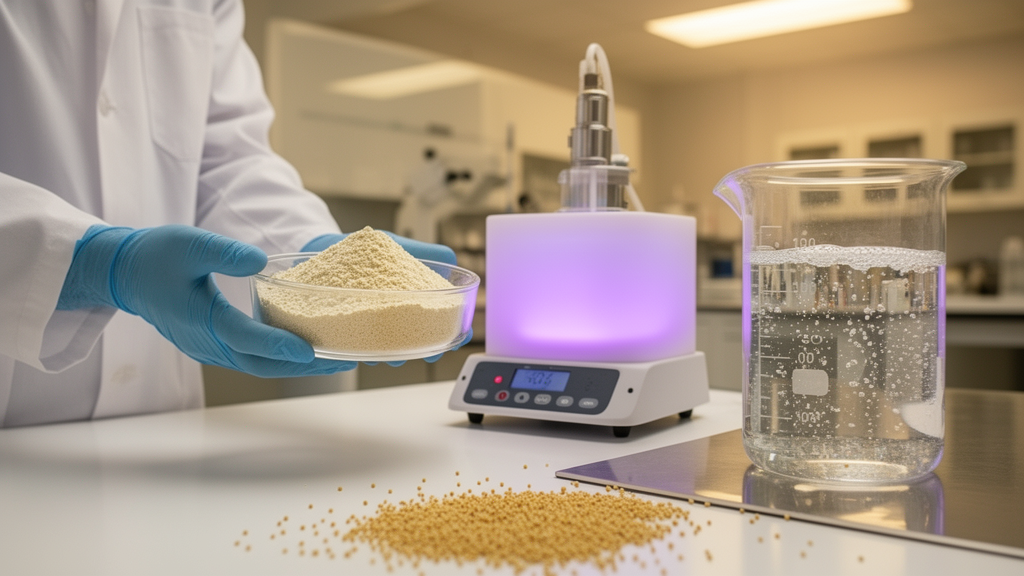
In a laboratory study published in the journal Agricultural Products Processing and Storage, researchers report that a sequential treatment combining cold plasma exposure of the grain, tempering with plasma-activated water, and a final cold plasma pass on the milled flour reduced Salmonella by 3.0 log cycles at the most intense condition tested, 28 kilovolts for 60 minutes per step. The finding matters because pearl millet flour, increasingly marketed worldwide as a nutrient-dense gluten-free cereal, is frequently contaminated through unhygienic postharvest handling, and the conventional heat-based fixes come with nutritional trade-offs.
The study, carried out by Bindusri Naraharasetti, Snehasis Chakraborty, Kaliramesh Siliveru and P. V. Vara Prasad, framed pearl millet as a crop worth protecting. The grain thrives in harsh, arid environments, which makes it climate-resilient at a time when agriculture faces mounting pressure, and its nutritional profile is substantial: 2.7 to 7.1 percent fat, 8.5 to 15.1 percent protein and 58.5 to 72.5 percent carbohydrates, along with omega-3 fatty acids and a broad amino acid spectrum including phenylalanine, leucine, isoleucine, threonine, glutamic acid, aspartic acid, proline and alanine. The Food and Agriculture Organization declared 2023 the International Year of Millets to highlight exactly this potential, and market analysts cited in the paper put the global millet flour market at roughly USD 5.4 billion in 2025, growing at 5.9 percent.
That commercial growth collides with a persistent contamination problem. The authors cite surveys showing that pearl millet flour can carry Staphylococcus aureus at 3.32 to 5.67 log CFU per gram, Bacillus cereus at 7.18 to 10.25 log CFU per gram, Escherichia coli at 2.13 to 6.08 log CFU per gram, fungal loads of 2.84 to 8.25 log CFU per gram and enterobacteria at 3.02 to 3.50 log CFU per gram. Consuming contaminated flour can cause food intoxication and food poisoning. Salmonella was chosen as the target organism for the new work because it is a recognized hazard in low-moisture cereal products, is relatively resistant, and has been implicated in flour-linked outbreaks, including one tied to contaminated wheat flour that produced 12 illnesses and 3 hospitalizations. The logic is that if a treatment can subdue a hardy pathogen like Salmonella, less resistant organisms should fall as well.
Existing interventions for pearl millet flour are mostly thermal, and each carries costs. Hot water blanching at 98 degrees Celsius for 30 seconds reduced aerobic mesophiles, yeast and coliforms by 4.45, 4.14 and 4.47 log cycles respectively in earlier work, and steaming at 100 degrees Celsius for 20 minutes cut coliforms and aerobic mesophiles by 5.38 and 4.71 log cycles. Roasting grains at 180 degrees Celsius reduced aerobic mesophiles by 4.69 log CFU per gram, while a rotary dryer at 150 to 170 degrees Celsius managed only a 0.28 log reduction of fungi. Ultrasound achieved reductions of roughly 4.5 to 4.8 log cycles across microbial groups. But heat degrades heat-sensitive nutrients such as lysine, methionine and phenolics, darkens the flour and imparts a cooked flavor, which is why the researchers turned to atmospheric cold plasma, a non-thermal technology that generates reactive radical species, including excited ions, atoms and electrons, that attack microbial cells on food surfaces.
The experimental design was deliberately layered. Pearl millet grain purchased in Mumbai, India was inoculated with a cocktail of four Salmonella strains, Newport, Typhimurium, Kentucky and Enterica, at roughly 9 log CFU per gram, a deliberately high load chosen to demonstrate the level of inactivation. The team then applied a full factorial design across two variables, root mean square voltage of 20, 25 or 28 kilovolts and exposure times of 20, 40 or 60 minutes, using a multipin-plane plasma reactor operating in batch mode under atmospheric air. Three treatment stages were defined: treatment A, cold plasma applied directly to the grain; treatment B, tempering the grain to 16 percent moisture with plasma-activated water generated by exposing distilled water to the same plasma conditions; and treatment C, cold plasma applied to the milled flour. Every combination of individual, pairwise and three-way treatments was tested, with three replications and analysis of variance at a significance level of 0.05.
The individual results revealed a clear hierarchy. Cold plasma treatment of the grain alone peaked at a 1.40 log reduction at 28 kilovolts for 60 minutes, with lower voltages and shorter times producing far smaller effects; at 20 kilovolts, brief exposures did not significantly reduce Salmonella. Tempering with plasma-activated water alone was the weakest link, achieving only 0.18 to 0.39 log reductions across conditions, apparently because reactive species saturated at lower voltages. Cold plasma on the flour reached 1.20 log at 28 kilovolts for 60 minutes and showed a biphasic inactivation pattern, a rapid kill of susceptible cells followed by a slower, resistant phase. Interestingly, grain treatment outperformed flour treatment even though plasma is a surface technology that cannot penetrate the kernel, because flour agglomerates and its high surface area shields microbes, demanding longer exposure.
Combining the steps changed the arithmetic substantially. Grain plasma plus water tempering, A plus B, peaked at 1.70 log at 28 kilovolts for 40 minutes, while water tempering followed by flour plasma, B plus C, was the weakest combination at 1.6 log maximum. The strongest pairwise pairing was direct plasma on both grain and flour, A plus C, which reached 2.60 log at 28 kilovolts for 60 minutes, and notably delivered reductions of 1.41 to 1.67 log at milder conditions such as 25 kilovolts for 60 minutes. The full sequence, A plus B plus C, scaled from 0.56 log at the gentlest condition to the headline 3.00 log reduction at 28 kilovolts for 60 minutes. The mechanism, the authors explain, involves reactive nitrogen species such as nitrite, nitrate and nitric oxide and reactive oxygen species such as ozone, hydroxyl radicals and atomic oxygen, which break peptidoglycan bonds, initiate lipid oxidation and damage membrane proteins, while the acidic plasma-activated water, with a pH of 2.05 to 2.78, imposes oxidative stress that lowers intracellular pH and kills cells.
Quality consequences divided cleanly along the tempering line. For treatments that involved only cold plasma, whether on grain alone or grain plus flour, the bulk, true and tapped densities, geometric mean diameter, protein and ash content of the flour were statistically unchanged, though moisture content and water activity dropped, from about 11.4 to 11.1 percent and 0.37 to 0.35 respectively, because plasma breaks water molecules into oxygen-free radicals. Color was likewise unaffected. The full A plus B plus C sequence was different: true, bulk and tapped densities fell to 1,468.7, 522.2 and 573.2 kilograms per cubic meter, the geometric mean diameter rose from about 250 to 284.3 micrometers as moisture formed liquid bridges between particles, and the flour became lighter and less red and yellow, with the L* value climbing from 74.26 to 76.91. The authors note that a lighter flour is actually preferred for baked products, and that lower density can improve flowability during packing, but the elevated moisture of 15.7 percent and water activity of 0.69 could accelerate enzymatic deterioration during shelf life.
The researchers are candid about the limits. A 3-log reduction falls short of the 5-log target that high-inoculation challenge studies often aim to demonstrate, the work was done at laboratory scale with a batch reactor, and the combination treatment is time- and energy-consuming compared with single passes. Protein and ash were preserved across all conditions, which is the core advantage over heat, but the team flags that pasting and baking properties, particle microscopy and overall quality attributes remain unexamined, as does efficacy against pathogens other than Salmonella and the question of whether resistance develops under prolonged high-voltage exposure. They position the study as a guide for developing practical, scalable processing stages rather than a finished industrial protocol, with optimization of time, cost and operational efficiency still ahead.
Even so, the paper adds a concrete data point to a sparse literature. Prior cold plasma studies on other cereals reported 1.5 to 2.5 log reductions of bacteria and fungi on wheat at 80 kilovolts and more than 1.5 log on brown rice at 20 kilovolts for 10 minutes, while an earlier pearl millet study claimed larger reductions against mixed natural flora at much lower voltage. By systematically decomposing where in the milling chain plasma does its work, on the grain surface rather than in the flour, and by quantifying the modest contribution of plasma-activated water tempering, the new study gives millers and food safety engineers a map of which sequence to optimize. As millet flour moves from regional staple to global commodity, the gap between a 3-log laboratory reduction and a commercially validated kill step is exactly the distance future work will have to close.
Subject of Research: Cold plasma and plasma-activated water tempering for Salmonella inactivation in pearl millet flour
Article Title: Cold plasma treatment as an intervention strategy to achieve safety in pearl millet flour
Article References: Naraharasetti, B., Chakraborty, S., Siliveru, K., & Prasad, P. V. V. (2026). Cold plasma treatment as an intervention strategy to achieve safety in pearl millet flour. Agricultural Products Processing and Storage, 2(1), Article 46. https://doi.org/10.1007/s44462-026-00080-6
Image Credits: AI Generated
DOI: 10.1007/s44462-026-00080-6
Keywords: cold plasma, pearl millet flour, Salmonella, plasma-activated water, food safety, non-thermal processing, grain tempering, microbial inactivation, flour quality, reactive oxygen species, cereal processing, foodborne pathogens
News Source: Daisy Hatcher. (October 28, 2026). Cold Plasma and Activated Water Cut Salmonella in Pearl Millet Flour. Scienmag.