


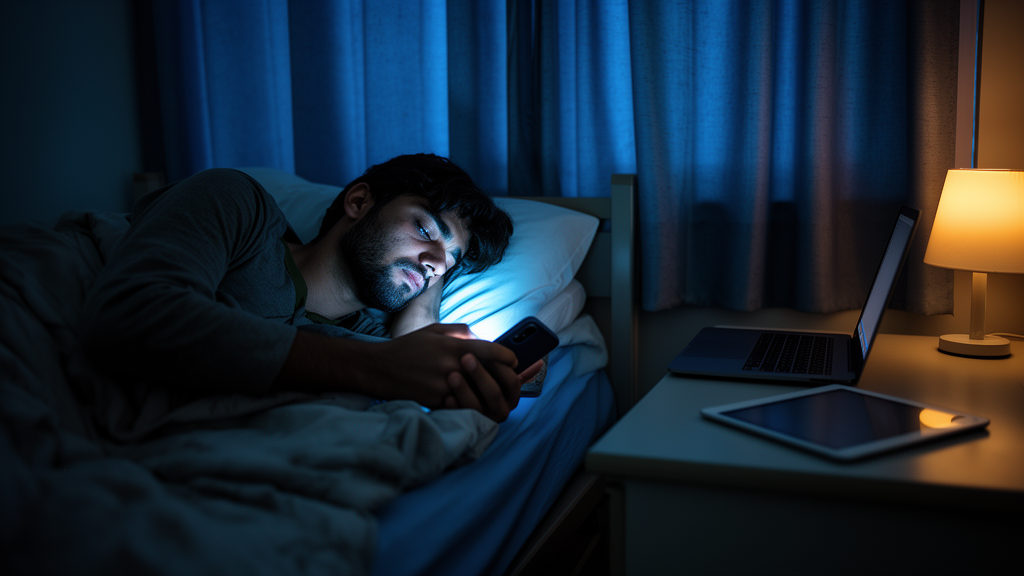
University students in Lahore, Pakistan, spend an average of more than eight hours a day looking at screens, and the overwhelming majority of them are sleeping badly, according to a cross-sectional study published in BMC Public Health. Among 618 students surveyed between June and November 2025, 93.7 percent scored in the poor-sleep range on a validated sleep questionnaire, and the amount of time spent on digital devices emerged as a key factor distinguishing those who slept worst from those who slept somewhat better. The research team, led by Nida Bokharee and colleagues, measured screen time objectively using the Stay Free application installed on participants' phones, rather than relying solely on self-report.
Participants had a mean age of 23.56 years, with a standard deviation of 4.83, and 83.2 percent were undergraduates. The numbers are striking. Mean daily screen time came to 8.23 hours, with a standard deviation of 1.81 hours, while mean sleep duration was just 4.95 hours, with a standard deviation of 1.01 hours.
The researchers divided screen time into three categories: low, defined as less than six hours per day; moderate, six to eight hours; and high, more than eight hours. When the team cross-tabulated these categories against sleep quality using Fisher's exact test, the association was highly significant, with a p-value below 0.001. The relationship also followed a dose-response pattern.
In adjusted logistic regression, students in the low screen-time group had dramatically lower odds of poor sleep than those in the high group, with an adjusted odds ratio of 0.006, while the moderate group also showed reduced odds, with an adjusted odds ratio of 0.197 and a p-value of 0.039. In other words, the more time students spent on screens, the more likely they were to report poor sleep. Two other independent predictors stood out.
Sleep duration itself carried an adjusted odds ratio of 42.540 for poor sleep quality, and obesity carried an adjusted odds ratio of 12.097 with a p-value of 0.010. The authors also report a positive Spearman correlation of 0.527 between sleep duration and subjectively poorer sleep quality, significant at p below 0.001. Because the study is cross-sectional, it captures associations at a single point in time and cannot establish that screen time causes poor sleep; reverse causation, in which students who cannot sleep turn to their devices, remains a plausible alternative explanation.
Gender differences were also evident. Females were significantly less likely than males to fall into the high screen-time category, with a chi-squared statistic of 30.551 on two degrees of freedom and a p-value below 0.001. Beyond sleep, the survey documented a cluster of physical complaints that students attributed to prolonged device use.
Headache was the most common, reported by 71.7 percent of participants, followed by fatigue at 62.6 percent, dry eyes at 49.0 percent and eye strain at 37.9 percent. Its limitations are those inherent to the design: a single city, a convenience of university students rather than the general population, and reliance on cross-sectional data that preclude causal inference. The modified PSQI scoring also means the results may not be directly comparable to studies using the standard instrument.
Nevertheless, the scale of the sleep problem in this cohort is hard to ignore. The authors argue that their findings underscore the need for interventions promoting healthier digital habits, better sleep education and broader lifestyle improvements on campuses. Future longitudinal and experimental studies will be needed to determine whether reducing screen time actually improves sleep, but this study provides a detailed baseline showing just how common heavy device use and poor rest have become in this population.
Subject of Research: Association between screen time and sleep quality among university students in Lahore, Pakistan
Article Title: Association between screen time and sleep quality among university students in Lahore, Pakistan: a cross-sectional study
Article References: Bokharee, N., Ahsan, F., Habibullah, F., Faiz, A., Saeed, A., Shabbir, U., & Waheed, I. (2026). Association between screen time and sleep quality among university students in Lahore, Pakistan: a cross-sectional study. BMC Public Health. https://doi.org/10.1186/s12889-026-29451-1
Image Credits: AI Generated
DOI: 10.1186/s12889-026-29451-1
Keywords: screen time, sleep quality, university students, Pakistan, cross-sectional study, Pittsburgh Sleep Quality Index, sleep duration, digital devices, public health, obesity, eye strain, headache
News Source: Ophelia Keating. (October 28, 2026). Screen Time and Sleep: Pakistani Students Show Heavy Device Use, Poor Rest. Scienmag.



